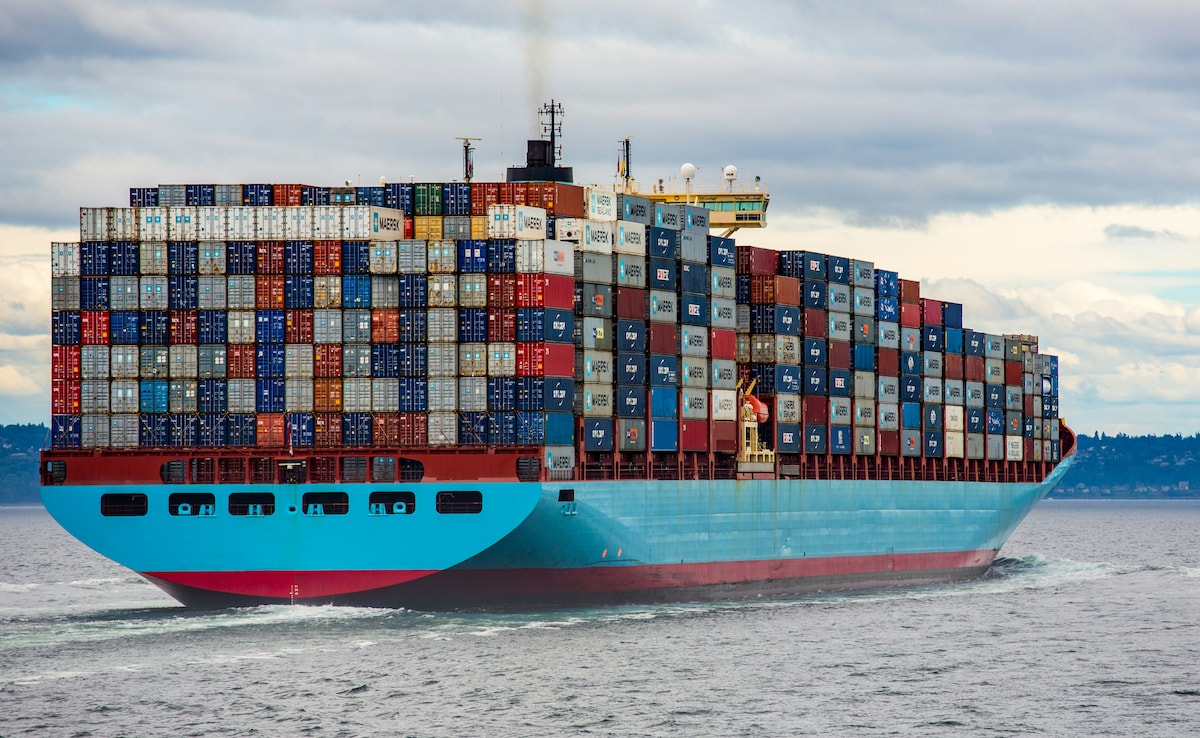
The interception of the container vessel SELEN in the Strait of Hormuz on Wednesday was not a simple clerical error. While the official line from Tehran cites a "lack of permission" and "failure to comply with legal protocols," the timing suggests a far more calculated move by the Islamic Revolutionary Guard Corps (IRGC). The ship, bound for Karachi from the United Arab Emirates, was forced to reverse course at the very moment Pakistan’s leadership was attempting to position itself as a neutral mediator in the escalating conflict between Iran, the United States, and Israel. This was a message delivered in steel and salt water.
Iran has effectively transformed the world's most vital energy chokepoint into a private gated community. By turning back a vessel destined for a "friendly" neighbor like Pakistan, Tehran is demonstrating that no one—not even potential allies or self-appointed peace brokers—crosses the 21-mile-wide passage without explicit, case-by-case coordination with the IRGC Navy.
Sovereignty as a Protection Racket
For decades, the Strait of Hormuz operated under the principle of transit passage, a concept in international law that allows ships to move through territorial waters of coastal states for the purpose of continuous and expeditious navigation. That era is dead. Tehran recently informed the International Maritime Organization (IMO) that "non-hostile" vessels must now coordinate directly with Iranian authorities to benefit from safe passage.
This coordination is increasingly looking like a financial and political toll. Reports have surfaced of a "Tehran Toll Booth" where some commercial vessels are allegedly being asked to pay transit fees reaching $2 million for the privilege of not being fired upon or seized. The SELEN, a small feeder ship flying the flag of St. Kitts and Nevis, likely lacked the high-level diplomatic cover or the specific financial "coordination" required to navigate these new, unofficial rules.
The Mediation Paradox
The irony of the SELEN incident is sharp. Only days ago, Pakistani Prime Minister Shehbaz Sharif and Army Chief Asim Munir were engaging in high-stakes diplomacy with both Donald Trump and Iranian President Masoud Pezeshkian. Pakistan offered to host peace talks, seeking to leverage its long-standing ties with Tehran and its renewed engagement with Washington.
By stopping a Karachi-bound ship, Iran is signaling that it does not want a mediator; it wants a witness to its control. The IRGC's actions serve to undercut the civilian government in Tehran, showing that while diplomats may talk of peace and "friendly states," the military branch holding the keys to the Strait determines who eats and who starves. Pakistan relies heavily on seaborne trade, and this disruption serves as a blunt reminder of Islamabad's vulnerability.
A Selective Blockade
Iran’s strategy is no longer a total blockade, which would invite an overwhelming military response from the U.S. Fifth Fleet. Instead, it is a selective blockade.
- Allied Passage: Vessels from China and Russia, or those carrying Iranian oil in the "shadow fleet," continue to move with relative ease.
- The Yuan Incentive: There are credible reports that Iran is prioritizing tankers whose cargo is traded in Chinese yuan, further distancing the region's economy from the U.S. dollar.
- The Hostility Filter: Any ship with even a tenuous link to U.S. or Israeli ownership is effectively banned, often facing drone or missile strikes if they attempt the crossing.
The SELEN fell into a gray zone. It wasn't a "hostile" ship in the traditional sense, but it hadn't jumped through the IRGC’s hoops. In this new maritime order, silence or neutrality is no longer a shield. Every transit is an act of political submission.
Global Markets and the New Status Quo
The economic fallout is already visible. While global oil prices fluctuate based on Donald Trump's social media posts, the reality on the water is that insurance premiums for the Gulf have become prohibitive for many smaller operators. Large shipping firms like Maersk have already suspended various routes in the region.
The disruption of the SELEN is a micro-event with macro-consequences. When a regional power can stop a neighbor’s cargo ship over a "protocol violation," the predictability required for global trade evaporates. We are witnessing the normalization of a "pay-to-play" system in international waters.
The United States has so far avoided direct kinetic intervention to reopen the Strait, opting instead for targeted strikes on Iranian infrastructure and attempting to maintain a flow of Iranian oil to keep global supplies stable. This "Open for All or Closed to All" dilemma is the central challenge for the current administration. If the U.S. allows Iran to continue hand-picking which ships pass, it essentially concedes sovereignty of the Strait to the IRGC.
The SELEN has returned to anchorage, but the precedent remains. If you want to move goods through the Strait of Hormuz in 2026, you don't look to international law. You look to Tehran, and you make sure your paperwork—and perhaps your bank transfer—is in order before you hit the horizon.