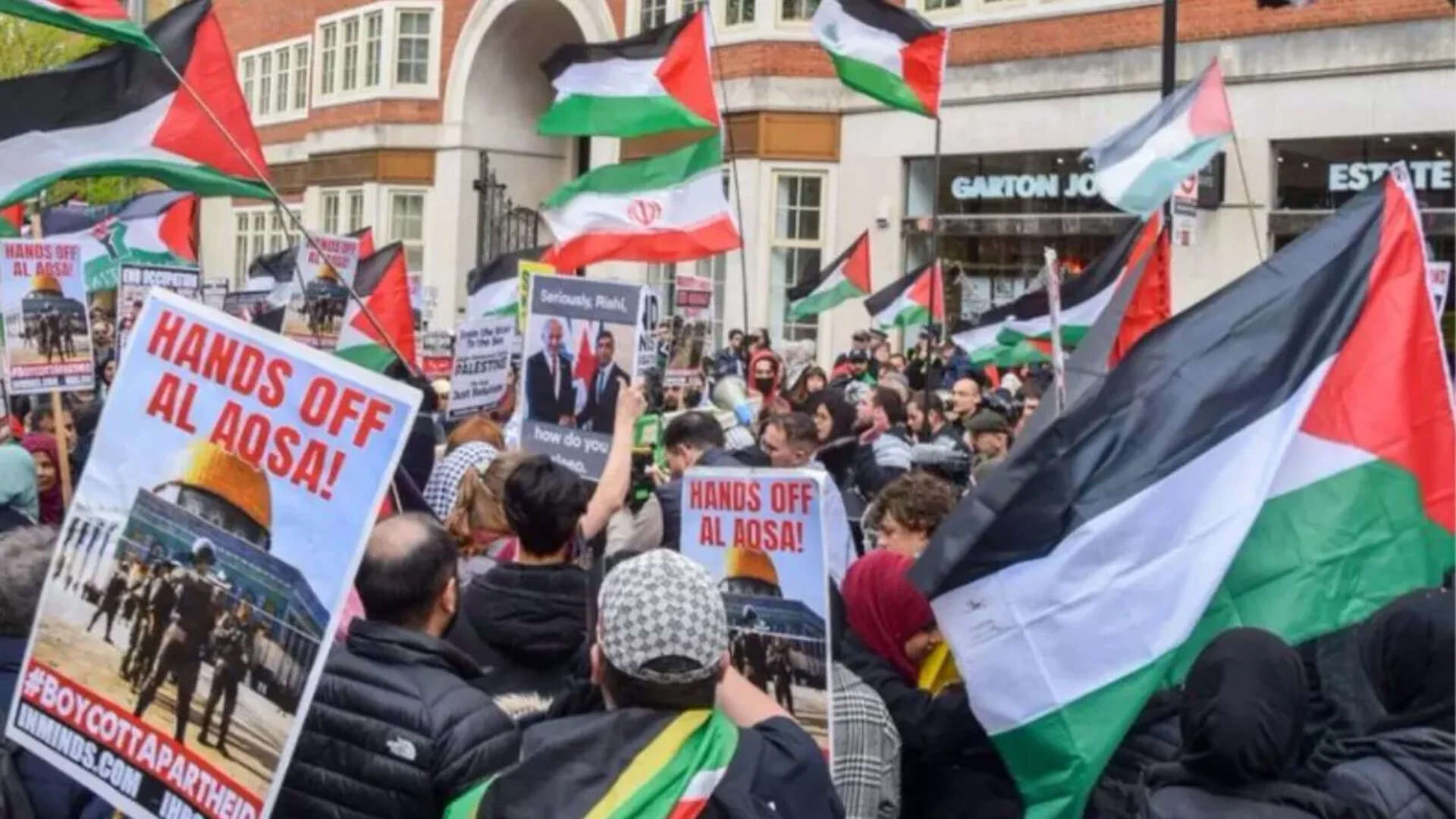
The headlines are predictable. They focus on the banners, the shouting, and the aesthetics of the outrage. If you read the standard reporting on the Al-Quds Day rallies in London, you are led to believe this is a localized security problem or a simple clash of "values" on a Saturday afternoon.
You are being fed a surface-level narrative. For a deeper dive into similar topics, we recommend: this related article.
The media focuses on the "Death to" chants and the posters of Ayatollah Khamenei because they are easy to film. They are visceral. They trigger an immediate, emotional response. But if you are focusing on the optics, you are missing the structural reality of what is happening on the streets of the UK. This isn't just a protest; it is a live-fire exercise in soft power and asymmetric influence that the West is currently losing because it refuses to define the terms of the engagement.
The Lazy Consensus of "Radicalization"
Most analysts look at these rallies and scream about radicalization. They treat it like a virus that people "catch" by standing too close to a megaphone. This is a fundamental misunderstanding of how political influence works in a globalized city. For broader details on the matter, in-depth coverage can also be found on Reuters.
What you saw in London wasn't a spontaneous eruption of anger. It was a disciplined projection of state-backed ideology. Al-Quds Day was established by Iran in 1979. It is a specific, exported political product. When the press treats it as a mere "protest," they grant it the domestic protection of "civil liberties" while ignoring that it functions as an extension of a foreign state’s foreign policy.
Stop asking "Why are they allowed to march?" and start asking "Who is organizing the logistics?"
In my years tracking how fringe movements migrate into the mainstream, I have seen billions of dollars in "security theater" wasted on monitoring the wrong people. We watch the guy with the loudest sign. We ignore the entities providing the funding, the legal cover, and the digital infrastructure that makes the rally possible.
The Myth of the "London Bubble"
There is a comforting lie told by pundits that these events are isolated to a few blocks in Westminster. They suggest that if we just ignore them, they stay there.
They don't.
These rallies serve as content farms for global digital consumption. A three-minute clip of a confrontation with the Metropolitan Police is worth more to a propaganda machine in Tehran or Doha than a thousand white papers. The "London" part of the Al-Quds rally is irrelevant to the organizers. The backdrop of Big Ben is just a high-value production asset.
When you see a protester waving a poster of a foreign autocrat, they aren't trying to convince a Londoner to change their vote. They are signaling to a global audience that the "Heart of the West" is contested territory. It is a psychological operation disguised as a march.
Why the "Police Reform" Argument Fails
Whenever these rallies happen, the "People Also Ask" section of the internet fills up with questions about why the police don't "do more."
The premise is flawed. You cannot fix a civilizational friction point with better policing tactics.
The Metropolitan Police are trapped in a pincer movement. If they intervene aggressively, they provide the "oppression" narrative the organizers crave. If they stand back, they appear weak to the domestic population. This is a classic "no-win" scenario engineered by those who understand the liberal democratic legal framework better than the people who wrote it.
Laws like the Public Order Act are designed for domestic labor disputes or local grievances. They are not equipped to handle a protest that is essentially a franchise of a foreign revolutionary movement. Trying to solve this with "better training" for beat officers is like trying to stop a flood with a mop.
The Identity Trap
The competitor articles love to frame this as a religious conflict. It isn't. It is an identity-politics hijack.
By tying the Al-Quds narrative to broader themes of anti-imperialism and social justice, the organizers have successfully insulated themselves from criticism. If you attack the rally, you are accused of attacking a marginalized group. This is the "shield" strategy.
I have seen this play out in corporate boardrooms and international summits: an aggressive agenda adopts the language of the vulnerable to bypass the defenses of the majority. It is brilliant, it is cynical, and it is working.
The "nuance" the media misses is that many of the people at these rallies aren't even there for the theology. They are there for the sense of belonging that the host culture has failed to provide. We are seeing the consequences of a vacuum. If you don't give people a coherent national identity to buy into, they will import one from five thousand miles away.
The Hard Truth About Free Speech
Here is the part where I lose the partisans: You cannot ban your way out of this.
The moment you ban the Al-Quds rally, you drive the infrastructure underground where it becomes even harder to track. You also create a precedent that will eventually be used against the very people currently calling for the ban.
The solution isn't more censorship; it is more clarity.
- Follow the Money: Stop obsessing over what is on the posters and start auditing the charities and "community centers" that organize the buses.
- End the "Neutrality" Pretense: The government needs to stop treating these events as domestic disagreements and start treating them as foreign influence operations.
- Challenge the Narrative: Where is the counter-messaging? If the only group providing a sense of "justice" to young, alienated men is a group chanting "Death to" a foreign military, then the state has already abdicated its primary responsibility.
The Cognitive Dissonance of the West
We live in a bizarre reality where we worry about "foreign interference" in our elections via Facebook ads, yet we watch thousands of people carry the literal icons of foreign regimes through our capital city and call it "diversity."
This is not a failure of law; it is a failure of nerve.
The Al-Quds rally is a stress test for the UK's social fabric. Every year, the test gets harder, and every year, the response remains a mix of panicked hand-wringing and "business as usual" complacency.
If you think this is about a strip of land in the Middle East, you are the mark. This is about who owns the streets of Europe, who controls the narrative of "justice," and whether a liberal society has the stomach to defend its own borders—both physical and ideological.
Stop looking at the posters. Start looking at the power dynamics.
The protesters aren't there to change your mind. They are there to show you that your mind no longer matters.
Decide if you are okay with that.