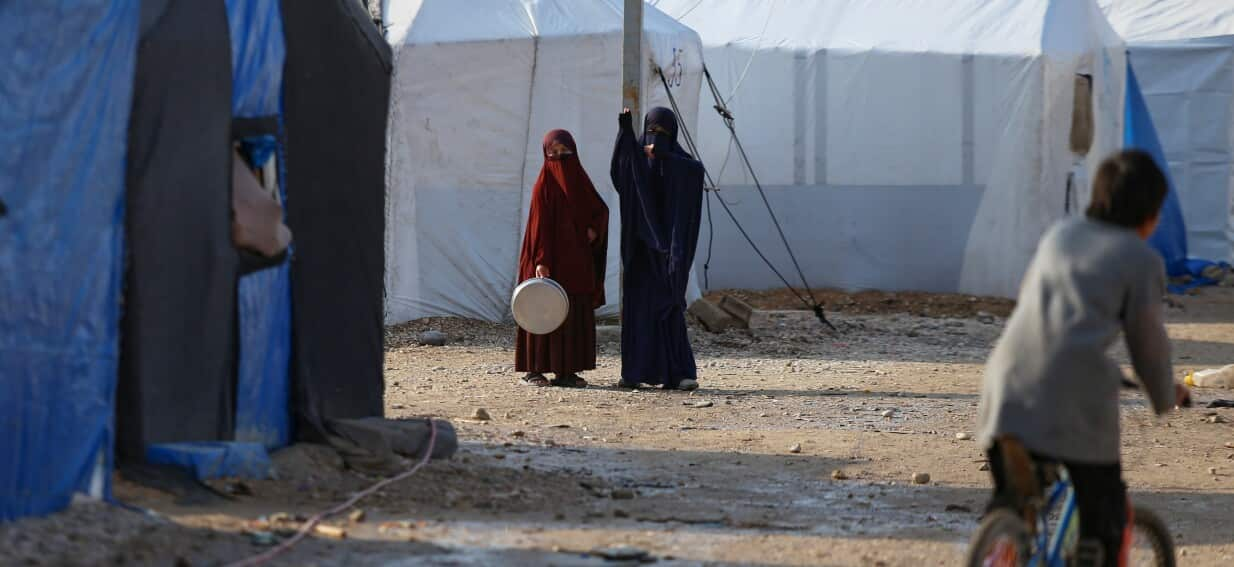
The stability of the post-ISIL Levant is currently predicated on a logistical and political impossibility: the permanent containment of a displaced population within a legal and geographic vacuum. Specifically, the Al-Hol and Roj camps in Northeast Syria do not function as humanitarian waystations but as high-density incubation environments for ideological persistence. The failure of the international community to execute a systematic repatriation strategy is not merely a diplomatic oversight; it is a failure to account for the Decay Rate of De-radicalization. As the duration of internment increases, the probability of successful reintegration decreases exponentially, while the risk of generational militant contagion becomes a mathematical certainty.
The Three Pillars of Generational Radicalization
To understand why the current containment model is failing, we must analyze the environment through a structural lens. The radicalization process in these camps is driven by three intersecting vectors that create a closed-loop system of extremist reinforcement.
1. The Information Monoculture
In an environment where the Governing Authority (the Syrian Democratic Forces or SDF) is viewed as an adversarial occupier, the internal social hierarchy of the camps is ceded to the most organized and aggressive elements. Without external intervention or a diverse influx of moderate information, the ISIL-linked "Hisbah" (morality police) enforces an ideological monoculture.
Children born into or raised within this vacuum do not have a "pre-radical" state to return to. Their developmental baseline is the ideology of the caliphate. This creates a Permanent Extremist Baseline, where the lack of formal education is replaced by informal, militant indoctrination.
2. The Economic Dependency Paradox
The camps rely entirely on international aid for survival. This creates a psychological dependency on a system that the residents are simultaneously taught to despise. When aid is insufficient—due to funding gaps or security bottlenecks—the extremist leadership within the camp fills the void through smuggling and black-market activities. This positions the radical elements as the sole providers of "security" and "prosperity," effectively mirroring the governance model ISIL used to seize territory in 2014.
3. The Legal Liminality Gap
The residents of these camps exist in a state of legal non-existence. They are neither prisoners of war with defined rights nor refugees with a path to asylum. This liminality is the primary recruitment tool for extremist agitators. They frame the lack of repatriation as a betrayal by the "apostate" home nations, proving that the only entity that values these individuals is the defunct Caliphate. The longer a state refuses to reclaim its citizens, the more it validates the extremist narrative of Western abandonment.
The Cost Function of Delayed Repatriation
The reluctance of Western and regional governments to repatriate their citizens is often framed as a security measure. However, a cold-eyed risk assessment reveals that the Deferred Cost of Inaction far outweighs the immediate security risk of controlled repatriation.
The Security Dilution Effect
The SDF, which guards these facilities, is a non-state actor with finite resources. Every month that the population remains in Al-Hol, the "guard-to-detainee" ratio becomes more precarious. As regional tensions fluctuate—particularly with Turkish military operations or Syrian regime movements—the security perimeter of these camps degrades. A single coordinated breakout or a regional shift in power could release thousands of radicalized individuals into a stateless environment simultaneously. This is the Mass-Escape Volatility that intelligence agencies are currently discounting.
The Data Atrophy Problem
Security services currently have a "warm" trail on many of the individuals in these camps. They have biometric data, records of movement, and familial links. However, as children age and identities shift within the camp’s informal systems, this data becomes obsolete. By refusing to repatriate now, governments are ensuring that when these individuals eventually leave—whether through escape, release, or the collapse of the SDF—they will do so as "ghosts" with no digital or forensic footprint, making them significantly harder to track in the future.
Mechanistic Failure of the "Wait and See" Strategy
The current global strategy is a reactive posture based on the hope that the problem will remain localized. This ignores the Leaking Perimeter Principle. No containment facility is 100% hermetic.
- Smuggling Corridors: Financial networks continue to funnel money into the camps via Hawala systems. This capital is used to bribe guards and facilitate the escape of high-value targets.
- External Radicalization: The plight of those in the camps is used as propaganda to radicalize individuals in the home countries. The "suffering" of the women and children in Al-Hol serves as a powerful recruitment tool for the next generation of domestic terrorists.
- The Martyrdom Narrative: If the camps are allowed to descend into famine or disease, the resulting deaths are not viewed as a humanitarian tragedy by the extremist core, but as a sacrifice that justifies future retaliatory violence.
Optimization of the Repatriation Pipeline
A rigorous strategy requires moving away from the binary of "all or nothing" repatriation. Instead, we must apply a Tiered Risk-Mitigation Framework to process the population.
Phase I: Forensic Identification and Categorization
The first step is a technical audit of the camp population to distinguish between three distinct cohorts:
- Active Enforcers: Individuals holding leadership roles within the camp's ideological structure.
- The Indoctrinated Majority: Individuals who adhere to the ideology but lack operational capability.
- The Vulnerable/Minors: Individuals whose primary risk factor is their environment rather than their personal agency.
Phase II: The Jurisdictional Handover
Nations must stop viewing repatriation as a humanitarian favor and start viewing it as a legal obligation under the Principles of Sovereign Accountability. By bringing citizens home, states regain the legal authority to monitor, prosecute, or rehabilitate them. Within the borders of a functioning state, security services can utilize the full suite of surveillance and parole mechanisms that are impossible to execute in a Syrian desert camp.
Phase III: The De-radicalization Buffer
Repatriation should not lead directly to reintegration. The model should involve a "Buffer Zone"—specialized facilities in the home country where individuals undergo psychological and ideological deconstruction. This allows for a controlled transition while maintaining public safety.
The Strategic Recommendation
The current containment model is an interest-bearing debt of security risk. Every day of delay adds to the "principal" of radicalization. The only logical path forward is the aggressive, systematic liquidation of the Al-Hol and Roj populations through national repatriation.
Governments must prioritize the extraction of minors and women who are not currently in leadership roles to break the generational cycle of the Caliphate. This is not a matter of compassion; it is a matter of Long-term Threat Neutralization. Failure to act ensures that in ten years, the international community will face a highly trained, deeply traumatized, and ideologically hardened force that was built entirely within the walls of an internationally funded facility. The tactical move is to dissolve the camps before they become the foundation of the next global insurgency.
Establish bi-lateral task forces to begin the phased extraction of the lowest-risk cohorts immediately. Use the current window of relative SDF stability to execute these moves before the regional geopolitical landscape shifts and the opportunity for controlled transition is lost forever.