In the small, sun-drenched town of Estepa, the harvest isn’t just a seasonal event. It is a pulse. Here, the air smells of crushed olives and dust, a scent that has defined the region’s soul for centuries. For a family-run cooperative in Andalusia, the news coming out of Washington and Madrid this week didn't feel like "geopolitics." It felt like a ghost at the dinner table.
Imagine a farmer named Manuel. He doesn't care much for the soaring rhetoric of prime ministers or the thunderous social media posts of American presidents. What he cares about is the 25% tariff already eating his margins—and the terrifying prospect of that number jumping to 100%. If the United States follows through on a full trade embargo, Manuel’s liquid gold becomes a lead weight.
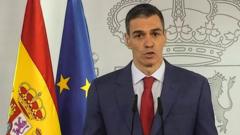
The dispute started as a spark across the Atlantic and has now ignited into a bonfire. Donald Trump’s threat of a total trade embargo on Spain is a blunt instrument designed to force compliance on a dozen different fronts, from defense spending to digital taxes. But the response from Madrid was uncharacteristically sharp. Pedro Sánchez did not offer the usual diplomatic platitudes. He leaned into the microphone and spoke of sovereignty.
The Invisible Wall
Trade is often discussed in the abstract, as if it were a game of Risk played on a mahogany table. In reality, it is a web of millions of tiny, fragile threads. When a leader threatens an embargo, they aren't just shifting a decimal point on a balance sheet. They are threatening to sever the thread that connects a shoemaker in Elche to a boutique in Manhattan.
The tension has reached a boiling point because of a fundamental clash of philosophies. On one side, you have an American administration that views trade as a zero-sum battleground. On the other, a Spanish government trying to navigate a European identity that prizes multilateralism and "soft power."
Sánchez’s "No to war" stance isn't just about military intervention. It is a refusal to participate in an economic conflict that he believes will hollow out the middle class on both sides of the ocean. He is betting that the world is too interconnected to be torn apart by a single signature on an executive order.
Is he right?
History suggests that when the giants fight, the grass gets trampled. Spain is the world’s leading producer of olive oil. It is a powerhouse in renewable energy and infrastructure. If the American market—the world’s largest consumer engine—suddenly vanishes, the ripples won't just hit the Spanish GDP. They will hit the American consumer who finds their favorite bottle of wine has doubled in price overnight, or the construction firm in Texas that can no longer source specialized steel.
A Ghost in the Port of Algeciras
Walk through the Port of Algeciras and you see the physical manifestation of this anxiety. Thousands of steel containers are stacked like Lego bricks, each one representing a promise. Some carry fast fashion from Inditex; others carry aerospace components for Airbus.
The dockworkers there talk in hushed tones about the "Trump tax." They remember the volatility of the first term, but this feels different. It feels final. An embargo is not a negotiation tactic; it is an eviction notice from the global economy.
Sánchez’s rebuttal was intended to project strength, but beneath the bravado lies a desperate calculation. Spain's economy has shown remarkable resilience in recent years, outperforming many of its Eurozone neighbors. Yet, that growth is built on the very openness that is now under fire. If the "Special Relationship" between Europe and America dissolves into a series of protectionist walls, Spain finds itself on the front lines of a very cold economic winter.
The Human Geometry of a Tariff
Consider the math of a single olive.
To the politician, it is a commodity code. To the producer, it is the result of a year’s worth of water, labor, and prayer. When a 100% tariff is applied, the math stops working. You cannot simply find another market for millions of tons of perishable goods overnight. China and India might be growing, but they don't have the same cultural or economic appetite for Spanish exports that the U.S. has spent decades cultivating.
The human cost is often found in the things that don't happen. The daughter who doesn't go to the university in Madrid because the family farm had its worst year in a generation. The small tech startup in Valencia that freezes hiring because their American venture capital is suddenly wary of the political climate. These are the silent casualties of a trade war.
Sánchez is attempting to frame this as a moral crusade. By saying "no" to the logic of the embargo, he is attempting to rally the rest of the European Union to his side. He knows that Spain cannot stand alone against the American behemoth. He needs Brussels to see this not as a Spanish problem, but as an existential threat to the very idea of the EU.
The Architecture of Defiance
The rhetoric coming out of Moncloa Palace is designed to be resonant. It leans on the idea of dignity. There is a deep-seated pride in Spain—a country that has spent the last forty years sprinting to catch up with the modern world after decades of isolation. To be threatened with an embargo feels like being told they don't belong at the table anymore.
But defiance has its own price tag.
While Sánchez wins points at home for standing up to a perceived bully, the markets are less sentimental. Investors crave stability above all else. Every time a headline flashes about a "full trade embargo," the cost of doing business in Spain ticks upward. Insurance premiums for shipping rise. Long-term contracts are put on hold. The mere threat of the embargo is doing work before a single drop of ink hits a piece of paper.
This is the "invisible stake" that rarely gets mentioned in the news cycles. It’s the erosion of trust. Once a trade partner proves they are willing to use the "nuclear option" of an embargo over a policy disagreement, the relationship is never the same. Even if the threat is withdrawn, the scar remains. Businesses begin to "de-risk," which is a polite way of saying they stop investing in you.
The Quiet Room in Washington
On the other side of the Atlantic, the view is framed by a different set of grievances. The American argument is that Spain—and Europe at large—has been "free-riding" on American security and market access for too long. They see the digital services tax as a direct attack on Silicon Valley. They see the lack of defense spending as a betrayal of the NATO alliance.
In this worldview, an embargo isn't an act of cruelty; it’s a correction. It’s the ultimate leverage.
The tragedy is that both sides are operating on a logic that makes sense in their own echo chambers but ignores the reality of the people on the ground. The American consumer doesn't want to pay more for their car parts or their food to settle a dispute over a digital tax they don't understand. The Spanish worker doesn't want to lose their job because of a geopolitical chess move made 4,000 miles away.
Beyond the Brink
We are currently in the "phony war" phase of this conflict. There are speeches, there are threats, and there are frantic diplomatic cables flying back and forth. But the actual walls haven't been built yet.
Sánchez is gambling that he can call the bluff. He is banking on the idea that the American business community—the retailers, the distributors, the manufacturers—will eventually scream loudly enough to stop the embargo from becoming reality. He is counting on the complexity of the modern world to be his shield.
But gamblers sometimes lose.
If the embargo does come, it won't look like a sudden explosion. It will look like a slow fading. It will be the sound of a factory floor going quiet in Bilbao. It will be the sight of unsold crates rotting in a warehouse. It will be the "For Sale" signs appearing in the windows of shops that have been open since the 1950s.
The prime minister’s hit back was a necessary performance. A leader cannot simply bow when threatened. But as the sun sets over the olive groves of Estepa, the shadows are getting longer. The people who actually make the goods, ship the products, and build the economy are watching the horizon, waiting to see if the world they know is about to be traded away.
In the end, trade isn't about numbers. It’s about the freedom to reach out and touch the other side of the world. It’s about the quiet confidence that the work you do today will have a buyer tomorrow. When that confidence vanishes, the cost is higher than any tariff can calculate.
The olives are ripening on the trees. The ships are moving in the harbor. For now, the pulse continues. But in every kitchen and boardroom across Spain, there is a new, cold realization: the ocean has never felt wider.
Would you like me to analyze the specific economic sectors in Spain most vulnerable to these proposed tariffs?