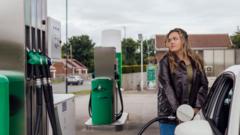
Seamus watches the digits on the pump flicker like a dying neon sign. Every cent that climbs on the display is a cent that leaves his kitchen table. It is 5:30 AM in a rainy forecourt off the N2, and the air smells of damp asphalt and expensive fumes. For Seamus, and for thousands of others across the Irish countryside, the car isn't a luxury. It is a lifeline. Without it, the job in the warehouse doesn't happen. The kids don't make it to school. The elderly neighbor doesn't get her prescription.
When the Irish government announced a significant cut to the excise duty on petrol and diesel, they weren't just adjusting a spreadsheet in a glass office in Dublin. They were intervening in a quiet, nationwide crisis of mobility. Don't forget to check out our recent coverage on this related article.
Taxation is often discussed in the abstract, as if it were a weather pattern we simply have to endure. But excise duty is different. It is a direct levy on the ability to move. When the cost of a litre of fuel soared past two euros, the math of daily life in Ireland simply stopped working for the average family. The government’s decision to slash duty by 20 cents per litre for petrol and 15 cents for diesel was a recognition that the social contract was fraying at the edges.
The Invisible Ledger
Consider a hypothetical commuter named Sarah. She lives in Meath but works in Dublin. Her commute isn't a choice; it’s the result of a housing market that pushed her fifty kilometers away from her office. Before the duty cuts, Sarah was spending nearly a quarter of her take-home pay just to get to the place that provided the pay in the first place. If you want more about the history of this, TIME provides an in-depth breakdown.
The weight of that financial pressure is invisible. You don’t see it when she’s driving; you see it when she’s standing in the supermarket aisle, choosing the generic brand of cereal because the premium one feels like an indulgence she can no longer afford. The "cost of living" is a sterile phrase. The "cost of surviving" is more accurate.
By reducing the excise duty, the state effectively put money back into Sarah's pocket before she even earned it. It was a rare moment where the gears of bureaucracy turned in favor of the person at the pump. The move cost the exchequer roughly 320 million euros. To a politician, that’s a budgetary line item. To the person driving an aging diesel Volkswagen, it’s the difference between a stressful month and a manageable one.
A Country Built on Four Wheels
Ireland is a nation of villages connected by narrow ribbons of tarmac. While Dublin enjoys the luxury of the Luas and an extensive bus network, the rest of the country remains stubbornly, necessarily dependent on the internal combustion engine. This geographical reality creates a massive disparity in how fuel taxes hit the population.
For a city dweller, a rise in fuel prices might mean an extra tenner a month or switching to a bicycle. For a farmer in Roscommon or a nurse in West Cork, it is a non-negotiable tax on their existence. The government knew this. They understood that if they didn't act, they risked a level of rural resentment that could destabilize more than just the economy.
The cuts were designed to be temporary, a "bridge" to get the population through a period of unprecedented global volatility. Russia’s invasion of Ukraine had sent energy markets into a tailspin, proving just how fragile our modern comforts truly are. We discovered, quite painfully, that our morning coffee and our drive to work are tethered to geopolitical tremors thousands of miles away.
The Conflict of Conscience
There is, however, a tension at the heart of this story. Ireland has committed to ambitious climate goals. We are told, quite rightly, that we must move away from fossil fuels. We are encouraged to buy electric vehicles and embrace public transport.
But transitions are messy. You cannot tell a man struggling to pay for home heating oil that he should spend 40,000 euros on a new Tesla. The excise duty cut represents a pragmatic, if uncomfortable, pause in the green agenda. It is an admission that human welfare in the present must sometimes take precedence over environmental targets for the future.
Critics argued that lowering fuel taxes would only encourage more driving, further bloating our national carbon footprint. But that argument ignores the lack of alternatives. If the bus doesn't run through your village, you drive. If the train station is forty minutes away, you drive. Poverty is not an effective environmental policy. Forcing people into financial ruin does not make them "green"; it just makes them desperate.
The government chose the path of least resistance, which in this case, was also the path of most mercy.
The Ripple Effect
When the price at the pump drops, the entire economy breathes a sigh of relief. It isn't just about the private motorist. Every loaf of bread in the supermarket arrived there on a truck powered by diesel. Every plumber, electrician, and delivery driver relies on fuel to keep their business solvent.
When fuel prices spike, businesses have two choices: go bust or pass the cost to the consumer. This is how inflation becomes a runaway train. By curbing the cost of fuel, the government applied a brake to that train. It was a move to protect the margins of small businesses that operate on the edge of viability.
I remember talking to a courier who operates out of Athlone. He told me that during the peak of the price surge, he was working fourteen-hour days just to break even. He wasn't working for profit; he was working to pay for the fuel that allowed him to work. It was a circular trap of exhaustion. When the duty was cut, he finally saw a path back to a living wage. That is the human element that gets lost in the talk of "macroeconomics" and "fiscal policy."
The Psychology of the Pump
There is a profound psychological shift that happens when the first digit of the fuel price changes from a '2' back to a '1'. It signals a return to a perceived normalcy. High fuel prices create a low-level, constant anxiety in a society. It makes the world feel smaller, more restrictive. It makes people stay home. It kills the casual Sunday drive to see a relative. It stifles the spontaneous trip to the coast.
The excise duty reduction wasn't just a financial intervention; it was a psychological one. It was a signal from the state that they were watching, that they understood the pressure, and that they were willing to forgo their own revenue to provide a modicum of relief.
But we must be honest about the future. These cuts are a bandage, not a cure. The era of cheap, easy fossil fuels is waning, and the volatility we see today is likely a preview of the decades to come. The government can only hold back the tide of global markets for so long before the cost becomes too great for the national treasury to bear.
The real challenge isn't just lowering taxes; it's building a country where the tax on a litre of petrol doesn't determine whether a family can afford to eat.
Seamus finishes filling his tank. The total is still high, higher than it was two years ago, but it’s less than it was last week. He clicks the nozzle back into the holster and walks toward the shop to pay. He grabs a newspaper and a coffee. He has a few extra euros in his pocket now. It isn't a fortune, but in the gray light of a Monday morning, it feels like a start.
The rain continues to fall on the N2, and the cars keep moving, fueled by a temporary reprieve and the stubborn necessity of getting where they need to go.
Would you like me to analyze how these fuel duty changes compare to similar measures taken across the European Union during the energy crisis?