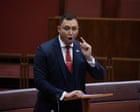
The red light on the camera isn't just a signal. For some, it is a pulse. In the silent, carpeted corridors of Canberra, where the air usually smells of old paper and expensive espresso, Senator Ralph Babet found himself standing at a peculiar crossroads between the digital wild west and the rigid architecture of parliamentary law.
It started with a post. Then a thread. Then a firestorm.
The Senate of Australia is a place built on the idea of "order." It is a chamber of "The Honourable" members, a room where the very walls are designed to muffle the screams of history and turn them into polite debate. But the internet does not have walls. It does not have carpets. It has an infinite capacity for the "offensive" and the "disrespectful"—terms that, in the world of 2026, have become as sharp as any blade.
The Invisible Gavel
When the Senate Environment and Communications Legislation Committee handed down its verdict, they weren't just criticizing a few sentences typed out in the heat of a social media scuffle. They were attempting to draw a line in the sand of a beach that is constantly eroding. They told Babet he had crossed it. They told him his comments were beneath the dignity of his office. They demanded he apologize.
He looked at the demand and, in a move that surprised no one who has followed his trajectory, he simply said: No.
This isn't just about a politician being stubborn. We see that every day. This is about the fundamental friction between two entirely different worlds. On one side, you have the "Old World" of institutional decorum—a world where words are weighed by committees and vetted by staffers. On the other, you have the "New World" of the digital town square, where authenticity is measured by how much you are willing to offend the people your followers already dislike.
Imagine a man sitting in a wood-panneled office, the weight of a century of tradition pressing down on his shoulders, while his thumb hovers over a glass screen that connects him to millions of people instantly. That is the modern politician’s haunting reality. The Committee saw a breach of conduct. Babet saw a battle for the soul of free speech.
The Anatomy of a Sanction
What happens when an unstoppable ego meets an immovable institution? Usually, the institution wins by exhaustion. But Babet is betting on a different outcome. By refusing to accept the sanction, he is effectively telling the Senate that their rules of engagement are obsolete.
The specific comments in question were labeled as "vile" and "abusive." In the dry language of the official report, these are technical violations. But in the lived experience of the people on the receiving end of those posts, they are something else entirely. Words have a way of sticking. They don't just disappear when you refresh the feed; they settle into the psyche of the public, shifting the boundaries of what we consider "normal" behavior from our leaders.
Consider a hypothetical teacher in a small town. If that teacher stood in the middle of the playground and shouted the things that are routinely posted on X, they would be fired before the lunch bell rang. Yet, in the highest halls of power, we are still debating whether or not a Senator should be allowed to use his platform as a flamethrower.
The committee’s report was a desperate attempt to reclaim the playground. They argued that Babet's conduct didn't just hurt individuals—it hurt the institution of the Senate itself. It tarnished the brand.
The Currency of Defiance
There is a specific kind of power that comes from being the person who refuses to say "sorry." In the modern political economy, an apology is often seen as a bankruptcy filing. It is an admission that the mob was right. For Babet, the sanction wasn't a punishment; it was a campaign contribution.
Every time a committee condemns him, his engagement numbers spike. Every time a "standard" news outlet calls his behavior "disrespectful," a thousand more people click "follow" to see what the fuss is about. He is playing a game that the Senate hasn't yet learned the rules to. They are playing chess with a man who is busy building a new board entirely.
But there is a hidden cost to this kind of defiance.
When we strip away the political theater, we are left with a vacuum where empathy used to live. If a leader can say anything, to anyone, at any time, without consequence, then the words themselves start to lose their value. We are living through a Great Inflation of Language. When everything is "vile," nothing is. When everyone is "offended," the word becomes a punchline.
The Ghost in the Machine
We often talk about "social media" as if it’s a tool, like a hammer or a wrench. It isn't. It’s an environment. It’s an ecosystem that rewards the sharpest edge and the loudest cry.
Babet’s refusal to bow is a symptom of a much larger fever. He is the ghost in the machine of Australian democracy, reminding us that our rules were written for a time when "public comment" meant a letter to the editor or a speech on a soapbox. It didn't mean a 24/7 direct neurological link to the frustrations of a divided electorate.
The Senate committee is trying to use a Victorian-era map to navigate a digital minefield. They talk about "respect" and "decorum" as if those things are self-evident. They aren't. Not anymore. To a significant portion of the population, "decorum" is just a code word for "the elite protecting their own feelings."
This is why the stalemate matters. It isn't just a spat between a Senator and a committee. It is a stress test for our entire system of government. If the Senate cannot enforce its own standards of conduct, does it actually have any? And if a Senator can ignore the collective will of his peers, who does he actually answer to?
The Loneliness of the Long Game
There is a peculiar loneliness in this kind of battle. You can see it in the way Babet frames his resistance. He paints himself as the solitary defender of a "silent majority," a man willing to take the hits so others don't have to. It’s a compelling narrative. It’s the hero’s journey, rebranded for the era of the "like" button.
But the reality is often grittier. Behind the defiant posts and the "refusal to accept" lies a growing pile of legal fees, administrative friction, and the slow, grinding erosion of professional relationships. You can only flip the table so many times before people stop inviting you to dinner.
The invisible stakes here aren't just about Babet’s career. They are about the precedent. If the Senate backs down, they admit they are toothless. If Babet backs down, he loses his brand. So they stay locked in this grim dance, neither side willing to lead, both waiting for the other to trip.
The committee noted that Babet had used his platform to "target" individuals, creating a culture of fear for those who might disagree with him. This is the part that gets lost in the "free speech" debate. Free speech is about the right to speak; it isn't a shield against the consequences of that speech. When a Senator targets a private citizen, the power imbalance is staggering. It is a Goliath claiming he is the one being bullied by David’s pebble.
The Echo in the Hall
Walk through the halls of Parliament House late at night, and you can almost hear the echoes of every debate that has ever happened there. You hear the ghosts of statesmen who believed that the dignity of the office was more important than the ego of the man holding it.
Babet is betting that those ghosts are wrong. He is betting that the future belongs to the unfiltered, the unrepentant, and the unbowed.
The tragedy of the situation is that both sides might be right. The Senate is right that respect is the lubricant of a functioning democracy. Without it, the gears grind to a halt and eventually shatter. But Babet is also right that the world has changed, and the old ways of "polite disagreement" are being swallowed by a digital sea that doesn't care about Roberts Rules of Order.
As the sun sets over the Brindabella Ranges, the red light on the camera stays on. It waits for the next post, the next outrage, the next refusal. We are watching a slow-motion collision between the past and the future, and nobody seems to have a map for the wreckage.
The Senate wants an apology. Babet wants a revolution. What the rest of us are left with is a growing sense that the words we use to describe our world—words like "honour," "respect," and "truth"—are being rewritten in real-time by people who are too busy shouting to listen to the silence that follows.
The last word isn't something you win. It's something you're left with when everyone else has walked away. Babet may get his last word, but he might find that the room he’s speaking to is suddenly, chillingly empty.