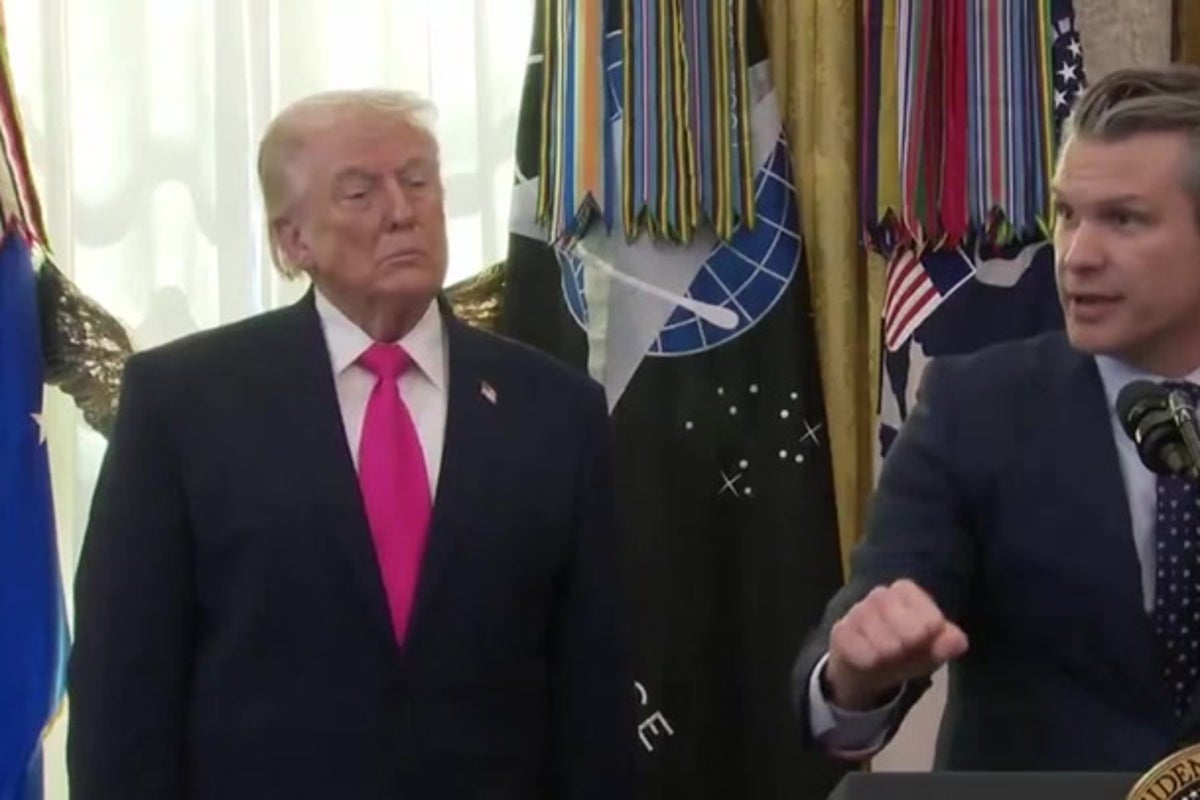
A map sits on a desk in the Pentagon. It isn't just paper and ink. To the men and women watching it, the map is a living, breathing organism of shifting red zones and flickering blue icons. Each icon represents a soul—a sailor on a destroyer in the Red Sea, a drone operator in a windowless room in Nevada, or a family in Erbil wondering if the night sky will stay dark. When Pete Hegseth speaks about Iran, he isn't just talking about a country. He is talking about the invisible tether that connects a missile launch in a desert to the price of milk in a Kansas grocery store.
The rhetoric coming out of the new administration is not a gentle breeze. It is a gale. Hegseth, the man tapped to lead the world’s most powerful military, recently stood before the cameras with a message that felt less like a policy briefing and more like a vow. The United States will keep the pressure on Tehran as long and as hard as necessary.
Donald Trump watched. He didn't just watch; he signaled his total alignment. This is the "Maximum Pressure" campaign reborn, but with a sharper edge and a fresh set of eyes.
To understand why this matters, you have to look past the podiums. Imagine a merchant captain navigating the Strait of Hormuz. His hands are tight on the wheel. He knows that nearly twenty percent of the world's total petroleum consumption passes through this narrow choke point. One wrong move, one "asymmetric" strike from a fast-attack boat, and the global economy catches a fever. For this captain, the policy of "maximum pressure" isn't an abstract political theory. It is the difference between a safe voyage and a catastrophic insurance claim.
The strategy is a vise. One jaw of the vise is economic—sanctions that strip the Iranian regime of the hard currency it needs to fund its proxies. The other jaw is the credible threat of military force. Hegseth's words are designed to tighten both.
The Weight of the Vise
Sanctions sound like dry, legalistic paperwork. They aren't. They are a form of siege warfare conducted through banks instead of trebuchets. When the U.S. restricts Iran’s ability to sell oil, the ripples move fast.
Consider a hypothetical mid-level official in Tehran. For years, his department has channeled funds to groups across the Middle East—the "Axis of Resistance." He pays for the drones that harass shipping lanes and the rockets that target regional rivals. But when the "Maximum Pressure" campaign hits its stride, the bank accounts start to run dry. He has to choose: does he fund the militia in Lebanon, or does he fix the crumbling infrastructure in his own backyard?
The goal of the Hegseth-Trump doctrine is to make that choice impossible. By applying pressure "as long and as hard as necessary," the administration aims to drain the swamp of regional instability by cutting off the water at the source.
But the stakes are high.
Critics argue that a cornered adversary is the most dangerous kind. They fear that as the economic walls close in, the regime might lash out in a desperate bid for leverage. This is the delicate dance of high-stakes diplomacy. You have to squeeze hard enough to force a change in behavior, but not so hard that you trigger the very explosion you are trying to prevent.
The Human Toll of Silence
Beyond the warships and the balance sheets, there is a human element that rarely makes the evening news. It’s the silence of a political prisoner in Evin Prison, hoping that international pressure might finally crack the doors open. It’s the bravery of the Iranian protesters who took to the streets under the banner of "Woman, Life, Freedom," risking everything for a future that looks nothing like the present.
For these people, American policy is a lifeline. Or a gamble.
Hegseth’s approach is rooted in the belief that "peace through strength" is the only language the current Iranian leadership respects. It is a rejection of the "strategic patience" of the past. It suggests that the time for nuanced hedging is over.
The President-elect has never been a fan of long, drawn-out entanglements. His brand of foreign policy is transactional and blunt. If Iran continues its nuclear enrichment, if it continues to threaten its neighbors, the pressure will escalate. There is no middle ground in this narrative.
The Ripple Effect
When Hegseth speaks, the world listens in different ways.
In Jerusalem, there is a sense of grim vindication. For years, Israeli officials have argued that only a credible military threat can stop Iran’s nuclear ambitions. In Riyadh, there is a cautious calculation. The Gulf states want stability, but they also want a partner who won't blink when the tension rises.
And then there are the American families.
War is not a game. Anyone who has worn the uniform, as Hegseth has, knows the cost of a failed policy. The "invisible stakes" are the thousands of service members stationed in the region. They are the ones who bear the physical weight of "maximum pressure." They live in the shadow of the drones. They monitor the radar screens for a flash of light that shouldn't be there.
The administration’s gamble is that by leaning in now, they prevent a much larger conflict later. It is the logic of the forest fire: sometimes you have to burn a controlled line to stop the entire woods from going up in flames.
A New Chapter of Defiance
The transition from words to action is where the story gets complicated.
Iran has spent decades learning how to survive under pressure. They have built "dark fleets" to smuggle oil. They have developed a sophisticated network of shadow banking. They are masters of the "grey zone"—actions that fall just below the threshold of open war but keep their enemies off-balance.
But the 2026 version of American pressure looks different. It is more integrated. It uses artificial intelligence to track illicit shipments with terrifying precision. It leverages the global financial system with surgical accuracy.
The navy doesn't just sit in the water anymore. It is a node in a massive, digital net.
Hegseth’s task is to ensure that this net is unbreakable. He is signaling that the U.S. military is being unshackled from the bureaucratic hesitation that often characterizes Washington. This is about restoration. It is about convincing the world—and Iran specifically—that the "red lines" are no longer painted in disappearing ink.
The Sound of the Clock
Time is the one variable no one can control.
The Iranian regime is aging. Its leadership faces internal dissent and an economy that is gasping for air. The "Maximum Pressure" 2.0 campaign is a bet on the clock. If the U.S. can hold the line, if the sanctions can bite deep enough, and if the military posture remains unshakeable, something has to give.
But what gives?
Is it a new nuclear deal that actually has teeth? Is it a fundamental shift in how Iran treats its own people? Or is it a collision course that the world has been trying to avoid for forty years?
The rhetoric is a shield. By projecting total certainty, Hegseth and Trump are trying to take the "maybe" out of the equation. They want Tehran to believe there is no escape hatch, no back-channel reprieve, and no cooling-off period.
The air in the Middle East is thick with anticipation. The sailors on the destroyers check their gear. The analysts in D.C. check their data. And the leaders in Tehran check their options, which are shrinking by the hour.
The pressure isn't just a policy. It is a presence. It sits in the room during every high-level meeting. It follows every oil tanker. It is the weight of a superpower that has decided it is done waiting for the other side to play fair.
The story isn't over. It is barely beginning. As the sun sets over the Persian Gulf, the blue icons on that Pentagon map continue to flicker, steady and watchful, waiting to see if the pressure will finally turn the tide or if the shadow will only grow longer.
The quiet before the storm isn't empty. It is heavy with the breath of those waiting for the first crack of thunder.