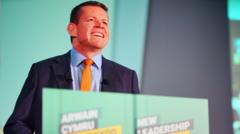
You can feel the shift in the air in Cardiff. After nearly three decades of Labour holding the keys to the Senedd, the political landscape in Wales isn't just changing—it's fracturing. Rhun ap Iorwerth just dropped a 60-page roadmap for Plaid Cymru’s first 100 days in power, and it’s a far cry from the usual vague manifesto fluff. This is a "we’re ready to govern" document designed to settle the nerves of an electorate that’s increasingly looking at Plaid as the only viable alternative to the status quo or the rising tide of Reform UK.
If you’re wondering why this matters right now, look at the polls. Plaid is sitting around 37%, with Labour trailing and Reform nipping at everyone's heels. The 7 May election is basically a coin toss. People are tired of hearing about "potential." They want to know what happens on day one, day fifty, and day one hundred. Plaid’s plan tries to answer that by focusing on the stuff that actually keeps you up at night: waiting lists, school standards, and the fact that your paycheck doesn't go as far as it used to.
The 100 Day Blitz on the NHS
The centerpiece of this plan is a surgical strike on the Welsh NHS. It’s no secret that the health service here has been struggling. Plaid’s big play is the creation of 10 new surgical hubs. The idea is simple: pull elective surgeries out of the main hospitals where they get bumped by A&E emergencies and put them in dedicated centers. If you’ve been waiting two years for a hip replacement, this is the policy you care about.
It’s not just about buildings, though. The plan calls for an immediate "reset" of the relationship between the government and frontline staff. I’ve seen enough of these plans to know that "reset" can be code for "more meetings," but ap Iorwerth is doubling down on a One Welsh Public Service model. This is an attempt to break down the silos between social care and hospital care. If they can actually get the two talking, they might stop the "bed blocking" that’s currently strangling the system. It’s a massive "if," but it’s the right target.
Rewiring the Welsh Economy from Scratch
For years, the Welsh economy has felt like a passenger on the Westminster train. Plaid wants to uncouple it. Within those first 100 days, they’re promising to launch a National Development Agency. Think of it as a powerhouse for Welsh business that actually has teeth. They want to take equity stakes in local companies, ensuring that when a Welsh business succeeds, the money stays in the community rather than flowing out to shareholders in London or overseas.
They’re also looking at a "re-localising" strategy. This involves:
- A nationwide skills audit to see where the gaps are.
- Incentives for Welsh students to stay and work in Wales after graduation.
- A "cross-party" review of university funding to stop the brain drain.
The most controversial bit? The plan to use the Barnett formula—the money Wales gets from the UK government—to fund a massive expansion of free childcare. Critics say the math doesn't add up. Plaid argues that by investing in childcare now, they’ll get more parents back into the workforce, which boosts the tax base. It’s a gamble. It’s the kind of gamble a party takes when they’re tired of being the junior partner in a coalition.
Putting the Smartphone Ban in Schools
Education is the other pillar. The "literacy and numeracy plan" sounds like standard political fare, but the headline-grabber is the move to restrict smartphones for under-16s in schools. It’s a populist move, sure, but it taps into a genuine anxiety among parents about distraction and mental health.
Beyond the gadgets, the plan promises a library in every school. In an age of digital everything, there’s something almost radical about that. It’s a clear signal that they want to get back to basics. They’re also looking at reforming the "Seren" program. Right now, it’s seen by some as a pipeline that sends the brightest Welsh kids to Oxford or Cambridge and they never come back. Plaid wants to pivot that focus back toward Welsh institutions.
Fighting on Two Fronts
You can’t talk about this 100-day plan without talking about Reform UK. Rhun ap Iorwerth has been blunt: he sees this election as a choice between "culture or ignorance." By releasing such a detailed roadmap, Plaid is trying to look like the grown-ups in the room. They’re betting that while Reform can shout about the problems, Plaid is the only one with a manual on how to fix the plumbing.
They aren't mentioning "independence" on every page, which is a tactical choice. Instead, they’re talking about "parity of powers" with Scotland and "fair funding." It’s "independence-lite"—building the machinery of a state without necessarily scaring off the middle-of-the-road voters who just want their bins collected and their doctor to answer the phone.
The reality of a minority government is the shadow hanging over all of this. With the new Senedd voting system, it's almost impossible for any party to get a total majority. This 100-day plan is as much a set of opening demands for a coalition deal as it is a promise to the voters. Whether it’s with a diminished Labour or someone else, these are the red lines.
If you’re living in Wales, the next few months are going to be loud. The best thing you can do is look past the slogans and actually dig into the delivery timelines. A plan is just paper until the first 10 surgical hubs actually open their doors. Keep an eye on the childcare rollout dates—that’s where the fiscal reality will hit the hardest.


