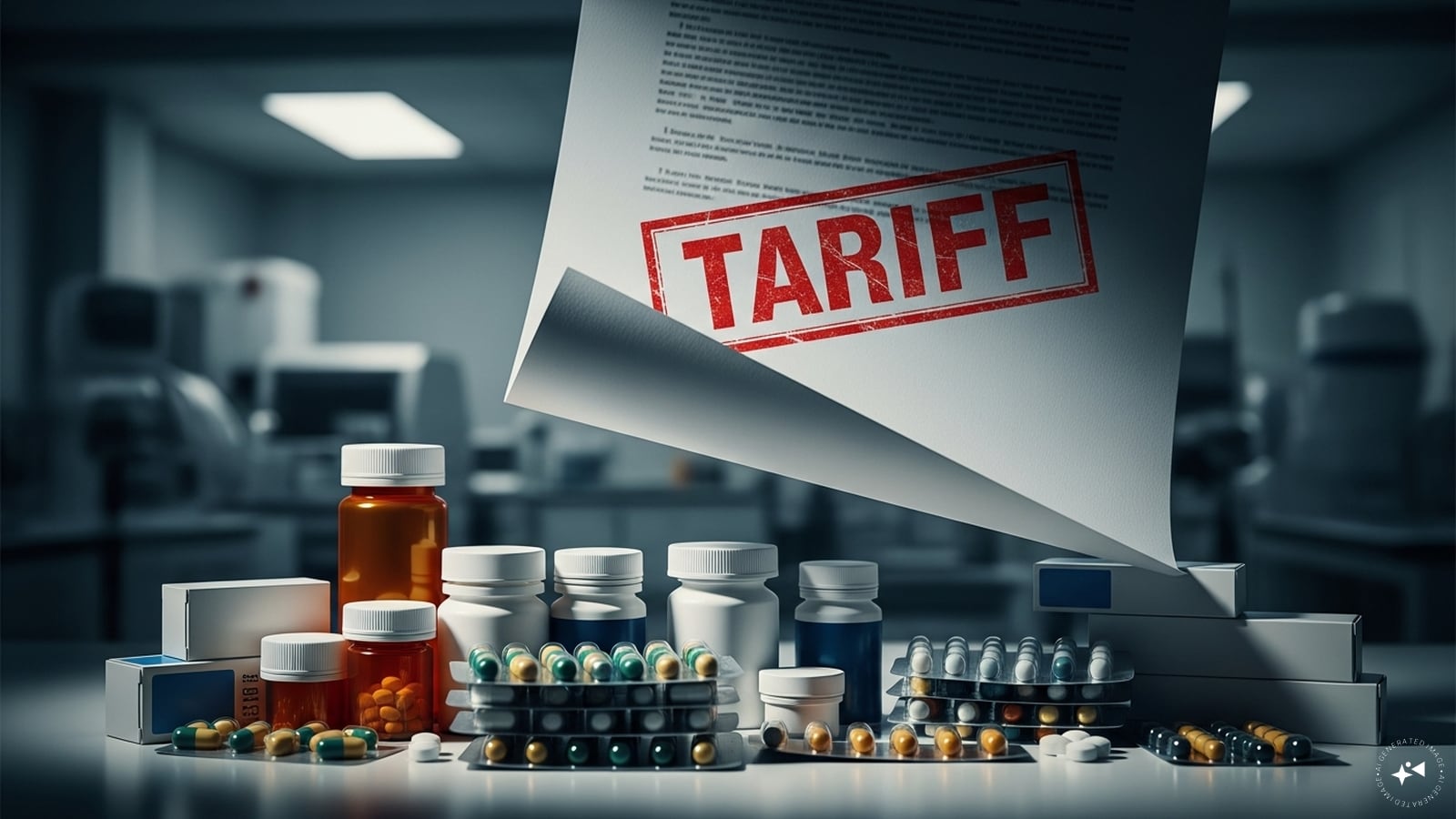
The reintroduction of aggressive tariff regimes targeting specific pharmaceutical manufacturers represents a fundamental shift from market-based pricing to a geopolitical tax on biological innovation. While political rhetoric frames these levies as a tool for "re-shoring" and "national security," the economic reality is a radical restructuring of the cost-of-goods-sold (COGS) for global drugmakers. This policy does not merely increase the price of a pill; it alters the internal rate of return (IRR) calculations for long-cycle R&D projects and forces a localized fragmentation of what has, for three decades, been a highly efficient, globalized value chain.
The Triad of Pharmaceutical Elasticity
To analyze the impact of new tariffs on drugmakers, one must look past the headline percentage and evaluate the three variables that determine how a firm absorbs or offloads the cost: Meanwhile, you can read other developments here: The Caracas Divergence: Deconstructing the Micro-Equilibrium of Venezuelan Re-Dollarization.
- Therapeutic Substitution Capacity: Can the market pivot to an equivalent drug? If the tariffed product is a unique biologic with no biosimilar, the manufacturer holds maximum pricing power. If the product is a generic small molecule, the tariff functions as a death sentence for that specific supplier’s market share.
- Payer Contract Rigidity: In the U.S. market, pharmacy benefit managers (PBMs) and insurers operate on multi-year rebate cycles. A 10% tariff cannot be instantly passed to the consumer when a three-year contract dictates a fixed net price. This creates a "margin squeeze" where the manufacturer carries the tax burden until the next negotiation cycle.
- Active Pharmaceutical Ingredient (API) Geographic Concentration: Many drugs are finished in the U.S. or Europe but rely on APIs or chemical precursors from the very regions being targeted (primarily China and India). The tariff serves as a tax on the raw materials of health, making domestic "finishing" more expensive rather than less.
The Mechanism of Value Chain Fragmentation
The pharmaceutical industry operates on a decade-long capital expenditure cycle. When a government introduces trade barriers, it creates a "regulatory risk premium" that exceeds the cost of the tariff itself. Manufacturers must now decide between three sub-optimal strategic paths.
Strategy Alpha: The Dual-Supply Chain Model
Large-cap firms are beginning to build "Regionalized Redundancy." This involves maintaining one supply chain for the U.S. market (using U.S.-sourced or "friend-shored" materials) and another for the rest of the world (using lower-cost global sources). While this bypasses the tariff, it destroys economies of scale. The cost of maintaining two separate quality-controlled manufacturing lines increases the baseline price of the drug for all patients, effectively acting as an invisible inflation tax. To see the bigger picture, we recommend the excellent report by Harvard Business Review.
Strategy Beta: Absorption and R&D Defunding
For firms with lower margins, the tariff is absorbed into the operating budget. Because manufacturing costs and marketing spend are often fixed in the short term, the variable most likely to be cut is the R&D pipeline. The logical progression is clear: a $500 million annual tariff expense results in the cancellation of two or three Phase II clinical trials. The immediate political win of "taxing big pharma" results in a long-term deficit of medical breakthroughs for complex diseases.
Strategy Gamma: Re-Classification Arbitrage
Firms will inevitably seek to re-categorize their imports to fall under lower-tariff Harmonized Tariff Schedule (HTS) codes. If a finished drug is taxed at 25%, but a "chemical intermediate" is taxed at 5%, firms will shift the final 5% of the manufacturing process (packaging, labeling, or final stabilization) to U.S. soil. This provides a veneer of "bringing jobs back" while the core high-value manufacturing remains abroad, doing little to address actual supply chain security.
Quantifying the "Security" Fallacy
Proponents of pharmaceutical tariffs argue that domestic production is essential for national security. However, this ignores the Complexity Threshold of Modern Biologics. Unlike steel or timber, you cannot simply "turn on" a biologic manufacturing facility. A state-of-the-art bioreactor facility takes 5 to 7 years to permit, build, and validate under FDA Current Good Manufacturing Practice (cGMP) standards.
Tariffs applied today will not move production tomorrow. Instead, they create a period of "Vulnerability Gaps." During the years it takes to build domestic capacity, the existing foreign supply becomes prohibitively expensive, leading to shortages. For critical medications like insulin, chemotherapy agents, or antibiotics, the supply-demand curve is almost perfectly inelastic. Consumers do not stop needing the drug because it is more expensive; they simply spend less on other essentials or enter medical debt.
The Impact on Generic Competition
The most severe distortion occurs in the generic sector. Generic manufacturers operate on razor-thin margins, often below 10%. A 15-25% tariff on imported APIs is not a challenge to be managed; it is an existential threat to the business model.
When a generic firm exits the market due to tariff-induced insolvency, it creates a monopoly or duopoly for the remaining players. This leads to a paradoxical outcome: a policy intended to be "pro-worker" or "pro-nationalist" results in higher drug prices for the domestic population by stifling the very competition that keeps prices low. The second-order effect is a surge in "gray market" imports, where patients seek medications from Canada or Mexico, bypassing the domestic regulated system entirely and increasing safety risks.
Structural Bottlenecks in "Friend-Shoring"
If the U.S. administration attempts to move pharmaceutical production to "friendly" nations like Ireland, Switzerland, or Singapore, they encounter the Labor Scarcity Constraint. High-end pharmaceutical manufacturing requires specialized chemical engineers and quality assurance professionals. These talent pools are not infinitely expandable. Moving the world's drug manufacturing from one region to another requires more than just capital; it requires a migration of human expertise that does not happen in a single presidential term.
Furthermore, the environmental regulations in the U.S. (EPA) and the EU (REACH) are significantly more stringent than in the regions currently producing the majority of the world’s APIs. Moving production back to the West involves navigating a decade of environmental impact assessments. Without a concurrent "Regulatory Fast-Track" for pharmaceutical infrastructure, the tariffs act as a penalty without providing a viable exit ramp for the companies involved.
The Cost Function of Compliance
Regulatory compliance is the "hidden" fourth pillar of the tariff impact. Every time a supply chain is moved to avoid a tariff, the manufacturer must file a "Prior Approval Supplement" (PAS) or similar regulatory filing with the FDA. This requires:
- Bioequivalence Testing: Proving the drug made in the new location is identical to the old one.
- Stability Testing: Monitoring the drug for 6 to 24 months to ensure it doesn't degrade.
- Site Inspections: FDA inspectors must physically visit the new facility.
The sheer volume of companies moving supply chains simultaneously would create a multi-year backlog at the FDA, effectively freezing the market and preventing new, cheaper drugs from entering the system.
Strategic Realignment for the Next Decade
Firms cannot wait for the political winds to shift. The current environment dictates a move toward Modular Manufacturing Units (MMUs). Instead of massive, centralized plants, the future of the industry lies in smaller, automated, and mobile "factories in a box" that can be deployed within national borders to satisfy local content requirements without the massive overhead of traditional plants.
Simultaneously, the industry must pivot toward Vertical Chemical Integration. The reliance on third-party API manufacturers in adversarial regions is a structural weakness that tariffs have exposed. The winners of the next decade will be firms that own their precursors, regardless of where they are manufactured, and possess the logistical flexibility to reroute materials through a diverse array of global trade corridors.
The immediate tactical move for pharmaceutical executives is a total audit of the "Value per Gram" of their portfolio. Low-value, high-volume products (basics like ibuprofen or simple antibiotics) are no longer viable for import-dependent models under a high-tariff regime. These must be either divested or moved to fully domestic production lines immediately. High-value, low-volume biologics can withstand the tariff pressure for now, but they require a "Legal and Lobbying Buffer" to secure specific HTS exemptions based on "Medical Necessity."
The era of the frictionless global drug market is over. In its place is a fragmented, high-cost, and politically charged system where the ability to navigate trade law is as important as the ability to sequence a genome. Firms that fail to treat trade policy as a core component of their clinical development strategy will find their margins evaporated before their drugs even reach the pharmacy counter.
Strategic Play: Conduct an immediate IRR sensitivity analysis on all Phase II and Phase III pipeline assets, assuming a permanent 20% increase in API and intermediate COGS. Any asset with a post-tariff IRR below 12% must be deprioritized in favor of assets with higher therapeutic substitution barriers or those capable of being produced via localized, modular manufacturing systems. Expect a 18-24 month lag in FDA site inspections; front-load all domestic facility validation requests now to avoid the inevitable 2027 bottleneck.