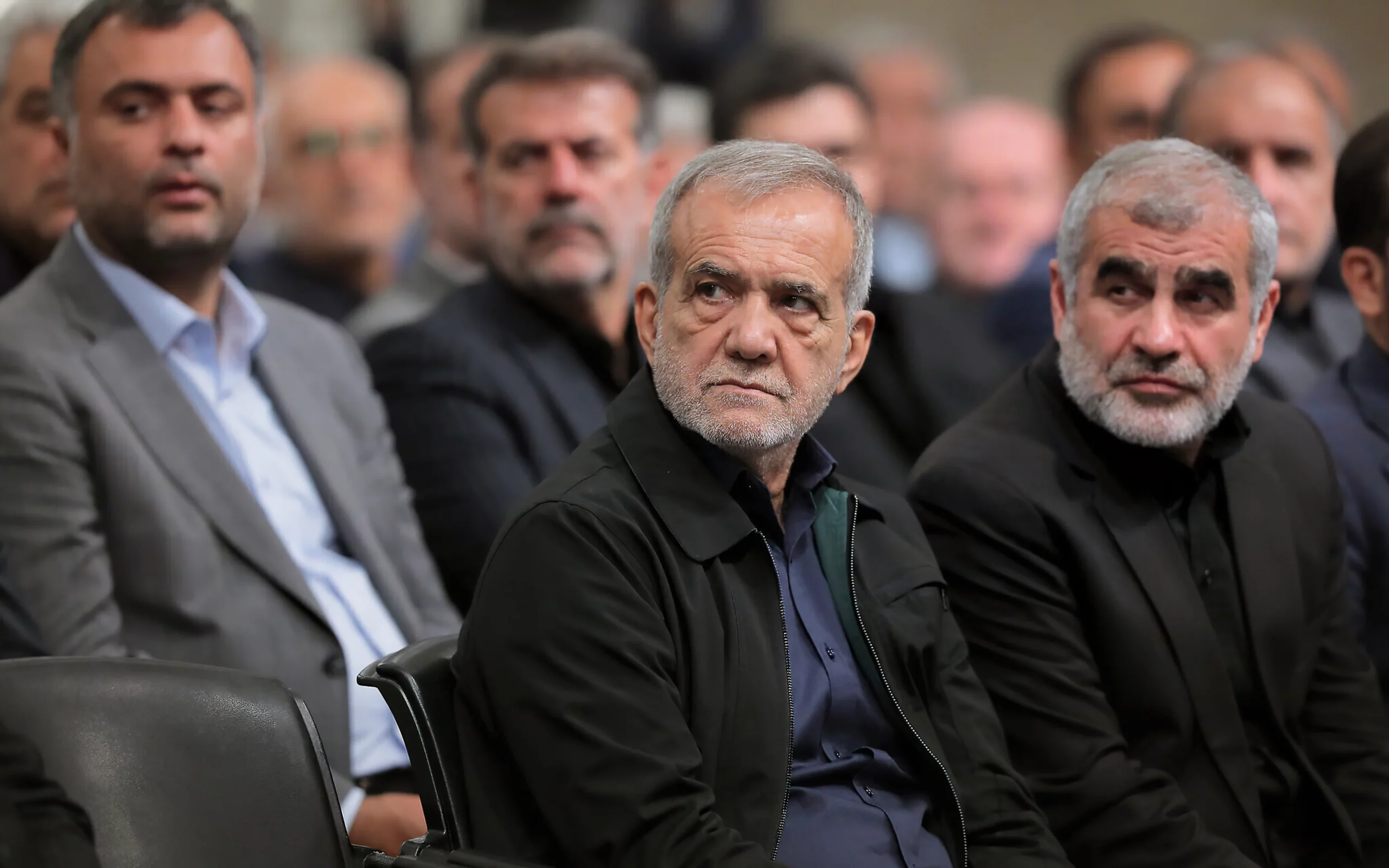
The international press is addicted to the "reformer" narrative. Every time Tehran swaps a hardline face for one that can smile in English, the West falls over itself to declare a "thaw." It happened with Khatami. It happened with Rouhani. Now, it is happening with Masoud Pezeshkian.
The standard media line is lazy: Pezeshkian is a heart surgeon trying to mend broken ties while the IRGC plays the spoiler. This is a fundamental misunderstanding of how the Islamic Republic functions. It treats the presidency as a center of power rather than a department of public relations.
Pezeshkian isn't a "moderate" fighting the system. He is the system's latest attempt to survive a liquidity crisis.
The Executive Puppet Show
Stop looking at the Iranian President as a decision-maker. In the hierarchy of Tehran, the President is the Chief Operating Officer of a firm where the Chairman—Supreme Leader Ali Khamenei—holds 100% of the voting stock.
The idea that Pezeshkian is "clarifying" his stance because he’s been "misinterpreted" is a scripted play. When the President speaks about regional stability while the IRGC launches ballistic missiles, it isn't a contradiction or a lack of communication. It is a strategic division of labor. One hand holds the olive branch to stall sanctions; the other hand holds the detonator to maintain leverage.
I’ve watched analysts waste decades trying to find the "moderate" faction within the Iranian regime. They did the same thing with the Soviet Union in the 80s and China in the early 2000s. They assume that economic necessity eventually forces a regime to change its ideological DNA. It doesn't. It just forces them to change their marketing.
Why the Regional Ties Narrative is Fraudulent
The media claims Pezeshkian wants to prioritize regional ties to "de-escalate." This premise is flawed because it assumes Iran wants a stable status quo.
Iran’s entire foreign policy is built on "Forward Defense." This isn't a secret. It’s a doctrinal pillar. By funding proxies in Lebanon, Yemen, Iraq, and Gaza, Iran ensures that any conflict happens on someone else’s soil. Why would Pezeshkian—or anyone else in that chair—dismantle the only thing that has kept the regime relevant for 45 years?
- Strategic Depth is Non-Negotiable: Without the "Axis of Resistance," Iran is just a mid-tier power with a failing currency.
- The Sanctions Trap: Pezeshkian’s job is to secure sanctions relief without giving up the ballistic program. If he fails at the former, the regime starves. If he succeeds at the latter, the regime dies.
- The Domestic Pressure Valve: The regime needs an external enemy to justify the internal crackdown. You cannot "modernize" the foreign policy without collapsing the domestic police state.
The Economics of Desperation
If you want to understand Pezeshkian, look at the inflation rate, not his speeches. Iran is facing a demographic and economic cliff. The youth are secular, unemployed, and angry.
Pezeshkian was selected—not elected, selected—because he offers a "human face" to the IMF and European trade partners. The regime needs $100 billion in investment just to fix its aging oil infrastructure. They aren't looking for friendship; they are looking for a wire transfer.
When Pezeshkian talks about "brotherly ties" with neighbors, he is actually begging for a way to bypass the dollar-dominated banking system. It’s a business move, not a moral pivot. If Saudi Arabia or the UAE can be convinced to stop backing maximum pressure, the regime gets another ten years of life.
The Logic of the Enemy
The competitor article suggests that "military friction" is an obstacle to Pezeshkian’s vision. This is backwards. Military friction is his leverage.
Imagine a scenario where Iran suddenly stopped all proxy activity. The West would have zero incentive to negotiate sanctions. Why would they? The threat would be gone. The "friction" is the only reason anyone takes a meeting with an Iranian envoy. Pezeshkian is the "Good Cop" who points at the "Bad Cop" (the IRGC) and says, "Give me a deal, or I can't keep these guys in the basement."
It’s a protection racket masquerading as diplomacy.
The False Choice Between Reform and Hardline
Stop using these terms. They are meaningless in a theocracy.
- Reformers: Want to save the regime by making it more efficient and less isolated.
- Hardliners: Want to save the regime by making it more feared and more isolated.
The goal is identical: Survival of the Velayat-e Faqih. Pezeshkian’s "clarification" of his stance is nothing more than a tactical retreat. When the IRGC's missile barrages draw too much heat, the President goes on a charm offensive. It’s a cycle of provocation and PR that has been repeating since 1979.
The West’s obsession with "empowering the moderates" is the single greatest failure of modern intelligence. You cannot empower someone who has no power to begin with. Every concession made to Pezeshkian is a concession made to the system that picked him.
Stop Asking if He is Sincere
It doesn't matter if Masoud Pezeshkian personally wants peace. It doesn't matter if he actually likes his neighbors.
In a system where the Supreme Leader can veto any law, command the entire military, and control the judiciary, the President's personal sincerity is an irrelevant variable.
If you want to know what Iran is going to do next, don't read the President's press releases. Look at the budget of the Quds Force. Look at the enrichment levels at Natanz. Look at the shipping lanes in the Red Sea.
The "clarification" is a ghost. The "military friction" is the reality.
Treating them as two separate forces fighting for the soul of the country is a fantasy. They are the two blades of the same scissors. And right now, they are cutting through the naive assumptions of every diplomat who thinks they can negotiate their way out of a 40-year ideological war.
The next time a headline tells you an Iranian leader is "reaching out," check your pockets. They aren't looking for a hand to shake. They are looking for a way to stay in power for another decade without changing a single thing about how they govern.
The real question isn't whether Pezeshkian is being misinterpreted. It's why we keep choosing to believe the interpretation that is obviously a lie.
Stop falling for the heart surgeon's bedside manner while the patient is holding a knife behind his back.