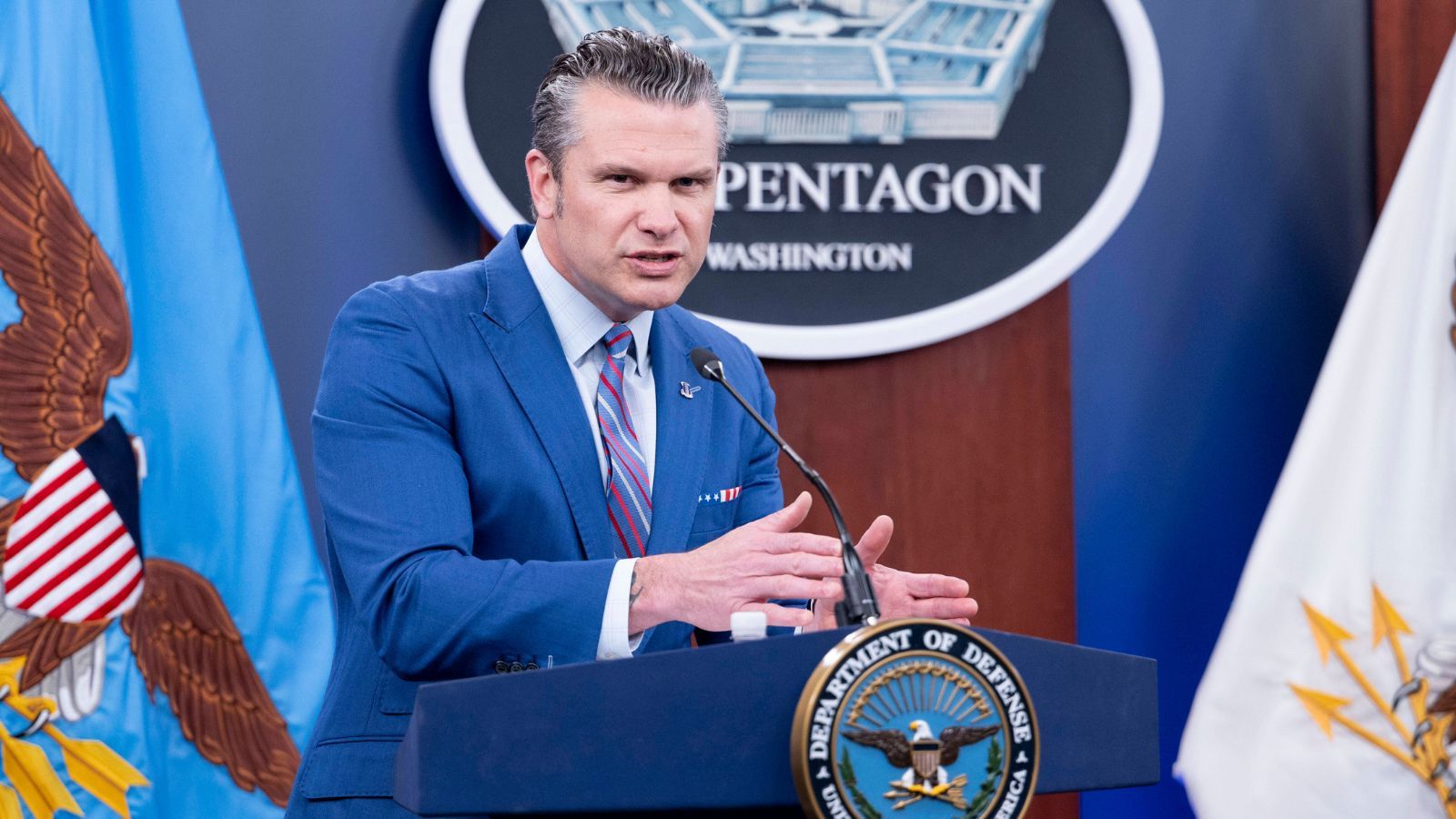
The recent deployment and public messaging from Pete Hegseth regarding his visit to U.S. troops in the Middle East serves as more than just a morale-boosting photo op. It marks a definitive shift in how the United States communicates its strategic leverage against Tehran. Hegseth’s core assertion—that the U.S. maintains an expanding array of military options while Iran finds its maneuverability shrinking—is a bold claim that requires a cold, hard look at the regional chessboard. The reality on the ground suggests that while the hardware and "options" favor Washington, the window for a clean diplomatic or military resolution is narrowing under the weight of proxy conflicts and a collapsing nuclear status quo.
The Projection of Strength Versus the Reality of Attrition
Military posture is often about perception as much as it is about firepower. When a high-profile figure like Hegseth stands with troops in the theater, the intended audience isn't just the American public; it is the Islamic Revolutionary Guard Corps (IRGC) and its regional affiliates. The message is clear: American presence is not a remnant of a fading era, but a calculated, active deterrent. Discover more on a related issue: this related article.
However, the "options" Hegseth references are often double-edged swords. The U.S. certainly possesses the kinetic capability to strike targets with precision, but every action in this region triggers a reaction from the "Axis of Resistance." Iran’s primary strategy has never been to win a conventional war against a superpower. Instead, they specialize in the "war of a thousand cuts"—using low-cost drones, ballistic missiles, and local militias to make the American presence feel increasingly expensive and politically unsustainable.
The Math of Deterrence
The disparity in spending is staggering. A single U.S. interceptor missile can cost millions of dollars, while the Iranian-made drones they are designed to shoot down might cost less than a used sedan. This economic asymmetry is one of the "options" Iran uses to keep the U.S. in a defensive crouch. To say Iran has "less" options ignores their mastery of unconventional warfare, which operates outside the traditional metrics of military strength. Additional analysis by The Guardian delves into related perspectives on the subject.
Regional Alliances and the Shifting Ground
One cannot discuss American leverage without looking at the neighbors. The Abraham Accords changed the landscape, creating a de facto security bloc between Israel and several Arab nations. This is likely what Hegseth points to when he suggests Iran is boxed in. The isolation of Tehran has been a primary goal of U.S. foreign policy for decades, and the current alignment of interests between Jerusalem, Riyadh, and Abu Dhabi creates a formidable wall.
But this wall has cracks. China’s mediation between Saudi Arabia and Iran last year signaled that the region is no longer a mono-polar playground for Western influence. If the U.S. relies too heavily on military "options" without a corresponding diplomatic strategy that accounts for these new global players, it risks being outmaneuvered in the very rooms where the real deals are made.
The Role of Forward Bases
The U.S. maintains a network of bases in Qatar, Bahrain, Kuwait, and the UAE. These are the physical manifestations of the "more options" Hegseth discussed. From these locations, the U.S. can launch intelligence, surveillance, and reconnaissance (ISR) missions that provide a granular view of every move Iran makes.
But these bases are also stationary targets. The political cost for host nations rises every time tensions spike. Leaders in the Gulf are playing a delicate balancing act: they want the American security umbrella, but they cannot afford a total regional conflagration that would incinerate their energy infrastructure and tourism-driven economies.
The Nuclear Clock and the Red Line
The most significant factor shrinking everyone's options is the state of Iran's nuclear program. International monitors have repeatedly warned that Tehran's breakout time—the time needed to produce enough weapons-grade uranium for a bomb—has decreased significantly. This puts the U.S. on a collision course with a "now or never" decision.
If the U.S. chooses a kinetic option to halt the program, it risks a regional war that could close the Strait of Hormuz, through which a massive percentage of the world's oil flows. If the U.S. does nothing, it accepts a nuclear-armed Iran, which fundamentally alters the power balance of the Middle East forever. This is the "brutal truth" of the situation: having "more options" doesn't mean having any good ones.
Logistics of a Modern Conflict
Consider the logistics of a potential flare-up. The U.S. Central Command (CENTCOM) has spent years refining its ability to move assets rapidly across the theater. This "dynamic force employment" allows the U.S. to be unpredictable.
- Carrier Strike Groups: These provide floating sovereign territory that can move 500 miles in a single day.
- B-52 Bomber Rotations: Direct flights from the continental U.S. to the Middle East prove that distance is no longer a shield for Tehran.
- Cyber Warfare: Options that don't involve a single boot on the ground but can cripple an adversary's command and control.
Hegseth’s confidence likely stems from the briefing rooms where these capabilities are mapped out. On paper, the U.S. is an unstoppable force. But history, particularly in the Middle East, is a graveyard for plans that looked perfect on paper.
The Human Element on the Front Lines
Beyond the grand strategy and the billion-dollar platforms are the men and women Hegseth visited. These soldiers are operating in a high-stress environment where a single miscalculation by a drone operator or a local militia commander could spark a global crisis. The mental toll of "constant readiness" is a factor that rarely makes it into the high-level policy papers, but it is the foundation upon which all military options rest.
The presence of U.S. troops acts as a "tripwire." Iran knows that killing Americans carries a price they are currently unwilling to pay. However, as the internal pressure on the Iranian regime grows—driven by a failing economy and domestic unrest—the temptation to provoke an outside enemy to galvanize the population increases. This makes the situation more volatile than it has been in years.
The Intelligence Gap
To maintain more options than your opponent, you must have superior intelligence. The U.S. has invested heavily in artificial intelligence and satellite imagery to track IRGC movements. We can see the missiles being moved out of storage in real-time. We can hear the communications between field commanders.
However, intelligence is not just about what you see; it is about how you interpret it. The biggest failures in American foreign policy have rarely been due to a lack of data, but rather a failure to understand the cultural and political motivations of the adversary. Hegseth’s rhetoric leans into a traditional "strength-first" approach, which assumes the adversary is a rational actor who will back down when faced with superior force.
The Proxy Network Paradox
Iran’s "options" are decentralized. They do not need to give a direct order for a group in Yemen or Iraq to act. This plausible deniability is their greatest asset. It allows them to squeeze the U.S. and its allies while maintaining a diplomatic "out." If the U.S. retaliates against the proxy, it spends resources on a secondary target. If it retaliates against Iran directly, it risks the full-scale war everyone claims they want to avoid.
The Economic Battlefield
Sanctions have been the primary non-military "option" for years. While they have devastated the Iranian Rial and limited the regime's ability to fund its projects, they have not produced a change in behavior. In fact, they have forced Iran to develop a sophisticated "resistance economy" and find back-channel partners for its oil exports.
The U.S. has reached the limit of what economic pressure can achieve. When the bank account is already empty, the threat of more fines loses its sting. This shifts the burden of deterrence back onto the military, which is precisely why visits like Hegseth's carry so much weight. We are moving out of the era of financial warfare and back into the era of raw physical presence.
Force Protection and the Future
Every time a U.S. official visits the region, the security protocols are a testament to the danger. The focus on force protection is paramount because the U.S. cannot afford the political fallout of a major casualty event.
The "more options" Hegseth speaks of includes a massive upgrade in base defenses. We are seeing the deployment of directed-energy weapons (lasers) and advanced electronic warfare suites designed to fry the circuits of incoming threats. This is a technological arms race happening in the shadows of the larger diplomatic struggle.
The Strategic Bottleneck
Ultimately, the U.S. strategy in the Middle East is facing a bottleneck. You can have a thousand options, but if your political objective is unclear, those options are merely tools without a blueprint. Is the goal regime change? Is it containment? Is it a new nuclear deal?
Without a defined end-state, the military presence becomes a perpetual holding pattern. Hegseth’s visit confirms that the U.S. is willing to maintain that pattern for as long as it takes, but it doesn't answer the question of how this cycle eventually ends. The leverage we hold today is significant, but leverage is only useful if you eventually use it to move something.
The Iranian regime is betting on American exhaustion. They believe that if they wait long enough, the political will in Washington will crumble, and the "options" will be packed up and sent home. The U.S., conversely, is betting that its presence will eventually force a moment of clarity in Tehran. Until one side is proven right, the region remains a tinderbox where the smallest spark can overwhelm even the most sophisticated military strategy.
The U.S. must ensure its "more options" are not just reactive measures to Iranian provocations. True strategic dominance requires taking the initiative in a way that forces the adversary to react to you, rather than the other way around. This requires a level of diplomatic and military synchronization that has often been elusive. As the rhetoric sharpens, the margin for error disappears. Strategies built on the assumption of a shrinking opponent often fail to account for the desperation of a cornered one. Maintaining the upper hand is a constant, grueling effort that requires more than just high-tech weaponry; it requires a deep, uncomfortable understanding of the limits of power.