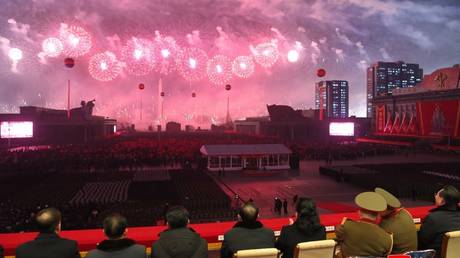
Kim Jong Un just wrapped up the Ninth Congress of the Workers' Party of Korea, and the message to the world is blunt. North Korea isn't just "pledging" a nuclear buildup; it's codifying a permanent, irreversible shift in how it interacts with the rest of the planet. If you're still waiting for a denuclearization breakthrough, you're looking at a ghost. That ship didn't just sail—it was scrapped and turned into a submarine-launched ballistic missile (SLBM).
The headlines usually focus on the "threat," but they often miss the nuance of Kim's latest power move. He isn't just building more bombs to be a nuisance. He's building them because he’s convinced the old international order is dead. Between the war in Ukraine and the return of "America First" rhetoric in Washington, Pyongyang sees a window to force the world to accept it as a nuclear peer, not a rogue state under probation. You might also find this similar story insightful: Strategic Asymmetry and the Kinetic Deconstruction of Iranian Integrated Air Defense.
The 2026 Shift from Defense to Operational Density
For years, the narrative was that North Korea wanted a "nuclear deterrent" to prevent an invasion. That phase is over. During the week-long congress that concluded in late February 2026, Kim made it clear that the goal now is operational density. It's no longer about having a weapon that can hit the U.S. mainland; it's about having so many different types of weapons that no defense system can keep up.
This isn't just talk. Look at the numbers. Estimates from the Stockholm International Peace Research Institute (SIPRI) now place the North’s arsenal at roughly 50 warheads, with enough material to nearly double that in short order. But the real story is the diversification. Kim's new five-year plan specifically targets: As highlighted in detailed reports by NPR, the effects are widespread.
- Underwater Strategic Weapons: Nuclear-armed unmanned underwater vehicles (UUVs) and nuclear-powered submarines.
- AI-Enhanced Systems: Unmanned attack drones and electronic warfare assets designed to paralyze enemy command centers.
- Tactical Saturation: Mass-producing 600mm and 240mm multiple rocket launchers to overwhelm South Korean defenses.
By integrating artificial intelligence and expanding his naval nuclear reach, Kim is trying to ensure that even if his land-based silos are hit, the retaliation comes from the sea or the shadows. It’s a move toward a "Second Strike" capability that would make any preemptive strike by the U.S. or its allies suicidal.
Why the Door to Washington is Ajar but the Door to Seoul is Bolted
One of the most striking things about this latest congress was the contrast in tone toward Washington versus Seoul. Kim is playing a sophisticated game of "Good Cop, Bad Cop" with himself.
He's signaled that he's open to "getting on well" with the United States, but only if Washington recognizes North Korea’s nuclear status as enshrined in its constitution. This is a massive trap. If the U.S. accepts this, the NPT (Non-Proliferation Treaty) effectively collapses. Kim is betting that a second Trump term might be more interested in a "grand deal" that freezes the program rather than the impossible task of dismantling it.
Meanwhile, South Korea is being treated as a "hostile state" and "eternal enemy." Kim has officially abandoned the idea of "compatriots." By labeling the South as a foreign enemy rather than a brother to be reunited with, he's legally and ideologically clearing the way for the use of tactical nuclear weapons on the peninsula. You don't use nukes on your own people, but you might use them on a "hostile occupant."
The Russia Factor and the End of Isolation
Don't ignore the geopolitical tailwinds. North Korea isn't the isolated hermit kingdom of the 1990s. The military partnership with Russia—cemented by the deployment of North Korean troops to help Moscow's efforts in Ukraine—has changed the math.
In exchange for "cannon fodder" and artillery shells, Pyongyang is likely receiving sensitive technology. We’re seeing rapid advancements in missile re-entry tech and satellite reconnaissance that would have taken years to develop alone. Russia’s Foreign Minister Sergey Lavrov recently called North Korean denuclearization a "closed issue." When a P5 member of the UN Security Council says that, the sanctions regime becomes a sieve.
What Actually Happens Next
If you’re watching this play out, don't look for a sudden nuclear test as the only sign of escalation. Watch the "low-level" modernization. The real danger in 2026 isn't just a big explosion in a mountain; it's the quiet integration of tactical nukes into standard army units.
- Monitor the Naval Arm: Kim is obsessed with the "nuclear weaponization of the navy." Watch for the deployment of the Sinpo-class submarines or the "Haeil" underwater drones. These are the "stealth" elements of his strategy.
- Watch the Satellites: Every successful spy satellite launch gives North Korea better "eyes" to target U.S. carrier groups in real-time. This is the difference between a blind giant with a club and a sniper with a scope.
- Ignore the "Peace" Overtures: When Kim says he’s ready for "peaceful coexistence," he means he wants the U.S. to pay him to stop testing while he keeps what he has. It’s a protection racket, not a peace treaty.
The bottom line is that the Ninth Party Congress has moved North Korea from the "development" phase to the "deployment" phase. The world is now dealing with a mid-tier nuclear power that has the backing of a desperate Russia and a distracted China. The old playbook of "strategic patience" is officially obsolete.