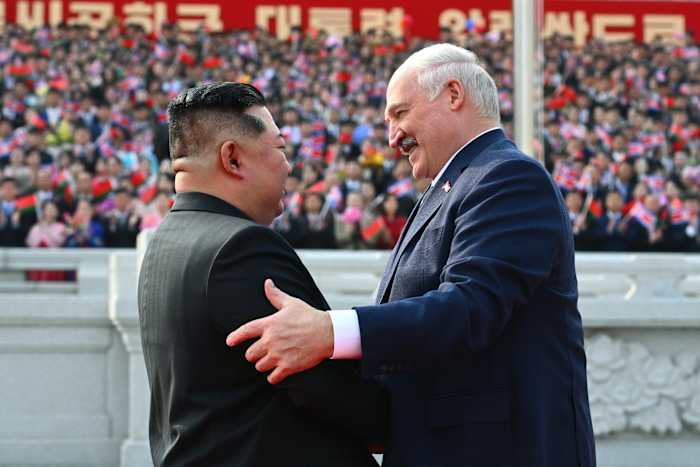
The headlines are predictable. Alexander Lukashenko touches down in Pyongyang, and the Western media machine starts churning out the same tired tropes. "The Axis of Outcasts." "A Desperate Alliance of Dictators." "The Last Cold War Frontiers."
It is lazy. It is inaccurate. Worst of all, it misses the cold, hard economic logic driving this meeting.
If you think this is about shared ideology or a "bond of tyrants," you are falling for a fairy tale. Lukashenko and Kim Jong Un don’t care about each other’s political philosophies. They are running a high-stakes arbitrage play. While Washington and Brussels focus on "containment" and "sanctions," Minsk and Pyongyang are building a pragmatic, transactional corridor that bypasses the global financial system entirely.
This isn't an axis. It’s a supply chain.
The Labor Arbitrage You Aren't Allowed to Discuss
The most "shocking" part of this summit isn't the photo op. It is the silent movement of human capital.
North Korea possesses one of the most disciplined, low-cost, and technically proficient manual labor forces on the planet. Belarus is currently facing a massive labor vacuum. Between the drain of IT professionals to the EU and the mobilization needs of their neighbor’s "special military operation," Lukashenko’s industrial base is starving for bodies.
I have watched analysts wring their hands over the "morality" of North Korean labor exports. Let’s be real: in the world of sanctioned states, morality is a luxury that was sold off years ago.
Belarus needs construction workers. It needs agricultural hands. It needs people to run the heavy machinery in the MAZ and BELAZ factories that keep the Russian war machine lubricated. North Korea needs hard currency and grain.
This is a textbook trade of surplus for scarcity. By framing this as a "diplomatic threat," we ignore the fact that it is a business merger. If this were two Fortune 500 companies optimizing their labor costs by offshoring to a high-discipline region, we’d call it "strategic restructuring." Because it’s these two, we call it a crisis.
Sanctions Are the Ultimate Networking Tool
The West has spent decades perfecting the art of the financial blockade. But there is a fatal flaw in the strategy: when you kick everyone out of the same club, they start their own.
Sanctions have become the ultimate matchmaking service for rogue states. By cutting off SWIFT access and freezing dollar assets, the West has forced these nations to innovate in the shadows. They aren't "surviving" sanctions; they are building a parallel economy that is immune to them.
- Barter Systems: When you can't use the dollar, you trade potash for artillery shells. You trade tractor parts for cybersecurity talent.
- Crypto-Laundering: Pyongyang is arguably the world leader in state-sponsored digital asset acquisition. Minsk provides the physical proximity to European markets to wash that value.
- Defense Synergy: Belarus has the Soviet-era industrial bones. North Korea has the mass-production capacity for "dumb" munitions that modern high-tech warfare—ironically—still requires in massive quantities.
The competitor articles will tell you these countries are "isolated." That is a lie. They are isolated from you. They are more connected to each other than ever before.
The Myth of the "Junior Partner"
There is a condescending narrative that Lukashenko is merely Putin’s errand boy, sent to Pyongyang to beg for scraps.
This ignores Lukashenko’s 30-year track record of survival. He is a master of playing larger powers against each other. By establishing a direct line to Pyongyang, he isn't just serving Moscow; he is creating his own leverage.
If Lukashenko can secure a steady stream of North Korean components or labor, he becomes less dependent on direct Russian subsidies. He becomes a vital middleman. In the world of grey-market logistics, the middleman is king.
North Korea, meanwhile, gets a "legitimate" European face to interact with. Belarus still has thin, fraying ties to the global market. They provide the paperwork. Pyongyang provides the product.
People Also Ask: "How do we stop this?"
The short answer? You don't.
The premise of the question is flawed. It assumes that more sanctions or sharper rhetoric will suddenly make Kim or Lukashenko realize the "error of their ways."
I’ve spent years analyzing trade flows in restricted zones. Once a nation crosses the "Sanction Event Horizon"—where they have nothing left to lose—Western pressure loses all efficacy. At that point, the only thing that matters is the Transaction.
If you want to disrupt this, you don't do it with a G7 statement. You do it by out-competing them on the black market. But the West doesn't have the stomach for that kind of mud-wrestling.
The Technical Reality of "Dual-Use" Deception
We need to stop talking about "agricultural cooperation" as if they are discussing potato yields. In the vocabulary of Minsk and Pyongyang, "agriculture" is often code for "heavy vehicle chassis."
The specialized trucks Belarus produces (BELAZ) are easily modified into Mobile Erector Launchers (MELs) for missiles. The "technical exchanges" mentioned in the official press releases are about hardening electronics against EW (Electronic Warfare)—something North Korea has practiced for decades and something Belarus desperately needs to modernize its defense exports.
This isn't a meeting. It's a R&D hand-off.
The Cost of Our Blindness
The biggest danger of the "Axis of Outcasts" narrative is that it makes us underestimate the enemy. We treat them like caricatures. We laugh at the outdated suits and the stiff ceremonies.
While we laugh, they are refining a blueprint for 21st-century survival. They are proving that a nation can be totally disconnected from the Western liberal order and still maintain a functional, lethal, and technologically advancing state.
They are building a "Sanction-Proof Stack."
- Layer 1: Physical Barter (Food for Arms)
- Layer 2: Sovereign Digital Currency (Bypassing SWIFT)
- Layer 3: Shared Intelligence (Cyber-warfare tactics)
If this model succeeds, it won't just be Belarus and North Korea. It will be the template for every nation that finds itself on the wrong side of a Washington policy shift.
Stop looking for the "diplomatic breakthrough." There isn't one. This is a cold-blooded optimization of assets between two entities that have realized that the "International Community" is just a gated community they no longer want to join.
The "Pariah Axis" isn't a sign of weakness. It’s a sign that the old world order has lost its monopoly on power. Lukashenko isn't in Pyongyang to talk. He's there to sign the invoices.