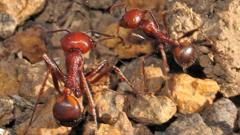
The moral panic over a $220 ant is a distraction. Mainstream media loves the narrative of the "greedy poacher" and the "innocent insect," but they are missing the economic engine that actually keeps species from vanishing. When a rare Dinomyrmex gigas or a specific Harpegnathos saltator variant commands a triple-digit price tag, the pearl-clutching begins. Environmentalists call it trafficking. I call it the most efficient conservation mechanism we have ever seen.
The current outrage centers on the idea that putting a price on wildlife is a death sentence. It is the opposite. In the real world, value is the only thing that buys protection. If an ant is worth $0.05, it is a pest to be crushed or a byproduct of a cleared forest. If that same ant is worth $220, it becomes a literal gold mine for the local community that lives alongside it.
The Myth of the "Pristine" Black Market
Critics argue that high prices drive species to extinction by incentivizing over-harvesting. This is a shallow, first-order observation. It ignores the reality of supply-side economics in the digital age. Most of these "trafficked" ants aren't being scraped out of the last remaining square meter of rainforest; they are being sourced by locals who suddenly have a financial reason to ensure that the forest stays standing.
When a collector in Berlin or Tokyo pays $200 for a queen, that capital flows—often through grey channels—back to regions where the alternative income is illegal logging or palm oil expansion. You cannot expect a subsistence farmer in Southeast Asia to protect a habitat out of the goodness of his heart while his kids are hungry. But he will protect a habitat if he knows a specific log contains a "crop" of high-value insects he can sell every season.
The "trafficking" label is a tool used by Western bureaucrats to maintain a monopoly on how we interact with nature. They want conservation to be a top-down, charity-funded model that rarely works. I’ve seen NGOs burn millions on "awareness campaigns" while the actual forests were leveled because the people living there saw no profit in keeping the trees.
The CITES Fallacy and the Regulation Trap
Let’s talk about the Convention on International Trade in Endangered Species of Wild Fauna and Flora (CITES). While its intentions are noble, its execution often creates a "forbidden fruit" effect that spikes prices without providing a legal pathway for sustainable trade.
When you ban the trade of a non-endangered but "charismatic" insect, you don't stop the demand. You just move the profit from the pockets of local harvesters to the pockets of actual criminal syndicates. If we want to save these species, we should be deregulating the trade for captive-bred or sustainably harvested specimens, not tightening the noose.
Why Price is a Proxy for Protection
Consider the mechanics of rarity. In any other industry, rarity creates an incentive for "farming."
- High Value: Encourages investment in breeding technology.
- Specialization: Hobbyists (the real "insiders") develop more knowledge about ant husbandry than 90% of academic entomologists.
- Data Collection: Every high-end sale is a data point on range, health, and morphology that wouldn't exist if the trade remained in the shadows.
By criminalizing the $220 ant, we are burning the library of information that these collectors provide. These enthusiasts are the ones figuring out the exact humidity levels, fungal requirements, and dietary needs of obscure species. If a wildfire or a plantation wipes out a wild population, the only surviving members will likely be in the "illegal" formicariums of the very people the media is currently demonizing.
The Professional Hobbyist as a Citizen Scientist
The "trafficker" isn't a guy with a butterfly net and a villainous mustache. In the modern era, they are often sophisticated keepers using macro-photography and climate-controlled setups that rival university labs.
I’ve sat in rooms with collectors who can identify a subspecies by the angle of a mandible—knowledge they gained because they had "skin in the game." Academia is slow. It relies on grants that take years to approve. The market is fast. The market identifies a new color morph or a behavioral quirk in weeks because there is a financial reward for being first.
The competitor articles tell you to report these sales. They tell you to "save the ants" by shutting down the trade. That is a recipe for total habitat loss. If the ant has no value, the land it sits on will be converted to something that does—like cattle ranching or soy.
The Inconvenient Truth of Habitat Competition
We need to stop pretending that "wildlife trafficking" is the primary threat to biodiversity. It’s not even in the top five.
- Habitat Loss: Driven by agriculture.
- Climate Shift: Driven by global emissions.
- Invasive Species: Driven by global logistics.
- Pesticides: Driven by industrial farming.
The ant trade is a rounding error in terms of biomass removal. In fact, every ant collected for the pet trade is one less ant that needs a grant to be studied. When we remove the economic floor for these insects, we remove the only reason for a local villager to keep that forest patch intact.
The $220 ant isn't a symptom of a broken system. It's the beginning of a better one. We should be encouraging the legalization and taxation of these trades, not their eradication. The market is the only thing that can scale faster than the chainsaw. If we let the bureaucrats win, we’ll have a lot of empty forests and some very happy palm oil companies.
Don't buy into the moralizing. Buy the ant.