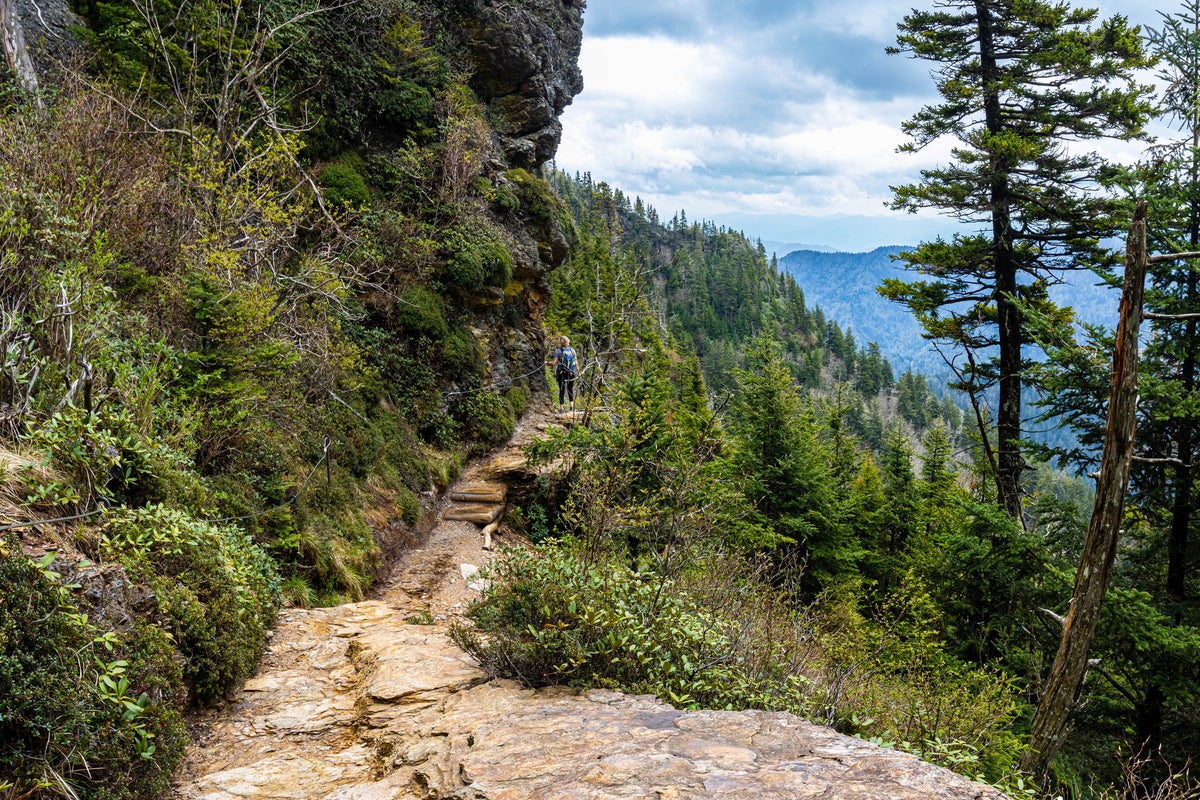
The fatal incident at the Chimney Tops trail in Great Smoky Mountains National Park (GSMNP) represents a failure of the safety-to-risk equilibrium that governs high-altitude recreational activities. While local reporting focuses on the emotional narrative of a 60-foot fall, a structural analysis reveals that such incidents are the result of specific environmental variables intersecting with human physiological and psychological limits. To understand why an experienced hiker or a casual visitor becomes a statistic, we must deconstruct the physics of the fall, the topography of the Chimney Tops, and the cognitive biases that lead to fatal decision-making in the backcountry.
The Topographical Risk Matrix of the Chimney Tops
The Chimney Tops trail is a high-density, high-impact corridor within GSMNP. The geological composition of the peaks—primarily Precambrian meta-sedimentary rock—creates a unique set of hazards. Unlike granite or limestone, which may offer reliable friction, the slate and phyllite found here are prone to fracturing and become remarkably slick when the dew point or precipitation levels fluctuate.
The risk profile of this specific terrain is defined by three primary environmental vectors:
- Inclination and Verticality: The final ascent to the pinnacles involves a 60-foot vertical differential. At this angle, the human center of gravity shifts forward, requiring constant micro-adjustments in the gastrocnemius and soleus muscles to maintain balance.
- Surface Friction Coefficients: Moisture in the Smokies is constant. Even on a clear day, high humidity levels (often exceeding 80%) create a microscopic film of water on the rock surfaces. This reduces the coefficient of static friction to levels that cannot support the lateral force of a standard hiking boot during a pivot.
- Mechanical Instability: The slate formations are layered. Applying weight to a protruding "shelf" creates a lever effect. If the internal tensile strength of the rock is compromised by freeze-thaw cycles, the shelf fails, leading to an immediate loss of three-point contact.
The Physics of a 60-Foot Descent
A fall from 60 feet is not a survivable event in the vast majority of terrestrial environments. To quantify the trauma, we look at the velocity at impact and the kinetic energy transfer.
Using the standard equation for free fall:
$$v = \sqrt{2gh}$$
where $g$ is the acceleration due to gravity (approximately $9.8 \text{ m/s}^2$) and $h$ is the height (18.28 meters), the impact velocity is approximately $18.9 \text{ m/s}$, or roughly 42 miles per hour.
The kinetic energy ($KE$) at the moment of impact is determined by:
$$KE = \frac{1}{2}mv^2$$
For an average adult, this energy transfer exceeds the structural integrity of the human skeletal system. The deceleration is instantaneous upon contact with the metamorphic rock at the base. This results in blunt force trauma that typically causes catastrophic failure of the central nervous system and multi-organ rupture. The "60-foot" metric is significant because it represents a threshold where the survival probability drops to near zero, regardless of medical intervention speed.
Cognitive Biases and Tactical Errors in Backcountry Navigation
Fatalities in National Parks are rarely the result of a single catastrophic event. Instead, they are the culmination of an "error chain." In the context of the Chimney Tops, several psychological mechanisms override the instinct for self-preservation.
The Peak-End Rule and Risk Normalization
Frequent visitors to the Smokies often suffer from risk normalization. Because thousands of people summit the Chimney Tops annually without incident, the perceived risk of the terrain decreases. This creates a cognitive "blind spot" where the hiker stops assessing the specific conditions of the day—such as localized ice or loose scree—and instead relies on the generalized safety of the trail's reputation.
Heuristic Traps in High-Elevation Travel
- Social Proof: If a hiker sees others standing near a cliff edge or attempting a precarious scramble, they assume the action is safe. In the case of the 60-foot fall, the presence of other visitors can inadvertently encourage a hiker to exceed their technical skill level.
- Scarcity: The "summit at all costs" mentality. If a visitor has traveled hundreds of miles to reach GSMNP, the psychological cost of turning back 50 feet from the top feels higher than the physical risk of proceeding on unstable ground.
- Expert Halo: Following a leader or a more experienced-looking hiker without verifying one's own foot placements or handholds.
Structural Limitations of Park Infrastructure
The National Park Service (NPS) faces a fundamental tension between preserving "wilderness character" and ensuring visitor safety. Following the 2016 Gatlinburg wildfires and subsequent trail damage, the Chimney Tops trail was capped with a permanent viewing platform to prevent hikers from reaching the actual pinnacles.
The 60-foot fall occurred because the individual bypassed these structural barriers. This highlights a critical bottleneck in park management: the "compliance gap." No amount of signage or fencing can physically stop a determined individual from entering a high-risk zone. The closure of the actual "chimneys" was a strategic decision based on the instability of the rock after the fires, yet the allure of the unblocked view continues to draw hikers into the "Dead Zone"—the area beyond the managed trail where the NPS no longer maintains the surface or provides safety anchors.
Operational Realities of Search and Rescue (SAR)
In high-angle terrain like the Smokies, the "Golden Hour" of trauma care is a mathematical impossibility. The logistics of a recovery or rescue operation at the Chimney Tops involve:
- Communication Lag: High-elevation ridges often have intermittent cellular service. The time between the fall and the first 901 call can range from 5 to 20 minutes.
- Technical Extraction: A 60-foot vertical drop requires a technical rope team. Mobilizing an NPS SAR team involves hauling hundreds of pounds of gear up a trail with a 1,400-foot elevation gain over two miles.
- Aerial Constraints: The dense canopy of the Smokies and the unpredictable wind currents near the ridges often prevent helicopter extraction via hoist.
This operational lag means that any hiker who falls in this terrain must be self-sufficient or rely on immediate, on-site first aid, which is rarely sufficient for the kinetic energy injuries sustained in a fall of this magnitude.
The Cost Function of Recreational Negligence
The impact of a single fatality extends beyond the loss of life. It creates a massive drain on federal and local resources. A technical recovery in the Smokies can cost upwards of $20,000 in personnel hours and equipment wear. Furthermore, these incidents often lead to further restrictive management policies, such as permanent trail closures or the installation of intrusive safety features that degrade the aesthetic and ecological value of the park.
From a strategy perspective, the management of GSMNP must shift from reactive signage to predictive behavioral intervention.
Risk Mitigation Protocols for High-Angle Hiking
To navigate environments like the Chimney Tops with a statistically significant margin of safety, hikers must implement a rigid operational framework. This replaces "feeling" safe with "verifying" safety.
Three-Point Contact Rule
In any scramble, three out of four limbs must be securely anchored at all times. The moment a hiker moves a hand and a foot simultaneously, their stability becomes dependent on a single point of failure. The fall at the Chimney Tops likely involved a transition where the hiker had only two points of contact, and a sudden shift in weight or a rock failure caused an unrecoverable tumble.
The 10-Percent Rule of Fatigue
Analysis of SAR data suggests that the majority of falls occur during the descent or near the end of a strenuous climb. Muscle fatigue reduces proprioception—the body's ability to sense its position in space. Hikers should assume their technical ability is 10% lower than their baseline for every hour spent on the trail.
Environmental Stop-Loss Limits
Established mountaineers use "turn-around times" and weather "red-lines." For a casual hiker at the Smokies, these should include:
- Any visible moisture on the rock surface.
- Wind gusts exceeding 25 mph, which can disrupt balance during a high-center-of-gravity move.
- The transition from a maintained trail to a social path (an unofficial trail created by foot traffic).
The death at Chimney Tops was not a random act of nature; it was a predictable outcome of the intersection between hazardous geology and the bypass of safety protocols. The technical reality is that the Smokies, while beautiful, are composed of crumbling, slick, and vertically unforgiving terrain.
Any hiker intending to summit high-risk peaks must treat the environment as a technical worksite rather than a playground. This requires the use of approach shoes with high-friction rubber (e.g., Vibram Megagrip), a rigorous adherence to trail boundaries, and an unsentimental assessment of one's own physical exhaustion. The strategic play is simple: prioritize the integrity of the center of gravity over the desire for a summit photograph. Failure to respect the physics of the fall ensures that the gravity of the Smokies remains the ultimate arbiter of survival.