The survival of a centralized autocratic regime depends entirely on the integrity of its command-and-control node. When Israel’s intelligence apparatus, Mossad, shifts from passive surveillance to active neutralization planning against an individual like Ali Khamenei, the process is not a singular event but a multi-stage engineering problem. This strategy relies on the systematic degradation of the target's "Security Shell"—the layers of physical, electronic, and human shielding that surround a head of state. By converting the target’s own defensive infrastructure, specifically surveillance cameras and communication hardware, into offensive entry points, Mossad bypasses the traditional brute-force requirements of kinetic warfare.
The Tri-Layer Model of Targeted Interdiction
To understand the mechanics of a high-level neutralization plan, one must deconstruct the operation into three distinct functional layers.
- The Information Layer (Intelligence Preparation of the Environment): This involves mapping every square meter of the target’s frequent locations. In the case of Iranian leadership, this includes the Beit Rahbari complex and various "safe houses."
- The Penetration Layer (Technical Exploitation): This is the stage where "defensive" tools are subverted. The competitor narrative suggests cameras became "spies." In technical terms, this is the exploitation of Closed-Circuit Television (CCTV) networks through firmware injection or supply chain interdiction.
- The Execution Layer (Kinetic Synchronicity): The final stage where the gathered intelligence is used to guide a precision strike or a localized sabotage event.
The Surveillance Paradox: Converting Defenses into Vulnerabilities
Modern high-value targets (HVTs) exist within a paradox: the more protection they seek, the more "attack surface" they create. Khamenei’s security detail utilizes thousands of sensors, biometric scanners, and high-definition cameras to monitor for intruders. However, every networked device represents a potential back door.
The Mechanism of Camera Subversion
The transition of a camera from a security asset to a Mossad "spy" occurs through three primary vectors:
- Supply Chain Compromise: Intercepting the hardware before it reaches the Iranian Revolutionary Guard Corps (IRGC). By installing modified chips or malicious firmware at the manufacturing or distribution stage, an intelligence agency ensures that the device functions normally while secretly broadcasting a low-frequency signal or opening a remote access port.
- Network Lateral Movement: Once a single non-secure device on the same network—perhaps a smart thermostat or a printer—is compromised, the attacker moves laterally to the security server. This allows for the manipulation of video feeds, enabling "looping" (showing old footage to hide real-time movement) or using the camera’s internal analytics to track the target’s specific gait and biometric signature.
- Optic Exploitation: Modern cameras have microphones and thermal sensors. Subverting these allows an agency to hear private conversations and see through thermal shielding to identify the exact room a target is occupying, even if visual line-of-sight is blocked by curtains or reinforced glass.
Signal Intelligence and the Identification of "Soft" Patterns
A target like Khamenei does not move randomly. His life is governed by a rigid schedule of religious duties, political meetings, and medical requirements. Mossad’s objective is to identify the "Statistical Anomaly"—the brief window where the target transitions between high-security zones.
Pattern-of-Life (POL) Analysis
Intelligence analysts use POL to quantify the target's movements. This creates a baseline of "normalcy."
- Variable A: Time spent in the inner sanctum.
- Variable B: Distance between the motorcade and the nearest uncontrolled building.
- Variable C: The frequency of security personnel rotations.
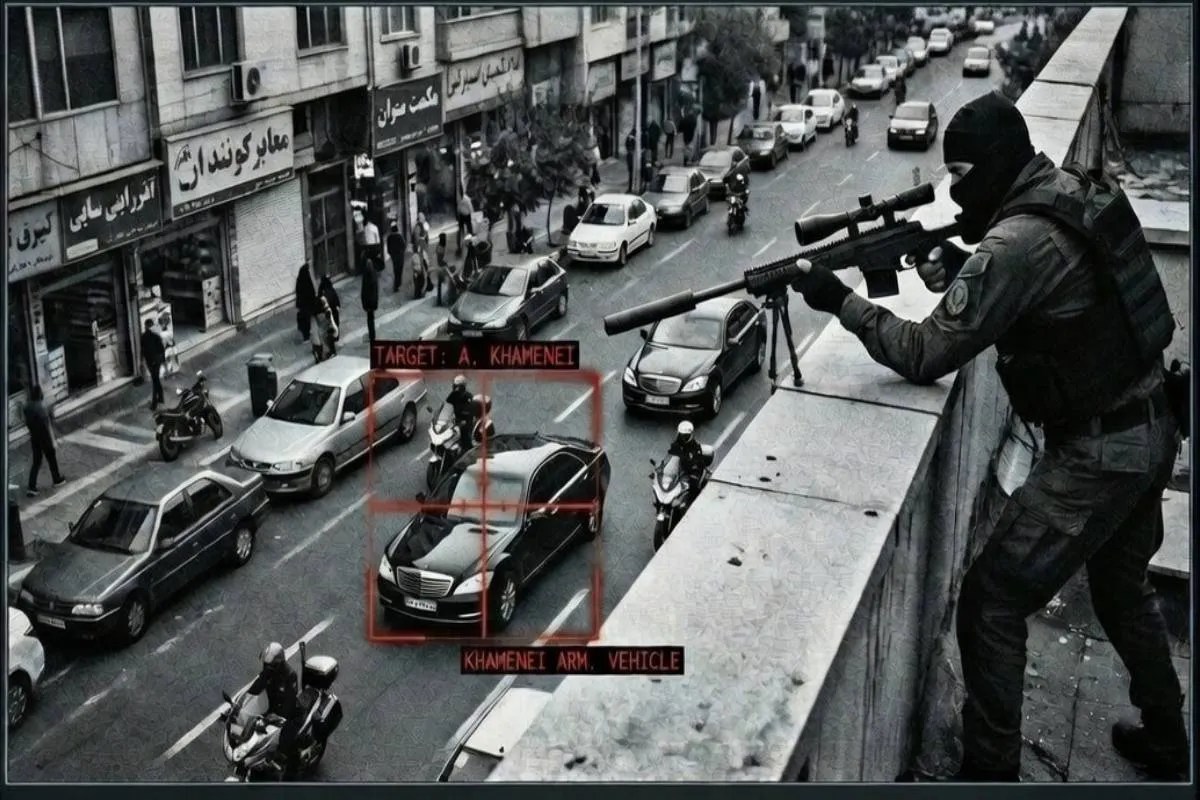
When these variables are plotted, the gaps emerge. A 15-second transit between a hardened bunker and an armored vehicle is often the only window for a kinetic strike. The subverted cameras mentioned in regional reports serve to shrink the margin of error in this 15-second window to zero.
The Role of Local Assets and the Human-Machine Interface
Technological superiority is insufficient without the "Human Intelligence" (HUMINT) component. The infiltration of the IRGC’s Ansar-ol-Mahdi Protection Corps—the unit responsible for Khamenei’s safety—is a prerequisite for hardware-based spying.
The Recruitment Funnel
Mossad does not always recruit through ideological alignment. The "MICE" framework (Money, Ideology, Compromise, Ego) remains the standard for subverting security personnel. In a crumbling Iranian economy, "Money" and "Compromise" (leverage regarding illicit activities or family safety) are the most effective levers. A subverted guard provides the "MAC address" of the internal server or physically plugs a "Rubber Ducky" USB device into a closed-circuit air-gapped network. This bridge allows the remote technical teams in Tel Aviv to bypass the physical isolation of the target’s most sensitive communications.
Operational Constraints and the "Window of Opportunity"
The execution of such a plan is limited by the "Perception Threshold." If the target realizes they are being watched, they change their patterns, rendering months of data useless. Therefore, the intelligence gathered is often held in reserve.
- The Cost of Premature Exposure: Activating a subverted camera system for a low-stakes observation risks the entire operation. Mossad likely maintains "dormant access," waiting for a geopolitical trigger—such as a direct Iranian missile strike on Israeli soil—to transition from observation to elimination.
- The Redundancy Problem: Iranian security uses layered encryption and occasionally switches to analog communication to thwart digital SIGINT. This forces the intelligence agency to develop "cross-domain" attacks, such as using laser microphones that can detect vibrations on window glass from kilometers away, augmenting the data captured by hacked internal cameras.
The Psychological Dimension of the "Killing Plan"
The disclosure of these plans via media channels—as seen in the competitor's reference—is itself a weapon. This is known as "Reflexive Control." By leaking the fact that cameras have been compromised, Israel forces the Iranian leadership into a state of paralyzing paranoia.
- Systemic Distrust: Khamenei begins to distrust his own security hardware.
- Internal Purges: The IRGC begins searching for moles, often accusing and removing loyal but effective officers, thereby degrading their own protective capabilities.
- Operational Paralysis: To stay safe, the target must limit communication and movement, effectively self-isolating and reducing their ability to govern.
Strategic Projection
The shift from traditional assassination methods (e.g., car bombs, snipers) to integrated technological subversion marks a new era in Middle Eastern shadow warfare. The complexity of the "Khamenei Plan" suggests that the goal is not merely the death of an individual, but the total demonstration of the IRGC’s incompetence.
The most effective strategic play for an intelligence agency in this position is the maintenance of "Permanent Threat Perception." By ensuring the target knows they are being watched through their own eyes—the security cameras—Israel achieves a strategic checkmate. The target is forced to choose between total isolation, which renders them politically impotent, or continued exposure, which makes their death a matter of timing rather than capability.
The immediate tactical move for Israel is the continued "spoofing" of Iranian internal networks, creating false positives that trigger security alerts. This exhausts the security detail and masks the actual signature of a forthcoming strike. The final movement in this sequence will likely not be a mass military invasion, but a highly localized event where the target’s own automated defense systems are remotely commanded to fail at the precise moment of engagement.