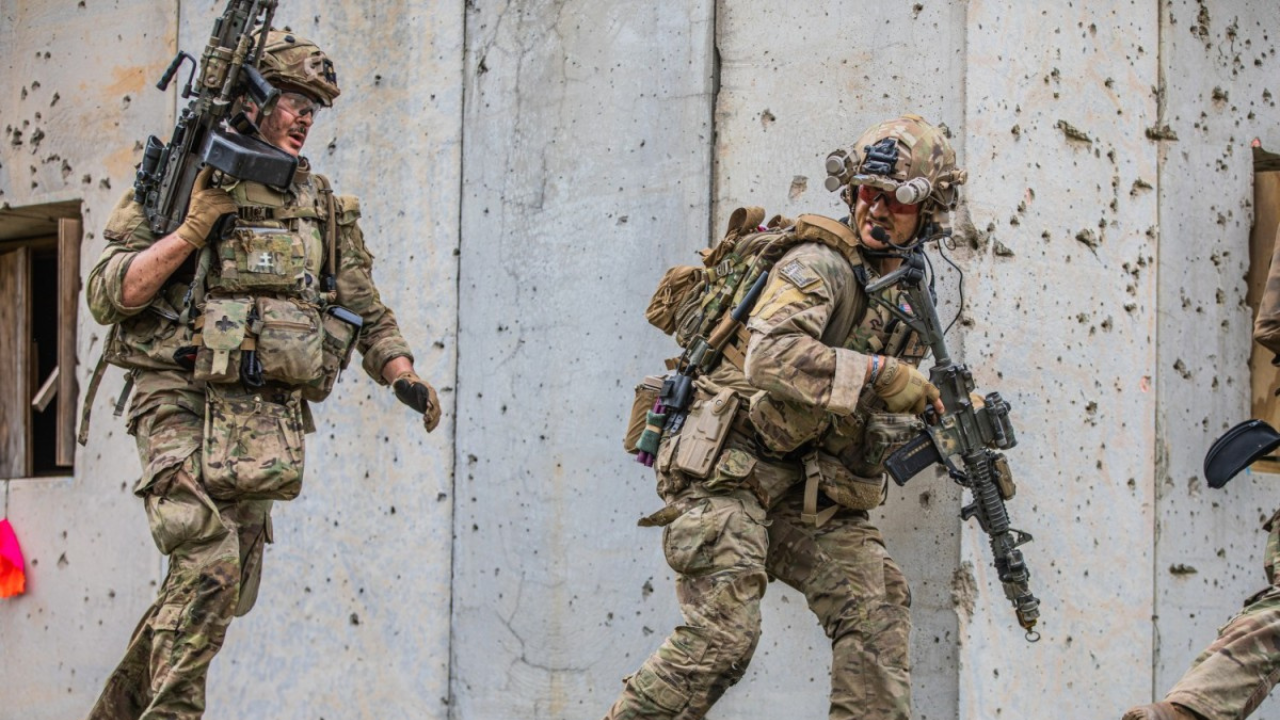
The 82nd Airborne Division does not function as a standard infantry unit; it is a high-readiness logistics and kinetic solution designed to solve the problem of strategic distance. While generalist reporting focuses on the historical nostalgia of the 1944 Normandy jumps, the modern utility of the 18th Airborne Corps rests on its status as the core of the Global Response Force (GRF). The GRF is a capability requirement that demands the delivery of a Brigade Combat Team (BCT) to any point on the globe within 18 hours of notification. This is not a goal but a rigid performance metric that dictates the unit’s training cycles, equipment procurement, and organizational structure.
The deployment of the 82nd to the Middle East represents the activation of a "forced entry" capability. In military theory, forced entry is the ability to seize and hold lodgments—such as airfields or ports—in a contested environment where the host nation cannot or will not provide access. The strategic value of the 82nd lies in its ability to bypass traditional geographic bottlenecks (chokepoints) by utilizing the vertical dimension.
The Triple-Lock Readiness Cycle
The division maintains its 18-hour deployment standard through a rotating readiness model known as the Sustainable Readiness Model (SRM). At any given time, one of the division’s three BCTs is designated as the GRF-1. This unit exists in a state of suspended animation relative to civilian life.
- The N-Hour Sequence: The sequence begins at N-Hour (Notification). Within 2 hours, key personnel are at their assembly points. By N+18, the "heavy drop" (artillery and vehicles) and the first wave of paratroopers must be wheels-up.
- The Outload Process: Success depends on the efficiency of the Green Ramp at Pope Army Airfield. This is a throughput optimization problem. The division must calculate the precise "cube and weight" of every piece of equipment to ensure the Maximum On Ground (MOG) capacity of the destination airfield is not exceeded.
- Rigging Operations: Unlike standard cargo, equipment for the 82nd must be "rigged" for low-velocity airdrop. This involves complex honeycomb cushioning and parachute extraction systems. A failure in the rigging phase results in a total loss of the asset upon impact, creating a functional deficit before the first engagement.
Kinetic Constraints and the Light Infantry Paradox
The 82nd Airborne faces a fundamental structural trade-off: Deployability vs. Survivability. To achieve the speed required for the GRF mission, the division must remain "light." This creates a specific set of tactical vulnerabilities when facing a peer or near-peer adversary equipped with heavy armor and integrated air defense systems (IADS).
The division’s primary maneuver element is the Infantry Brigade Combat Team (IBCT). Its lack of heavy tracked vehicles (like the M1 Abrams) means it relies on high-mobility platforms like the M1101/M1102 trailers and the Ground Mobility Vehicle (GMV). While these provide speed on the ground, they offer negligible protection against large-caliber direct fire or improvised explosive devices.
To mitigate this "protection gap," the division utilizes a high density of man-portable anti-tank systems (Javelin) and organic indirect fire (M119 105mm howitzers). However, the mathematical reality of an airborne operation is that the unit is at its most vulnerable in the first 72 hours—the "bridgehead phase"—before heavier reinforcements can arrive via sea or heavy lift. The mission is not to win a war of attrition, but to disrupt the enemy’s OODA loop (Observe, Orient, Decide, Act) and secure the infrastructure necessary for follow-on forces.
The Logistics of Vertical Envelopment
An airborne operation is a high-risk investment of human capital and material. The physics of the jump itself introduce a "dispersion variable" that commanders must account for. Even with GPS-guided navigation in the lead aircraft, paratroopers rarely land in a neat formation.
The "Assembly Phase" is the most critical bottleneck. Once on the ground, the unit is effectively a collection of individuals scattered across a drop zone that may be several kilometers long. The time taken to transition from a "dropped state" to a "combat-effective state" is the primary metric of success. This transition requires:
- Communication Re-establishment: Establishing a local mesh network to locate commanders and subordinate units.
- Heavy Drop Recovery: Locating and de-rigging vehicles and artillery pieces dropped on separate platforms.
- Massing Combat Power: Moving toward the objective before the enemy can mobilize a counter-attack.
The second limitation is the "Logistics Tail." Once an airborne unit is dropped, it is an island. It carries only what is on its back or in its dropped bundles—typically 72 hours of food, water, and ammunition. If the "airhead" (the seized airfield) is not secured and opened for transport aircraft within that window, the unit faces a total depletion of combat power.
Strategic Deterrence and the Signal Function
The deployment of the 82nd Airborne to the Middle East serves a dual purpose: tactical readiness and strategic signaling. In the calculus of international relations, the movement of a heavy armored division is a slow, deliberate process that suggests a long-term buildup. The movement of the 82nd is a "flash" signal. It communicates to adversaries that the United States possesses the capability to put boots on the ground faster than the adversary can complete its own mobilization cycle.
This speed acts as a deterrent by creating "strategic ambiguity." If an adversary believes a target can be seized or neutralized within 24 hours, the cost-benefit analysis of their initial aggression shifts. However, the efficacy of this signal depends entirely on the perceived competence of the outload. If the 82nd cannot maintain its 18-hour standard, the deterrent value evaporates.
Modernization and the Integrated Tactical Network
The 82nd is currently the "test bed" for the Army’s modernization efforts, specifically in the realm of the Integrated Tactical Network (ITN). This is a move away from rigid, proprietary radio systems toward more flexible, commercial-off-the-shelf (COTS) based architectures.
In a jump environment, the ITN allows for:
- Shared Situational Awareness: Paratroopers can see the location of their peers on a digital map (End User Device) before they even hit the ground.
- Redundant Links: If one satellite link is jammed, the network can failover to line-of-sight or cellular (if available) links.
- Reduced Signature: Modern systems focus on Low Probability of Detection (LPD) and Low Probability of Interception (LPI) to avoid being targeted by enemy electronic warfare (EW) units.
This technological layer is intended to solve the "dispersion variable" mentioned earlier. By reducing the time spent searching for units in the dark, the division increases its "lethality-to-time" ratio.
Risk Profiles and Failure Modes
The 82nd Airborne is a "fragile" asset in the Nassim Taleb sense—it is optimized for a very specific type of high-stakes success, but its failure modes are catastrophic.
- Anti-Access/Area Denial (A2/AD): If an adversary possesses sophisticated S-400 or similar surface-to-air missile systems, the transport aircraft (C-17s and C-130s) become massive, slow-moving targets. An airborne drop into a functional A2/AD bubble is not a tactical maneuver; it is a mass-casualty event.
- Weather Minima: High winds or low visibility can scrub an airborne operation. While the 82nd can drop in marginal weather, the risk of "jump injuries" increases exponentially, potentially rendering 10-15% of the force combat-ineffective before a single shot is fired.
- Mechanical Bottlenecks: The entire operation relies on a narrow fleet of strategic lift aircraft. If the Air Force cannot provide the required "chalks" (individual aircraft loads), the division’s speed is neutralized.
Strategic Recommendation for Deployment Monitoring
To evaluate the effectiveness of the current Middle East deployment, observers should ignore the rhetoric of "storming beaches" and focus on three specific indicators:
- The Lodgment Footprint: Observe whether the 82nd is seizing new infrastructure or merely reinforcing existing bases. Reinforcement is a political signal; seizure is a kinetic preparation.
- The Logistics Node: Monitor the activation of the 1st Sustainment Brigade. The airborne can take a point, but they cannot hold it without the immediate follow-on of sustainment architecture.
- The Multi-Domain Integration: Watch for the presence of specialized EW and cyber-detachments. If the 82nd is deploying with heavy EW support, it indicates they are preparing for a "contested" drop against a sophisticated state actor rather than a counter-insurgency role.
The 82nd Airborne remains the most potent tool in the U.S. arsenal for rapid escalation. Its utility is not found in the weight of its shells, but in the velocity of its arrival. The current movement into the Middle East should be viewed as a stress test of the GRF’s ability to project power in an era of increasing regional instability and peer-competition threats.
Identify the specific transport aircraft tail numbers and frequency of sorties departing from Pope Army Airfield to determine if this is a standard brigade rotation or a full-scale GRF surge.
Would you like me to analyze the specific air-defense systems currently active in the Middle East that pose the highest threat to C-17 transport corridors?