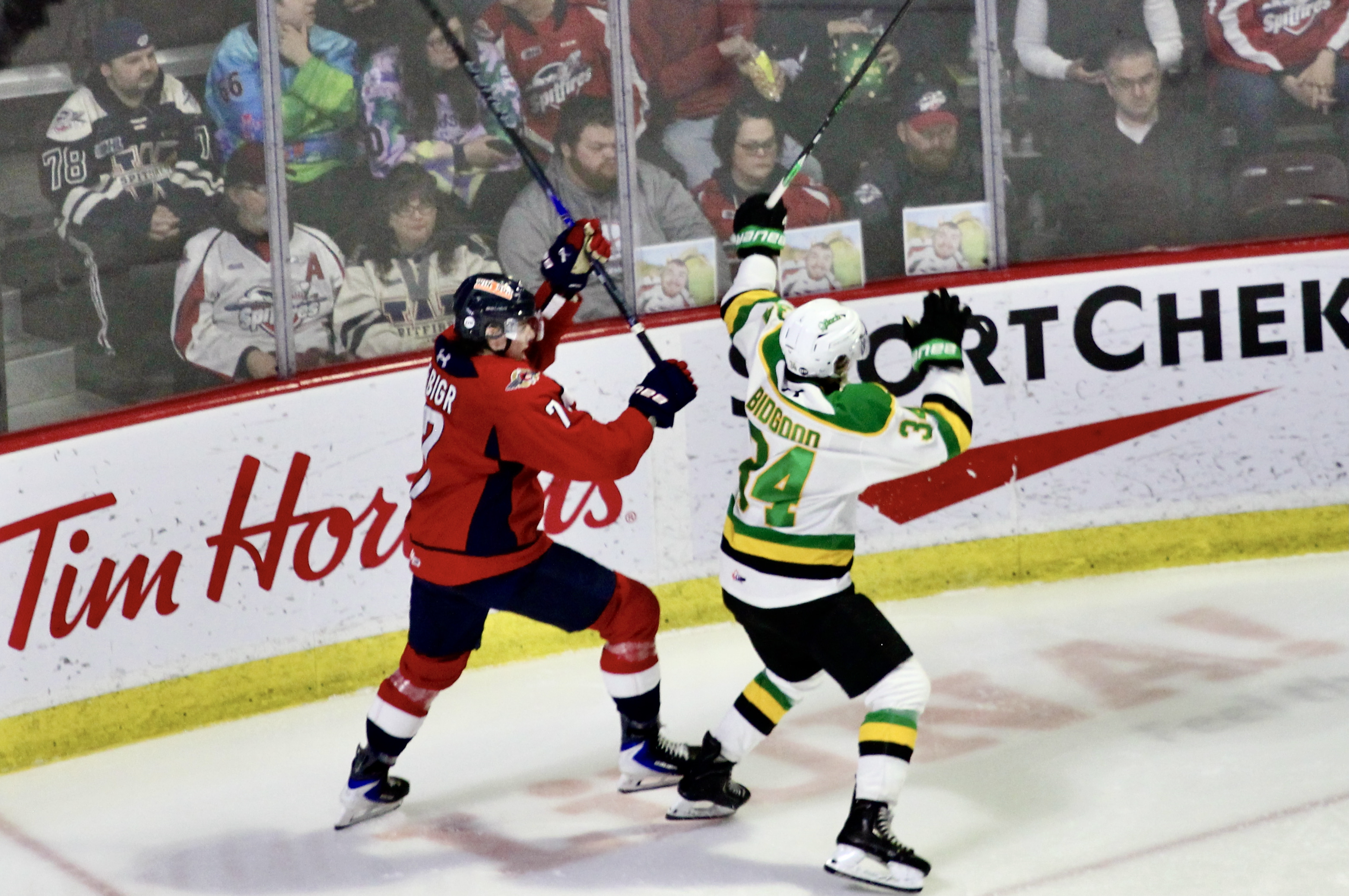
The air inside the Budweiser Gardens doesn’t just smell like popcorn and expensive beer. It smells like damp wool, sharpened steel, and the specific, metallic scent of shaved ice. For the London Knights, that scent usually carries the perfume of victory. But on a Tuesday night that felt more like a funeral than a tune-up for the playoffs, the atmosphere soured.
The scoreboard didn't just tell a story of a loss. It screamed it. Windsor 6, London 3.
To the casual observer scanning a ticker tape, it’s just a late-season blip. A lopsided score in a long 68-game grind. But in the OHL, where teenage boys carry the professional dreams of entire cities on their padded shoulders, there is no such thing as a throwaway game in March. Not when the Sault Ste. Marie Greyhounds are breathing down your neck. Not when a single point is all that separates a division lead from the precarious uncertainty of the second seed.
The Anatomy of a Collapse
Imagine you are a defenseman backpedaling into your own zone. Your lungs are burning. You can hear the rhythmic clack-clack-clack of an opponent’s stick against the ice, calling for the puck. You know exactly where the threat is coming from, but your legs feel like they’ve been replaced by lead pipes. This was the reality for London’s back end as the Windsor Spitfires—a team with nothing to lose and everything to prove—turned the Knights' defensive zone into a shooting gallery.
The Spitfires didn't just win; they dismantled.
It began with a flickering of momentum in the first period, a few missed assignments that would usually be covered by a spectacular save or a lucky bounce. But the bounces stayed in Windsor’s pocket. By the time the second period surged forward, the Knights looked less like a championship contender and more like a group of exhausted travelers who had lost their map.
The Invisible Standings
While the puck was sliding across the ice in London, the ghost of a team hundreds of miles away haunted the arena. The Sault Ste. Marie Greyhounds. The "Soo."
In the standings, the gap is a microscopic one point. Think about that. One point. It’s the difference between a puck hitting the post and going in, or a referee’s whistle blowing a half-second too early. It is a margin so thin you could bleed through it.
Every player in that locker room knows the math. They don't need a calculator to understand that the final week of the regular season has ceased to be a formality. It has become a sprint through a minefield. Losing to Windsor wasn't just about the two points left on the table; it was about the psychological leverage handed over to the Greyhounds. When you are chasing a ghost, every stumble feels like a fall off a cliff.
The Human Toll of the Regular Season Finish
We often treat these athletes as invincible avatars of skill. We see the jersey, the visor, and the highlight-reel goals. We forget that many of these "men" haven't yet reached their twentieth birthdays. They are navigating the pressures of professional-caliber expectations while their peers are worrying about prom dates or midterms.
When a lopsided loss like this happens, the silence in the room afterward is heavy. You can hear the velcro ripping on the shin guards. You can hear the heavy sighs. There is a specific kind of exhaustion that comes from underperforming when the stakes are highest. It’s not just physical fatigue; it’s the weight of knowing you let the standard slip.
London has always been a city of high standards. The green and gold isn't just a color scheme; it’s a mandate. To lose at home, in the final stretch, to a rival that took advantage of every single mistake, creates a tremor in the foundation.
The Technical Failure
If we strip away the emotion, the loss came down to a fundamental breakdown in puck management. The Knights are built on a philosophy of controlled aggression. They want to dictate the pace, use their speed to stretch the neutral zone, and force turnovers.
Against Windsor, the script flipped.
The Spitfires exploited the gaps between London’s defense and their retreating forwards. They utilized a North-South game that bypassed the Knights' transition game entirely. It was a tactical masterclass in disruption. When London tried to push, Windsor parried. When London hesitated, Windsor struck.
Consider the power play, usually a lethal weapon in the Knights' arsenal. On this night, it was a blunt instrument. The passes were a fraction of a second late. The shooting lanes were clogged with desperate bodies in Windsor jerseys. It was a reminder that in hockey, talent is the engine, but timing is the spark plug. Without timing, the engine just coughs and dies.
The One Point Precipice
Now, the Knights head into the final week of the season looking over their shoulders. The Greyhounds are there, waiting for another slip, another heavy-legged night, another defensive lapse.
The battle for the top spot isn't just about home-ice advantage in the playoffs, though that matters immensely. It’s about the narrative of the post-season. It’s about entering the dance as the hunter rather than the hunted. One point. It is the weight of a single beads of sweat. It is the difference between a roar of triumph and the cold, quiet realization that you’ve run out of time.
The ice will be flooded again tomorrow. The skate marks will be erased. But the memory of a 6-3 loss lingers in the marrow of the bones, a cold reminder that in the final week of March, nothing is given, and everything must be taken.
The Knights aren't just playing against their opponents anymore. They are playing against the clock, the standings, and the sudden, terrifying realization that their margin for error has evaporated into the cold arena air.