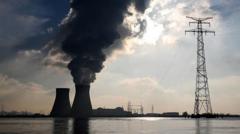
The European energy crisis has exposed a fundamental mismatch between decarbonization targets and the physical reality of baseload stability. While the previous decade prioritized a rapid transition to intermittent renewables—primarily wind and solar—the removal of Russian natural gas from the continental supply chain has revealed a structural deficit in firm power capacity. This deficit cannot be solved by battery storage at current chemical scales or by hydrogen cycles that remain in the prototype phase. The return to nuclear energy is not a sentimental pivot; it is a cold calculation of energy density, carbon intensity, and the levelized cost of system integration.
The Trilemma of Energy Density and Grid Inertia
The primary failure in contemporary energy discourse is the conflation of "installed capacity" with "utilization rate." Renewables often boast high nameplate capacities, yet their capacity factors in Europe typically fluctuate between 10% and 35%. Nuclear power plants consistently operate at capacity factors exceeding 90%. This discrepancy introduces a hidden cost: the requirement for 1:1 backup or massive overbuilding of the grid to manage peaks and troughs.
The physics of a synchronous grid requires "inertia"—the kinetic energy stored in large rotating masses (like the turbines in nuclear or gas plants). As synchronous generators are replaced by inverter-based resources (solar panels), the grid loses its natural ability to resist frequency changes. Nuclear provides this rotational inertia at scale, serving as a stabilizing anchor that intermittent sources currently cannot replicate without significant investment in synchronous condensers or high-cost electronic substitutes.
The Capital Expenditure Wall: Why Projects Stall
The economic barrier to a nuclear renaissance in Europe is not the cost of fuel or operations, but the Weighted Average Cost of Capital (WACC) and the duration of construction. Nuclear energy is characterized by a "front-heavy" cost structure.
- Regulatory Friction and Design Proliferation: Unlike the French "Messmer Plan" of the 1970s, which utilized a standardized reactor design to achieve economies of scale, modern Europe suffers from a fragmented regulatory environment. Each nation—and often each project—introduces bespoke modifications. This prevents the "nth-of-a-kind" (NOAK) cost reductions seen in South Korean or Chinese deployments.
- The Interest Rate Trap: Because a nuclear plant takes 10 to 15 years to build, interest during construction can account for up to 30% of the total project cost. If a government fails to provide low-interest financing or a "Regulated Asset Base" (RAB) model—where consumers pay a small amount during the construction phase to lower the risk for investors—the private sector will find the risk-adjusted return profile unattractive.
- Supply Chain Atrophy: Europe has spent thirty years decommissioning its nuclear manufacturing base. Rebuilding the talent pool of nuclear-certified welders, safety inspectors, and specialized engineers introduces a "first-mover penalty" for the first countries to re-engage with the technology.
Small Modular Reactors (SMRs) vs. Gigawatt-Scale Plants
The strategic debate has shifted from "nuclear vs. no nuclear" to "large-scale vs. SMRs." This choice represents a trade-off between thermal efficiency and financial agility.
Large-scale reactors, such as the EPR (Evolutionary Power Reactor), offer superior thermal efficiency and lower long-term costs per megawatt-hour once operational. However, their complexity makes them "too big to fail" yet "too big to build" for smaller European economies.
SMRs offer a different value proposition based on the modularization of risk. By manufacturing components in a controlled factory environment rather than on a chaotic construction site, developers aim to shorten the build time to under five years. The strategic advantage of SMRs is not that they are cheaper per unit of energy—they are often more expensive—but that they are easier to finance. A utility can build one 300MW module, start generating revenue, and use that cash flow to fund the second module.
The Geopolitical Cost of Uranium and Enrichment
Skeptics of the nuclear revival point to the supply chain of uranium as a new form of dependency, mirroring the previous reliance on Russian gas. This analysis is flawed for two reasons. First, uranium is energy-dense to an extreme degree; a single year’s fuel supply for a reactor can be stored in a warehouse, whereas gas requires constant pipeline flow or specialized LNG terminals. This allows for a "strategic fuel reserve" that provides years of buffer against price shocks.
Second, the bottleneck is not the raw ore, but enrichment capacity. Currently, Russia’s Rosatom holds a significant share of the global enrichment market. A viable European nuclear strategy requires an immediate and aggressive expansion of the Urenco-led enrichment facilities in the UK, Germany, and the Netherlands. Without a sovereign enrichment cycle, the "energy shock" merely shifts from a gas pipeline to a fuel rod.
Waste Management: The Technical vs. Political Gap
The technical solution for high-level nuclear waste is geological disposal. Countries like Finland, with the Onkalo spent nuclear fuel repository, have demonstrated that the engineering challenges are solved. The "waste problem" is a political and psychological barrier rather than a physical one.
The volume of waste produced by a nuclear plant is remarkably small. If an average European citizen used nuclear energy for their entire life, the resulting high-level waste would fit inside a soda can. Modern reactor designs also explore the use of "fast-spectrum" reactors that can utilize "spent" fuel from older plants as a fresh energy source, effectively turning waste into a resource and reducing the half-life of the remaining byproduct from thousands of years to mere centuries.
The Opportunity Cost of the "100% Renewable" Dogma
The pursuit of a 100% renewable grid introduces a "diminishing returns" problem. As the percentage of intermittent energy increases, the cost of the last 20% of decarbonization rises exponentially due to the requirement for seasonal storage (storing summer solar for winter heating).
Nuclear serves as the "clean floor" of the energy system. By providing 30% to 50% of the baseload, nuclear allows the remaining grid to be filled with low-cost wind and solar without requiring the astronomical investment in battery storage that a pure renewable play demands. This hybrid model—often referred to as "Firm Low-Carbon Power"—is the only pathway that maintains industrial competitiveness. High energy prices in Germany, driven by the "Energiewende" and the premature shutdown of nuclear assets, have already led to deindustrialization in energy-intensive sectors like chemicals and steel.
Strategic Execution: A Three-Point Directive for European Energy
To move beyond the rhetoric of "revival" and into functional energy security, European states must execute on three specific structural shifts.
First, the establishment of a Unified European Nuclear Regulator. The current system of national licensing is a relic. A reactor design approved in France should be legally pre-certified in Poland and the Czech Republic. This standardization is the only way to achieve the "fleet effect," where costs drop as the number of identical units increases.
Second, the adoption of Contract-for-Difference (CfD) Financing. The market price of electricity is too volatile to support the 40-year payback period of a nuclear plant. Governments must provide a guaranteed "strike price" for nuclear generation. This protects the investor from price crashes and protects the consumer from price spikes, creating a stable environment for the massive capital outlays required.
Third, the integration of Nuclear-Industrial Cogeneration. Future nuclear plants should not just produce electricity. The "waste heat" from reactors can be used for district heating or to provide the high-temperature steam necessary for industrial processes and green hydrogen production. By positioning nuclear plants as "energy hubs" for industrial parks, the efficiency of the plant increases from roughly 33% (electricity only) to over 70% (combined heat and power).
The window for a "gradual" transition has closed. The energy shocks of the mid-2020s have proven that a grid built on high-variance sources and external gas dependencies is a strategic liability. The transition to a nuclear-heavy baseload is not a rejection of green energy, but the necessary infrastructure to make green energy viable. Nations that prioritize the rapid deployment of standardized, Gen-III+ and Gen-IV reactors will secure a decades-long advantage in industrial pricing and sovereign autonomy. Those that continue to treat energy policy as a subset of moral philosophy will face a permanent state of economic contraction.
The final strategic move is the immediate decoupling of electricity pricing from marginal gas costs. By "ring-fencing" nuclear and renewable production into a separate pricing tier, Europe can ensure that the low operating costs of these technologies are passed directly to the consumer, rather than being held hostage by the price of the most expensive megawatt-hour on the market.