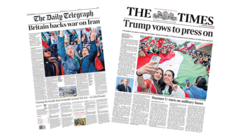
The tea had gone cold on a million kitchen tables across Britain before the first ink reached the presses. It was a Tuesday night, the kind of damp, unremarkable evening where the most pressing concern for most should have been the morning commute or the rising cost of a pint. Instead, a heavy, familiar dread began to settle.
On the front pages of the early editions, the headlines didn't just report news. They sounded like a drumbeat. For a more detailed analysis into this area, we recommend: this related article.
"Britain backs war on Iran."
The words are short. Sharp. They carry the weight of lead. When you see a sentence like that, you don't think about geopolitical strategy or the intricacies of the Strait of Hormuz. You think about your son. You think about the girl next door who joined the reserves to pay for university. You think about the silence of a street that has lost its young. For broader details on this topic, extensive coverage can also be found on USA Today.
Across the Atlantic, another man was making his own headlines. Donald Trump, draped in the familiar bravado that has become the background radiation of modern life, vowed to press on. Two titans, two different hemispheres, one shared trajectory toward a cliff edge.
The Human Cost of a Map
To a strategist in a windowless room in Whitehall, Iran is a series of coordinates. It is a set of nuclear enrichment facilities, a network of proxy militias, and a logistical puzzle to be solved with precision-guided munitions.
But consider a man named Elias.
He is hypothetical, but his reality is mirrored in thousands of homes from London to Tehran. Elias owns a small grocery in North London. He moved here twenty years ago. He pays his taxes, he worries about the damp in his cellar, and he watches the news with a hollow feeling in his chest. For Elias, "Britain backs war" isn't a policy shift. It is the possibility that the bridge between his two worlds is about to be incinerated.
He knows that when the missiles fly, they don't just hit "strategic assets." They hit the neighborhood where his aunt still buys bread. They hit the memory of the jasmine trees in his grandmother’s courtyard.
War is often sold as a surgical necessity, a clean excision of a malignant threat. The reality is much messier. It is the sound of a shattering window in a quiet suburb. It is the sudden, frantic scramble for a passport. It is the realization that the world you knew yesterday is gone, replaced by a ledger of casualties and "collateral damage."
The Vow of the Persistent
While the UK papers were grappling with the specter of conflict, the American narrative was focused on the internal combustion of its own democracy. Trump’s vow to "press on" despite the mounting legal and political storms isn't just a campaign slogan. It is a psychological state.
Power, once tasted, becomes a necessity. It is a shield against the consequences of the past and a weapon to carve out the future.
For the average voter, this persistence is polarizing. To some, it is the ultimate expression of strength—a refusal to blink in the face of an establishment that wants him gone. To others, it feels like a slow-motion car crash that no one is allowed to look away from.
When a leader vows to press on regardless of the cost, the cost is rarely paid by the leader. It is paid by the civility of the dinner table. It is paid by the trust in the local polling station. It is paid by the person who just wants to know if their pension will be worth anything in five years.
The Invisible Threads
We like to think these stories are separate. We put the "International Conflict" in one box and "Domestic Politics" in another. We pretend that the decision to back a war in the Middle East has nothing to do with a defiant political campaign in the United States.
We are wrong.
These events are woven together by the same thread of uncertainty. We are living in an era where the old rules have been burned, and the new ones are being written in real-time by people who seem more interested in the "win" than the "aftermath."
The "war on Iran" headline is a symptom of a world where diplomacy has become a dirty word. It suggests that we have reached the end of the conversation. When the talking stops, the metal starts moving.
Think about the sheer logistics of what "backing a war" means. It means the roar of Typhoon jets taking off from RAF Akrotiri. It means the silent, submerged tension of a nuclear-powered submarine. It means a logistics officer in a warehouse in Oxfordshire checking the inventory of body bags.
It is easy to support a war when it is an abstract concept discussed over coffee. It is much harder when you realize that every "strategic strike" creates a thousand new reasons for someone to hate us. Every bomb dropped is a seed planted for the next generation's conflict.
The Weight of the Morning Paper
By the time the sun rose over the Thames, the headlines had already begun to shift. The digital cycle is relentless. The "War on Iran" headline was replaced by a celebrity scandal or a weather warning.
But for those who stopped to read the small print, the gravity remained.
We are often told that we are more connected than ever before. We have the world in our pockets. We can see a drone strike in real-time or read a tweet from a former president the second it is posted.
Yet, we have never been more detached from the consequences of these events. We scroll past the threat of global conflict as if it were just another piece of content, another "story" to be consumed and forgotten.
The person who writes the headline "Britain backs war" isn't the person who has to pull a child from the rubble. The person who vows to "press on" through a legal minefield isn't the person who loses their job when the markets tank because of political instability.
We are the audience in a theater where the actors have forgotten the script and are now improvising with live ammunition.
The Quiet Middle
In the middle of all this noise—the shouting headlines, the defiant vows, the geopolitical posturing—there is the quiet reality of the people just trying to live.
There is the nurse finishing a night shift, reading the paper at a bus stop, wondering if the "war" will mean more cuts to the NHS. There is the student in Tehran, dreaming of a career in engineering, wondering if the sky will stay blue or turn to smoke. There is the farmer in Iowa, hearing the news on the radio, wondering if the world is finally going mad.
These are the people the headlines forget.
They are the ones who bear the weight of every "pivotal" decision. They are the ones who have to find a way to explain to their children why the world feels so fragile.
Conflict is not an inevitability. It is a choice. It is a choice made by people in suits who believe that the map is the reality. They believe that if they just push hard enough, the world will bend to their will.
But the world is not a map. It is a living, breathing collection of billions of stories. It is Elias’s grocery store. It is the morning commute. It is the cold tea on the kitchen table.
When we talk about "backing a war" or "pressing on," we are talking about the potential end of those stories. We are talking about the moment the narrative stops and the tragedy begins.
The headlines will continue to scream. The leaders will continue to vow. But in the quiet moments between the news cycles, we have to ask ourselves: how many more times can we hold our breath before we simply run out of air?
The ink is dry. The papers are out. The world is waiting for the next move, unaware that the most important moves are the ones that prevent the headlines from coming true.
Tomorrow, there will be a new front page. There will be a new crisis, a new vow, a new reason to be afraid. But for now, there is only the silence of the morning and the heavy, lingering weight of the words we haven't yet found the courage to say.
The jets are on the tarmac. The cameras are rolling. The world is watching, not because it wants to see the end, but because it’s terrified it already has.