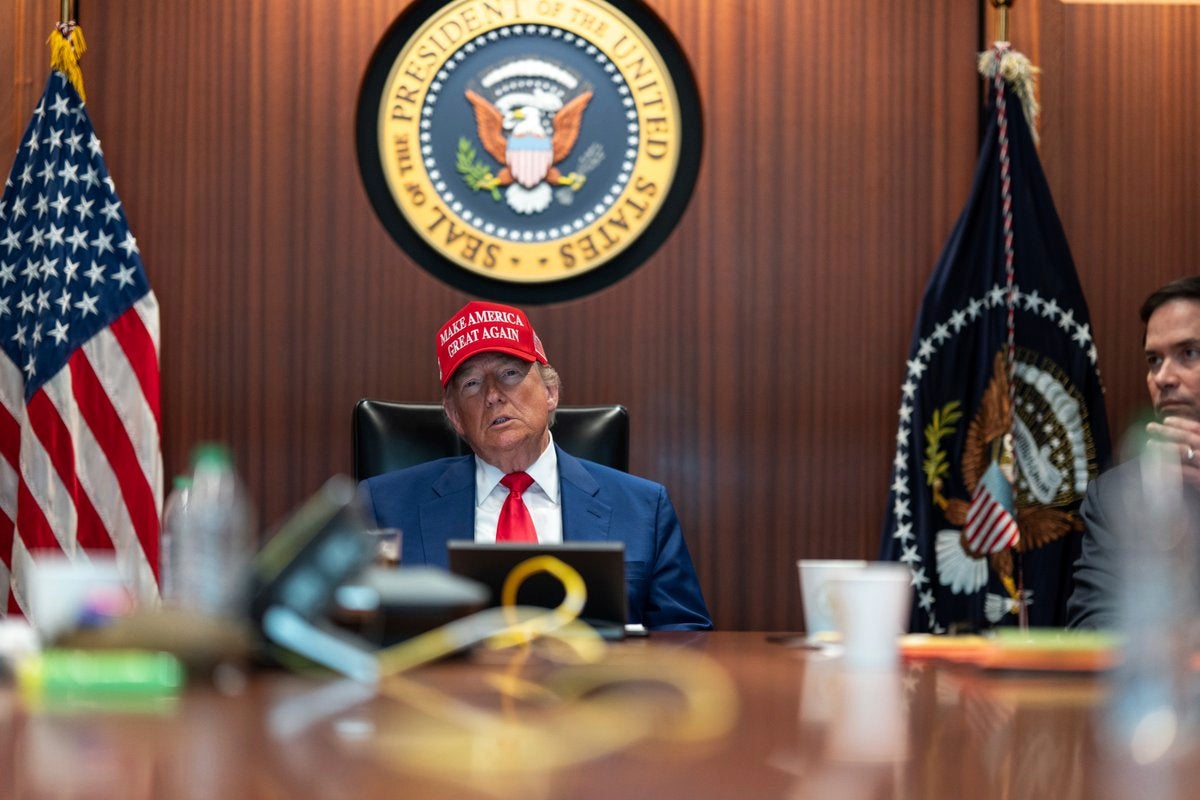
The air in the Situation Room does not smell like history. It smells like stale coffee, ozone from cooling fans, and the muted, clinical scent of expensive wool suits. There is a specific kind of silence that exists in the forty-eight hours after a strike is ordered—a heavy, pressurized quiet that sits in the lungs of every aide, general, and analyst. It is the silence of a fuse that has already been lit.
When the news broke that Qasem Soleimani had been killed in a drone strike outside Baghdad International Airport, the world didn't just wake up. It jolted. For the people tasked with managing the immediate fallout, those first two days were not a series of bullet points on a briefing slide. They were a frantic, high-stakes sprint to prevent a regional brushfire from becoming a global inferno.
Consider the human at the center of the digital storm. Somewhere in a windowless room in Virginia, an analyst watches a screen. They aren't looking at "geopolitical shifts." They are looking at heat signatures. They are looking at the movement of Iranian fast boats in the Persian Gulf. They are watching the digital chatter of encrypted networks bloom like a sudden, violent garden.
The first twelve hours were a blur of confirmation and confusion. In Tehran, the grief was not just political; it was visceral. Soleimani was a shadow-man, a figure who occupied a space between a general and a folk hero. To kill him was to tear a hole in the Iranian national psyche. As the crowds began to gather, the American side had to reckon with a terrifying reality: they had removed a piece from the board, but the board was now vibrating with unpredictable energy.
Security isn't an abstract concept when you’re a diplomat in a "hardship post" in the Middle East. For those individuals, the first forty-eight hours were defined by the sound of heavy blast doors slamming shut. It was the frantic scrubbing of hard drives. It was the realization that your face, your name, and your location were now potential targets for a thousand different types of retaliation. The "invisible stakes" for these people weren't about oil prices or election cycles. They were about whether the concrete walls surrounding them were thick enough to withstand a rocket-propelled grenade.
By the twenty-four-hour mark, the focus shifted from the kinetic—the explosion, the fire, the metal—to the rhetorical. This is where the modern machinery of war truly grinds. Every tweet from the Oval Office acted as a fresh splash of gasoline. To the critics, it was reckless provocation. To the supporters, it was a necessary re-establishment of a "red line" that had become blurry and frayed over years of proxy conflicts.
But the real problem lies elsewhere, hidden in the sheer speed of modern escalation.
In the old days of the Cold War, a crisis had a certain rhythm. A letter would be sent. A phone call would be placed. There was time for the adrenaline to level out. Now, we live in an era of instantaneous feedback loops. An Iranian official posts a photo of a flag on social media, and within seconds, algorithmic trading bots in New York are dumping stocks. The distance between a thought and a global consequence has shrunk to almost zero.
Imagine a young family in Isfahan. They aren't thinking about the Revolutionary Guard’s grand strategy. They are looking at the rising price of bread and wondering if the sky is about to fall. Imagine a sailor on a U.S. destroyer in the Strait of Hormuz, staring into the green glow of a radar screen, knowing that a single mistake—one nervous finger on a button—could start a war that their younger siblings would have to fight.
These are the people the headlines forget.
As the clock ticked toward the forty-eight-hour limit, the world held its breath for the "crushing revenge" promised by the Supreme Leader. The tension was a physical weight. Intelligence reports indicated that Iranian missile batteries were being moved. Cyber-security firms reported a massive spike in probing attacks against American infrastructure. The war wasn't just happening in the desert; it was happening in the wires under our streets and the servers in our basements.
The strike wasn't just an act of war. It was a stress test for the entire global order.
Consider what happens next: a missile is fired, but it misses its intended mark. Or perhaps it hits, but the casualties are lower than expected. In that narrow window of uncertainty, the fate of millions hangs on the temperament of a few dozen men in two different capitals who don't trust each other. The first forty-eight hours were a masterclass in the terrifying fragility of peace.
We often talk about "strategic assets" and "surgical strikes" as if they are clean, clinical things. They aren't. They are messy. They bleed. They leave behind a vacuum that nature—and politics—abhors. When the smoke cleared from that initial strike, it revealed a landscape where the old rules no longer applied, but the new rules hadn't been written yet.
The strike was a gamble on the idea that strength deters aggression. But the human element is rarely that logical. Pride, grief, and the need to save face are far more powerful drivers of history than a cost-benefit analysis. During those two days, the world wasn't watching a chess match. It was watching a game of Russian Roulette where the gun was pointed at the collective head of the Middle East.
The weight of those hours stayed with everyone involved. It stayed with the pilots who flew the missions. It stayed with the translators who had to listen to the screams on the ground. It stayed with the citizens who realized, perhaps for the first time in a decade, how thin the ice really is.
The story of those forty-eight hours isn't found in the official press releases. It’s found in the trembling hands of a technician looking at a satellite feed, waiting for the first launch flash. It’s found in the quiet prayers of a mother in Baghdad who just wants the drones to stop humming overhead so her children can sleep.
We like to believe we are in control of the machines of state. We build the systems, we program the drones, and we write the treaties. But in the heat of a crisis, the systems take over. The momentum of the machine becomes almost impossible to stop.
By the end of that second day, the world had changed. The pieces were still on the board, but the board itself had been tilted. We walked right up to the edge of the canyon, looked down into the dark, and for a moment, we all felt the wind pulling us toward the drop.
The silence returned eventually, but it was a different kind of quiet. It was the silence of a house after a break-in—a place that looks the same but feels fundamentally violated. The first forty-eight hours were a reminder that we are all just one decision away from a different world.
There is a light that stays on in the West Wing long after everyone has gone home, a solitary glow against the dark of the lawn, marking the spot where the world's most dangerous decisions are made by people who are just as tired, just as scared, and just as human as the rest of us.