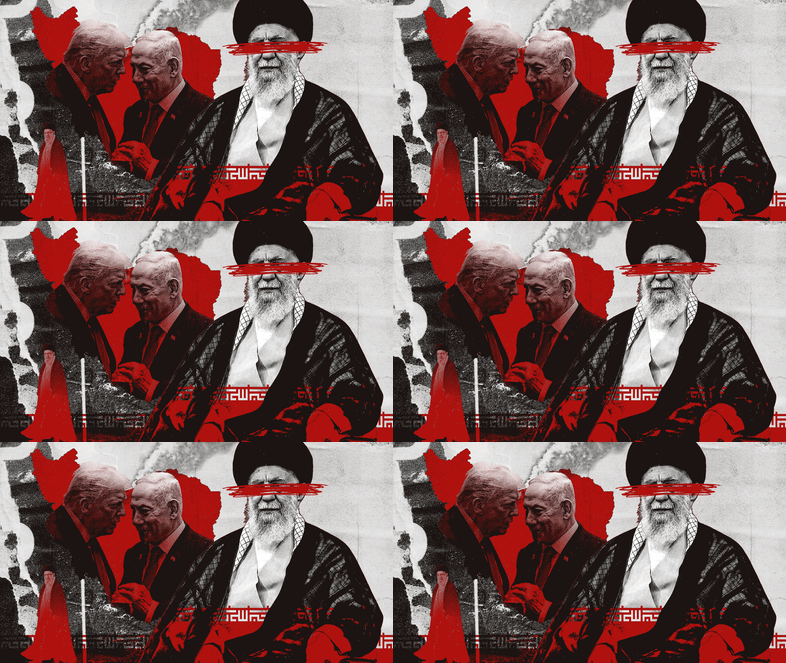
The silence of a Tehran night has a specific density. It is the sound of millions of people breathing in unison, a heavy, humid stillness that settles over the Alborz mountains. On this particular Saturday, that silence did not fade into the morning. It was shattered.
Imagine a radar operator in a darkened room. We will call him Arash. He is not a warmonger or a strategist; he is a man who thinks about his daughter’s upcoming exams and the faint hum of the cooling fans in his workstation. Suddenly, his screen—a green-tinted window into the vacuum of the upper atmosphere—blossoms with digital ghosts. These are not birds. They are not commercial liners straying off course. They are the signature of a coordinated, multi-layered kinetic event.
This was the moment the theoretical became physical.
The First Wave
Precision is a cold word. It implies a surgical neatness that masks the sheer violence of a supersonic missile meeting a fixed target. At approximately 2:00 AM, the first echoes of explosions rolled across the outskirts of Tehran and Karaj. These weren't random strikes. The United States and Israel had choreographed a sequence designed to blind before they bruised.
The initial targets were the "eyes" of the Iranian defense system. Integrated air defense batteries, many of them Russian-made S-300 systems, were the primary focus.
When a radar site is hit, it doesn't just stop working. It disappears in a secondary cook-off of electronics and high explosives. For the men stationed at those sites, the war didn't start with a manifesto or a diplomatic cable. It started with a flash that turned the night into a blinding, artificial noon.
The Calculus of Clouds
Military analysts often talk about "degrading capabilities." It sounds like a corporate performance review. In reality, it means that for several hours, the Iranian military was fighting a ghost. Over 100 aircraft—including F-35 "Adir" stealth fighters—navigated the narrow corridors of regional airspace.
The logistical nightmare of such an operation is staggering. Tanker planes circled in the shadows, passing fuel to fighters like silver nursing mothers in the dark. These jets crossed thousands of miles, navigating through the sovereign airspace of multiple nations, some of whom looked away, while others watched with bated breath, praying the sparks wouldn't land on their own dry tinder.
The Israeli Defense Forces (IDF) named this "Operation Days of Repentance." The name itself is a heavy piece of rhetoric, suggesting a moral balance being restored. But for the civilians in Tehran, there was no theology in the sound of the booms. There was only the vibration in the floorboards and the frantic checking of Telegram channels to see if the world was ending.
The Invisible Stakes
Why now? Why this specific intensity?
To understand the "why," you have to look past the fire. This wasn't just a response to the 200 ballistic missiles Iran launched toward Israel weeks prior. It was a communication. In the language of modern warfare, a missile strike is a paragraph. This operation was a dissertation.
By striking the facilities that produce the solid fuel for Iran's missile program, the attackers weren't just hitting today’s weapons. They were hitting next year’s weapons. They were targeting the industrial heart of the program—the mixers and the planetary centrifuges that create the propellant for the Shahab and Kheibar missiles.
If you destroy a missile, you’ve won a moment. If you destroy the machine that makes the missile, you’ve won a season.
The United States played a role that was both central and peripheral. While American boots weren't on the ground and American pilots weren't over the targets, the "Total Force" concept was in full effect. Intelligence sharing, regional positioning of THAAD (Terminal High Altitude Area Defense) batteries to protect Israel from retaliation, and a diplomatic full-court press to limit the target list were all part of the architecture.
Washington’s goal was a delicate, almost impossible paradox: hit Iran hard enough to satisfy Israeli security needs, but soft enough to prevent a total regional conflagration. They wanted a sting, not a decapitation.
The Human Echo
Back to Arash. Or perhaps a mother in an apartment in western Tehran, clutching a crying child. To her, the "strategic degradation of solid-fuel mixing facilities" is a meaningless string of syllables. What is real is the smell of ozone and the way the car alarms in the street below won't stop screaming.
We often view these events through the lens of a satellite. From 20,000 feet, the explosions are just tiny sparks on a thermal map. They look clean. They look like a video game. But on the ground, the air pressure changes. The windows rattle in their frames with a frequency that sits in your bones.
There is a psychological weight to being overflown. It is the realization that the ceiling of your world has been breached. For decades, Iran’s "forward defense" strategy was built on the idea that the fight would happen elsewhere—in Lebanon, in Iraq, in Yemen. This night brought the fight to the capital. The myth of the impenetrable shield didn't just crack; it was dismantled in three distinct waves.
The Morning After the Fire
As the sun began to crest over the Alborz, the smoke started to settle. The state media reports began their inevitable pivot, downplaying the damage, claiming the "air defense systems successfully intercepted most threats." It is a familiar script.
But the satellite imagery—the unblinking eyes of commercial and intelligence sensors—tells a different story. Scorched earth at the Parchin military base. Damaged structures at the Khojir missile production site. These are the scars of a very specific kind of surgery.
The real damage, however, isn't just in the concrete and the steel. It’s in the shift of the "Red Line."
For years, an unwritten code governed this shadow war. You hit my proxy, I hit your ship. You kill my scientist, I hack your infrastructure. That code is now ash. We have entered an era of direct, state-on-state kinetic exchange. The shadow has retreated, and the war is standing in the middle of the room, staring everyone in the eye.
Consider the cost of a single interceptor missile. Consider the cost of a single F-35. Now consider the cost of a child growing up in a city where the sky can turn white at 3:00 AM.
The geography of the Middle East hasn't changed, but the geometry of its fear has. The lines on the map remain the same, but the distance between a quiet dinner and a regional apocalypse has shrunk to the length of a flight path.
The planes have returned to their hangers. The pilots have unstrapped their masks. The diplomats are back at their mahogany tables, spinning the night’s violence into "strategic outcomes."
But in Tehran, the dust is still settling on the windowsills. People are sweeping up glass. They are looking at the sky, not for the sun, but for the next ghost on the radar. The silence has returned, but it is no longer heavy. It is brittle. It is the kind of silence that feels like it might break if you breathe too deeply.
Somewhere in the city, a man turns off a radar screen that no longer shows any ghosts. He walks outside and looks at a horizon that is finally, mercifully, dark again. He wonders how many more times the night can be broken before it stays broken forever.


