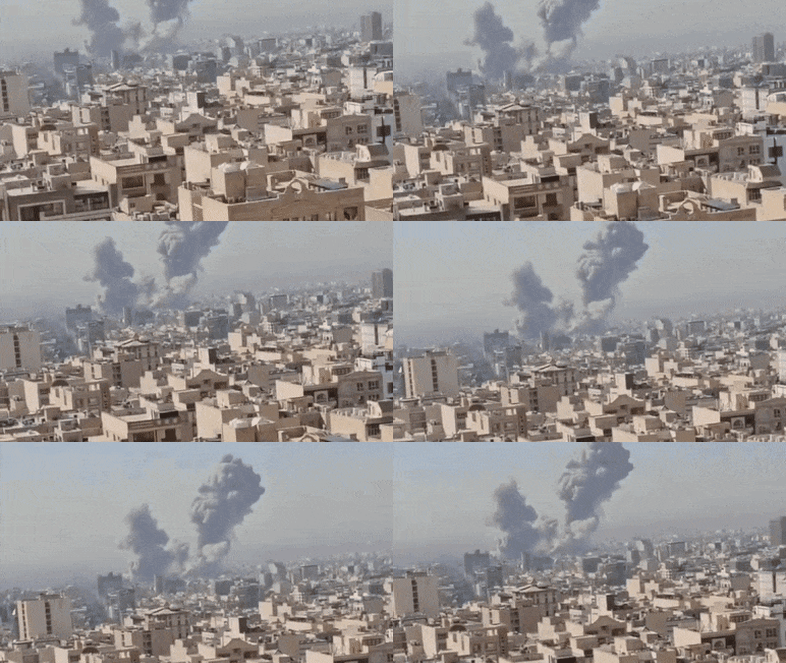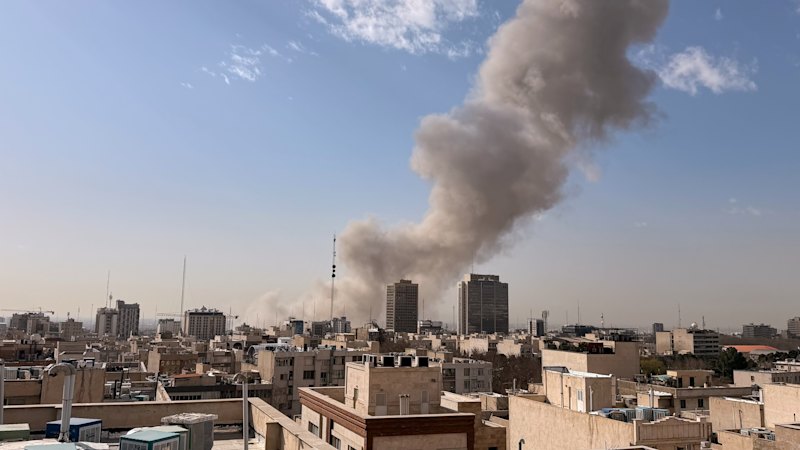
The smell of ozone and burnt rubber doesn’t care about geopolitical posturing. When the first explosions rattled the windows of apartment blocks in Tehran, the residents weren’t thinking about diplomatic cables or the nuances of international law. They were thinking about their children’s breathing. They were thinking about how the floor felt beneath their feet—suddenly fragile, like thin ice over a dark lake.
For decades, the rhetoric between Washington and Tehran has been a predictable dance of shadows. Sanctions, threats, and proxies. But the air changed this week. It became heavy. Electric.
The Sound of a Crumbling Status Quo
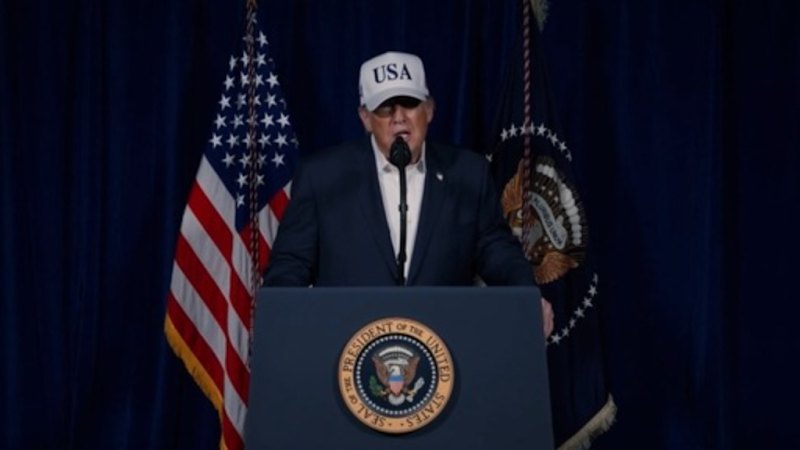
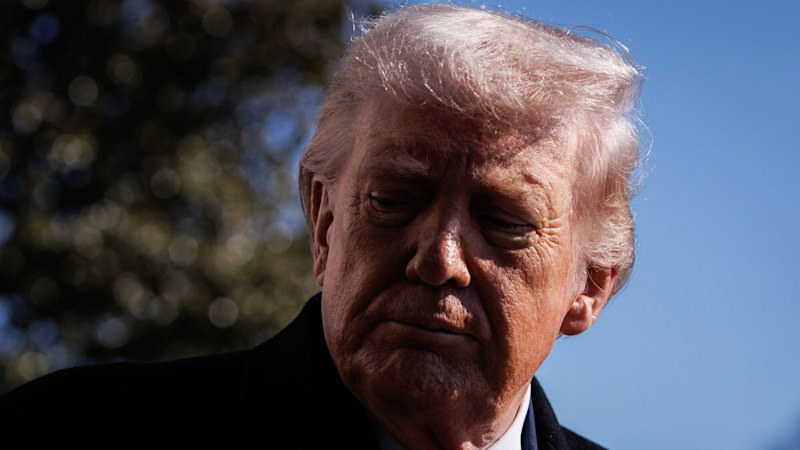
Donald Trump’s recent demand for the Iranian regime to lay down its arms didn’t arrive in a vacuum. It arrived amidst the literal thunder of strikes hitting military infrastructure across the country. This isn't just another cycle of "maximum pressure." It feels like the breaking of a dam.
Consider a shopkeeper named Amin. He is a hypothetical man, but his reality is shared by millions. He remembers the stories his father told of the Iran-Iraq war, the way the sirens sounded like a physical weight pressing down on the city. For years, Amin has balanced the ledger of a failing economy, watching the rial lose its value while the billboards above his shop shouted slogans about eternal resistance.
When the news broke that the U.S. President was calling for a total disarmament of the Revolutionary Guard, Amin didn't see a political victory. He saw the end of an era. The regime’s narrative—that they are the impenetrable shield of the people—was being punctured by the reality of precision munitions hitting targets within earshot of the Grand Bazaar.
The Invisible Stakes of a Disarmed State
Why does this matter more than the headlines suggest? Because we are witnessing the collision of two irreconcilable realities. On one side, you have a Western administration that views the Iranian military apparatus as a global arsonist. On the other, you have a ruling elite that views their weapons not as tools of war, but as the very bones of their survival.
To tell a regime to lay down its arms is to tell a man to step out of his skin. It is an existential demand.
The strikes hitting the country are tactical, aimed at missile sites and command centers, but the psychological impact is strategic. They are designed to show the Iranian public that the shield is broken. Yet, the danger of this approach lies in the vacuum. History is a cruel teacher when it comes to sudden power collapses.
We often talk about "regime change" or "disarmament" as if they are chess moves. They aren't. They are more like open-heart surgery performed with a broadsword. If the IRGC were to actually lay down their arms tomorrow, the immediate result wouldn't be a peaceful democracy. It would be a scramble for the soul of a nation that has been under pressure for forty years.
The Weight of the Word
The language used by the American presidency in this moment is sharp. It lacks the traditional buffers of State Department "concern." By telling the regime to surrender their weapons while their bases are smoking, the U.S. is signaling that the time for "containment" is over.
But what does this mean for the person in the street?
It means uncertainty. It means watching the sky every time a car backfires. It means wondering if the next strike will hit a power plant, a water treatment facility, or a neighbor’s house.
The facts are clear: Iran’s regional influence has been built on a network of missiles and militias. The U.S. objective is to dismantle that network. The statistics of the strikes—the number of batteries destroyed, the tonnage of explosives used—are easily verified. But those numbers don't capture the sound of a mother singing to her toddler to drown out the distant boom of a drone strike.
The Logic of the Brink
There is a terrifying symmetry to this escalation. The Iranian leadership has long played a game of "brinkmanship," pushing the envelope just far enough to extract concessions without triggering a full-scale war. They believed the West was too tired of "forever wars" to actually strike the heart of the country.
They were wrong.
The current strikes represent a fundamental shift in the risk calculus. The U.S. is no longer worried about "provoking" a response; they are actively dismantling the capacity to respond. It is a gamble of historic proportions. If it works, the regime is forced to the table in a position of unprecedented weakness. If it fails, the region enters a period of chaos that makes the last two decades look like a rehearsal.
A Nation at the Crossroads
The streets of Tehran are quiet today, but it is a heavy, unnatural silence. It is the silence of people waiting for the other shoe to drop.
When we read about "attacks rocking the country," we should visualize the dust. The fine, grey dust that settles on everything after a blast. It settles on the tea sets in living rooms. It settles on the dashboards of taxis. It is the physical manifestation of a world being torn down.
The regime is faced with a choice that isn't really a choice. Laying down their arms means the end of their power. Keeping them means the systematic destruction of their infrastructure. It is the ultimate checkmate, played out in the most volatile corner of the globe.
We often look for the "game-changer" in these stories—to use a term that fails to capture the gravity—but the real story is the endurance of the people caught in the middle. They are the ones who will have to live in whatever world emerges from the smoke.
Whether the regime listens to the command to disarm or doubles down on a suicidal defense, the Iranian people are the ones holding the bill. They are the ones who will rebuild the bridges, or walk across the ruins of them.
The red glow in the sky over Tehran wasn't just the fire of a missile hitting its mark. It was the light of a fire that has been smoldering for four decades, finally breaking through the roof. The world is watching the flames, but the people on the ground are the ones feeling the heat.
They are waiting to see if the morning brings a new kind of peace, or just a different kind of war.