The Silence Before the Sirens
The air in Tehran usually carries the scent of roasted saffron and exhaust fumes, a thick, familiar blanket that settles over the city as the Alborz mountains fade into the evening gloom. But on that Friday night, the air felt thin. Brittle. It was the kind of atmospheric tension that precedes a lightning strike, only this time, the storm was carved from steel and silicon.
When the flashes finally tore through the darkness, they weren't the erratic flickers of nature. They were precise. Methodical. The rhythmic thud of explosions rolling across the outskirts of the city signaled a breach of the invisible lines that hold the modern world together. While families huddled in basements and teenagers stared at glowing Telegram feeds in disbelief, the machinery of global diplomacy was already churning three thousand miles away in New York.
The United Nations Security Council is often described as a theater of the elite, a room of polished wood and muted carpets where the fate of millions is discussed in the hushed tones of the detached. Yet, as the news of the U.S.-supported Israeli strikes on Iranian soil filtered into the chamber, the air there grew just as heavy as the smoke over the Karaj heights. This wasn't just another exchange of fire in a decades-long shadow war. It was a puncture wound in the side of international law.
The Architect of Alarm
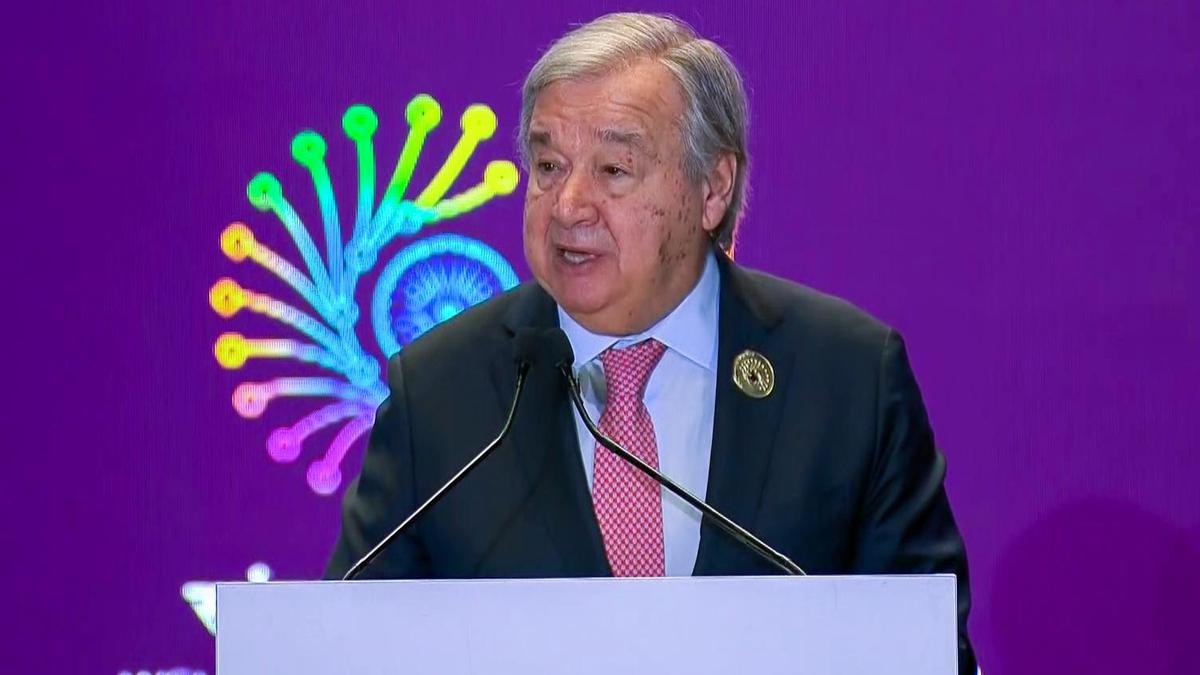
António Guterres does not have the luxury of anger, but he possesses a profound capacity for dread. As the UN Secretary-General stepped to the podium during the emergency session, he looked like a man watching a glass vase tilt toward a marble floor. He didn't lead with statistics or logistical data. He led with the fragility of the human soul.
He spoke of a region on the brink, a phrase we have heard so often it has lost its teeth. But Guterres gave it back its bite. He condemned the escalation with a bluntness that bypassed the usual bureaucratic filters. To him, and to the millions watching from the shadows of the Middle East, these strikes represented a failure of imagination—a refusal to see the faces of the people who live beneath the flight paths of the F-35s.
Imagine a father in a suburb of Isfahan. Let’s call him Omid. Omid isn't a strategist. He doesn't care about the enrichment percentages of uranium or the tactical advantages of neutralizing integrated air defense systems. He cares about the fact that his seven-year-old daughter is shaking so hard she can’t hold her water glass. To Omid, the "strategic objectives" of a foreign power feel like a personal assault on his right to exist in peace. This is the human cost that gets edited out of the press releases.
The Shadow of the Superpower
The narrative presented by the attackers was one of necessity—a pre-emptive strike to dismantle a looming threat. The U.S. stance was clear: support for Israel’s "right to defend itself" is an ironclad vow. But as the debate raged in the Security Council, a different question began to haunt the room.
Where does defense end and provocation begin?
The logic of the strike was built on the idea of deterrence. It’s a cold, mathematical theory: if you hit your opponent hard enough, they will be too afraid to hit back. However, history is a graveyard of failed deterrence. Each explosion in the desert or the outskirts of a metropolis acts as a seed. It plants resentment, fertilizes radicalism, and ensures that the next generation grows up with a heart hardened by the sound of falling masonry.
The U.S. involvement, whether through intelligence sharing or logistical green-lighting, shifts the gravity of the conflict. It moves it from a regional spat to a global crisis. When the world’s largest military power signals that international borders are porous for those with enough firepower, the very foundation of the UN Charter begins to crack. Guterres wasn't just mourning the loss of peace; he was mourning the loss of the rules.
The Invisible Stakes
We often talk about "geopolitics" as if it’s a game of chess played by giants. We analyze the moves, the gambits, and the sacrifices. But in this game, the pawns bleed.
The strikes targeted military installations, yes. But bullets and bombs are blunt instruments. They disrupt power grids. They shatter windows in civilian hospitals. They cause the price of bread to skyrocket as global markets panic over the Strait of Hormuz. For a family in Yemen or a shopkeeper in Lebanon, a strike on Iran isn't a headline—it's a harbinger of a wider fire that might soon consume their own street.
Consider the mechanics of the emergency meeting itself. The diplomats sat in a circle, a shape meant to represent equality and unity. Yet the veto power and the backroom alliances meant that the condemnation of the attacks was largely symbolic. This is the paradox of modern peace-keeping. The people with the power to stop the violence are often the ones providing the coordinates.
Guterres pointed to this hypocrisy without saying the word. He spoke of the "double standards" that erode the credibility of the international community. If one nation can claim "pre-emption" as a valid excuse for an invasion or a strike, then any nation can. We are moving toward a world where might doesn't just make right—it makes reality.
The Ghost in the Machine
The technology used in these attacks—the precision-guided munitions, the stealth capabilities, the cyber-electronic warfare—is designed to be "clean." The marketing for modern warfare suggests that we can now remove our enemies with surgical precision, leaving the surrounding world untouched.
It is a lie.
There is no such thing as a clean war. Even if not a single civilian life was lost—a statistical impossibility in such a densely populated region—the psychological trauma is a form of pollution. It lingers in the air long after the smoke clears. It changes the way people look at the sky.
In the Security Council, the representatives of the U.S. and Israel spoke of "neutralizing threats." They spoke in the passive voice, the language of the laboratory. But the Iranian representative spoke in the active voice, the language of the victim. The disconnect was total. It was as if two different species were describing the same event from two different dimensions.
The real tragedy of the emergency meeting wasn't the lack of a resolution. It was the realization that the language of diplomacy has become a dead tongue. We no longer have the words to convince one another to stop. We only have the words to justify why we started.
The Echo in the Halls
As the session drew to a close, the delegates filed out into the crisp New York air. For them, the day was over. They would go to dinner, perhaps have a drink at a bar near Turtle Bay, and sleep in beds that would not be shaken by the roar of jet engines.
But for Omid in Isfahan, and for millions like him across the fractured landscape of the Middle East, the night was just beginning. They are the ones left to interpret the silence. They are the ones who have to explain to their children why the world feels like it wants to break them.
The UN Chief’s condemnation was a scream into a vacuum. It was necessary, it was principled, and it was utterly ignored by the machines of war. The tragedy is not that we don't know how to achieve peace. The tragedy is that we have become so proficient at the choreography of conflict that we find the stillness of peace to be terrifyingly quiet.
The lights in the Security Council chamber eventually went out, leaving the room in a heavy, velvet darkness. Far away, the fires were still burning, casting long, jagged shadows across a map that no longer seems to mean what it used to. The sky had turned red, and no amount of debate could wash the color away.