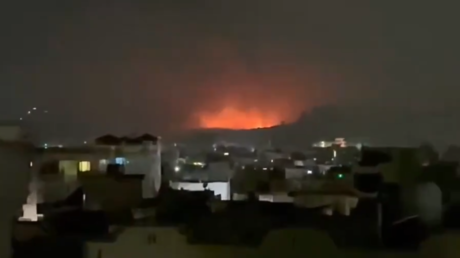
The tea in the glass was still steaming when the floor began to hum. It wasn't the low, familiar rumble of a generator or the passing of a heavy truck through the narrow, dust-choked streets of Kabul. This was a physical weight. It was the sound of the atmosphere being torn apart.
In the border regions where Afghanistan meets Pakistan, the dirt is stained by a thousand years of transit, trade, and blood. But on this night, the geography of the Durrand Line became irrelevant. Steel took its place. When the first strikes landed, they didn't just hit tactical targets; they hit the fragile silence that millions of families use to stitch together a semblance of a normal life.
The Geography of a Grudge
To understand why a blast in Kabul or a strike in Khost matters, you have to look past the political maps. You have to look at the people who inhabit the "In-Between."
Imagine a father, let’s call him Ahmad, sitting in a mud-brick house near the border. He isn't a strategist. He doesn't care about the high-level accusations of cross-border terrorism or the heated rhetoric exchanged between Islamabad and the Taliban government. He cares about the fact that his windows just turned into jagged shards of glass.
The conflict between Pakistan and Afghanistan is often framed as a chess match. Pakistan claims it is targeting militants—specifically the Tehrik-i-Taliban Pakistan (TTP)—who use Afghan soil as a springboard for attacks. The Afghan authorities, meanwhile, see these air strikes as a blatant violation of their sovereignty. But for those on the ground, these are not "security concerns." They are "living nightmares."
The strikes were a reaction to an ambush that killed seven Pakistani soldiers. In the logic of war, blood demands blood. But when the response comes in the form of fire from the sky, the precision promised by military briefings rarely matches the messy reality of the impact zone.
The Echo in the Capital
While the border burned, Kabul felt the ripple. Blasts rocked the city, sending plumes of smoke into an already grey skyline. In the capital, the sound of an explosion has a specific texture. It is a sharp, percussive crack followed by a vacuum of sound, and then—inevitably—the sirens.
Modern warfare relies on the idea of the "surgical strike." It is a comforting term. It suggests a scalpel, a steady hand, and the removal of a tumor without harming the body. But a bomb is not a scalpel. It is a sledgehammer. When a blast goes off in a populated area, the "body" of the neighborhood is forever scarred.
Consider the psychological toll. For a generation of Afghans, the sound of a jet engine or a sudden loud noise triggers a physiological response that no amount of "peace" can fully erase. It is a form of inherited trauma. Children who have never known a time without conflict can distinguish the sound of a drone from a passenger plane before they can solve a basic math equation.
The Invisible Stakes of a Border War
The world looks at these headlines and sees a regional skirmish. They see two neighbors who cannot get along. What they miss is the collapse of the "buffer."
For decades, the border between these two nations was porous—not just for militants, but for culture, families, and commerce. There are tribes whose graveyards sit in one country and whose pastures sit in another. When the strikes happen, that connectivity dies. The "In-Between" becomes a "No-Man's-Land."
The real cost of this escalation isn't just the immediate casualty count. It is the death of trust. Every time a strike is launched, the possibility of a diplomatic solution recedes further into the haze. We are witnessing the hardening of a frontier that was once a bridge.
Pakistan finds itself in a desperate position, facing an uptick in internal violence that it blames on its neighbor's perceived inaction. Afghanistan, under a government still seeking international legitimacy, cannot afford to look weak. It is a collision of two desperate needs, and the friction is generating enough heat to burn everything in sight.
The Human Currency of Conflict
Wait. Stop. Look closer at the footage that trickles out onto social media.
You see the graininess of the video. You see the flash of light. But look at the shadows. Those are people running. Not soldiers. Not "targets." People.
A woman clutches a bundle of blankets as she flees a crumbling building. A shopkeeper stares at the ruin of his inventory, wondering if he can afford to start over for the fourth time in ten years. These are the "collateral" elements that never make it into the official tallies of "militants neutralized."
Suppose we looked at this through the lens of a traveler. If you were to walk through these areas during a lull in the fighting, you would find a landscape of staggering beauty—rugged mountains, ancient trade routes, and a hospitality that is legendary. But that beauty is now a backdrop for tragedy. The mountains are no longer just scenery; they are hiding places. The trade routes are no longer for silk and spices; they are for munitions.
The Cycle of the Serpent
There is a mathematical cruelty to these exchanges.
Action A (an ambush) leads to Reaction B (an air strike).
Reaction B leads to Vengeance C (a retaliatory blast).
Each step is justified by the one before it. Each side points the finger and says, "They started it." But "starting it" is a concept lost to history in this part of the world. The roots of this particular tree of misery go down so deep they are tangled in the very bedrock of the region.
The logic of the strike assumes that if you hit hard enough, the enemy will stop. But history suggests the opposite. Violence is a fertilizer. It grows more of itself. When a village sees its children pulled from the rubble of a "surgical strike," that village does not become a bastion of peace. It becomes a recruiting ground.
The invisible stakes are the souls of the survivors. If we continue to treat these events as mere data points—8 killed here, 15 injured there—we lose the ability to see the catastrophe for what it is: a cascading failure of human empathy.
The Silence After the Blast
When the smoke finally clears over Kabul and the echoes of the border strikes fade into the night, a specific kind of silence settles. It isn't the silence of peace. It is the silence of bated breath.
It is the sound of a mother waiting for her son to come home from the market. It is the sound of a soldier staring into the dark, wondering if the next flash will be the last thing he sees. It is the sound of a region holding its collective pulse, waiting for the next turn of the wheel.
The tea in the glass is cold now. The hum in the floor has stopped. But the air still smells of cordite and burnt rubber, a lingering reminder that the sky can break at any moment, and no one—not the generals in Islamabad, nor the leaders in Kabul—can tell you when it will be fixed.
The mountains remain. They have watched empires come and go, and they have seen a thousand nights just like this one. They don't take sides. They only provide the echoes. And tonight, the echoes are screaming.


