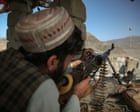
The wind in Parwan Province doesn't just blow; it carries the weight of forty years of gunpowder and unfulfilled promises. On a night that should have been defined by the mundane silence of a high-altitude desert, the air above Bagram Airbase suddenly curdled. It was the kind of tension that vibrates in the teeth of the men stationed behind the concrete T-walls. They weren't just guarding a runway. They were guarding the fragile ego of a nation that has spent decades trying to prove it can stand without leaning on a foreign crutch.
Bagram is a ghost haunt. Once the beating heart of the American war machine in Central Asia, it now serves as the primary aeronautical lung for the Taliban-led government. When the reports began to filter through—claims that the Afghan Air Force had intercepted and thwarted a series of Pakistani airstrikes—the narrative shifted from simple border friction to a high-stakes chess match played with supersonic jets and anti-aircraft batteries.
To understand why a few streaks of light in the midnight sky matter, you have to look past the official press releases. You have to look at the border.
The Invisible Line that Bleeds
Imagine a map where the ink never quite dried. The Durand Line, that 1,600-mile scar separating Afghanistan and Pakistan, has been a source of feverish resentment since 1893. For the people living in the shadow of the Hindu Kush, the border is a phantom. Families have kitchens in one country and bedrooms in another. But for the governments in Kabul and Islamabad, that line is a tripwire.
Pakistan has long argued that the border regions are a sanctuary for the Tehrik-i-Taliban Pakistan (TTP), a group that has waged a bloody campaign against the Pakistani state. From Islamabad’s perspective, these are not just militants; they are an existential threat operating with the quiet nod of Afghan authorities. Afghanistan, conversely, sees any cross-border kinetic action as a middle finger to its hard-won sovereignty.
When the Afghan Ministry of Defense announced they had "thwarted" an attempt on Bagram, they weren't just reporting a military maneuver. They were screaming a message to their neighbors: The sky is no longer an open door.
The Calculus of a Dogfight
The technical reality of "thwarting" an airstrike is less about cinematic dogfights and more about the cold, calculated geometry of radar and response times. For the Afghan forces, primarily operating with refurbished hardware and captured systems, the feat is significant. If we assume the reports are accurate, it suggests a level of readiness that many international observers doubted the current regime possessed.
Consider the hypothetical perspective of a radar operator in the Bagram control tower. You are staring at a glowing green sweep. You see "blips" that aren't supposed to be there. These aren't commercial haulers or slow-moving cargo planes. These are signatures moving at speeds that suggest intent.
- Identification: The system pings the intruder. No response.
- Escalation: Anti-aircraft units are dialed in. The hum of the generators rises.
- Deterrence: The moment the "lock" happens—the electronic handshake between a missile battery and a target—the cockpit of the intruding jet screams with a warning tone.
In most cases, this is where the "thwarting" happens. It’s a game of chicken at Mach 1. If the intruder turns back, the "strike" is prevented without a single shot being fired. But the psychological shrapnel remains.
The Human Cost of a Cold Border
While the generals argue over flight paths and sovereign rights, the people on the ground live in a state of permanent flinch. In the villages surrounding Bagram, the sound of a jet engine isn't a sign of travel; it’s a sign of potential erasure.
Think of a farmer in the outskirts of the base. He has seen the Soviets leave. He has seen the Americans leave. He has seen the black-and-white flags rise. To him, the "thwarting" of an airstrike isn't a triumph of the Ministry of Defense. It is a terrifying reminder that his home is still a bullseye. He knows that when giants argue, the grass gets trampled.
The tension between Pakistan and Afghanistan is often framed as a purely political dispute, but it is deeply visceral. Pakistan, a nuclear-armed state with a professional air force, feels a mounting frustration. They see their soldiers dying in ambushes near the border and feel they have the right to strike the source. Afghanistan, meanwhile, is a country obsessed with the idea of "Self." After decades of being a playground for superpowers, the current leadership views any violation of their airspace as a relapse into the status of a puppet state.
The Technology of the Scrappy
How does a sanctioned, internationally isolated government stop a modern air force? The answer lies in the "Frankenstein" nature of the current Afghan military. They are using a mixture of aging Soviet tech and abandoned American equipment.
- Radar Systems: Re-engineered units that have been kept alive through sheer mechanical willpower and black-market parts.
- Surface-to-Air Capabilities: Mobile units that can be hidden in the rugged terrain, making them difficult to preemptively strike.
- Human Intel: A vast network of observers along the border who provide early warning the moment a jet takes off from a Pakistani airbase.
This isn't a "cutting-edge" defense. It’s a desperate, functional one. It’s the military equivalent of keeping a 1970s truck running in the middle of a blizzard. It’s ugly, it’s loud, but it works when it has to.
The Geopolitical Ripple
If these strikes were indeed attempted and stopped, the implications ripple far beyond Bagram. It signals to the world—and specifically to regional powers like Iran, China, and Russia—that the Taliban-led military is moving from a guerilla insurgency to a conventional defensive force.
This transition is dangerous. A guerilla force is hard to hit because it is invisible. A conventional force is a target. By successfully defending Bagram, the Afghan government has signaled that they are ready to play by the old rules of nation-states. They are drawing a line in the clouds.
But there is a dark side to this newfound capability. Success breeds overconfidence. If Kabul feels it can effectively shut down Pakistani incursions, the incentive to negotiate over TTP sanctuaries diminishes. If Islamabad feels their aerial "stick" no longer scares the "mule," they may look for bigger sticks. The stakes are no longer just about border skirmishes; they are about the possibility of a full-scale conventional conflict between two neighbors who can ill-afford a war.
The Echo in the Dust
The night at Bagram didn't end in a fireball, but it didn't end in peace either. It ended in a stalemate.
We often think of war as a series of loud explosions, but the most significant moments are often the ones where nothing happens—the missile that wasn't launched, the bomb that stayed in the rack, the pilot who turned his plane around. These are the moments that define the "cold" in a Cold War.
The reports from Bagram tell us that the air is thin, the nerves are frayed, and the technology of the past is being used to fight the grudges of the future. The Afghan Ministry of Defense stands tall today, pointing to a sky that remains theirs. But beneath that sky, the dust of Parwan continues to settle on a land that has forgotten what it feels like to not be watched from above.
The lights of the base flicker in the dark, a lonely constellation in a valley that has seen too much history. Somewhere on the other side of the mountains, a pilot debriefs. Somewhere in Kabul, a commander smiles. And in the silence between them, the border continues to bleed.
The sky didn't break that night. But it's getting heavier every day.


