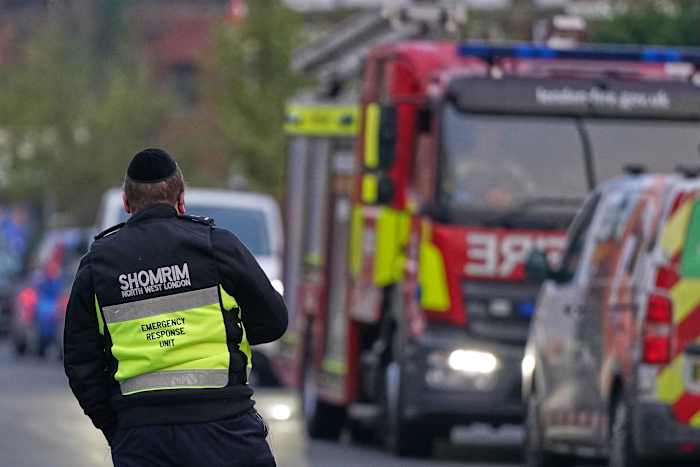
The air in North London usually carries the hum of a city that never quite sleeps. It is a predictable white noise of distant tires on wet pavement and the occasional fox darting through a garden. But in the early hours of a Sunday morning, that rhythm shattered. It wasn't the sound of a city waking up. It was the roar of accelerant meeting an open flame.
In a quiet corner of Hendon, two ambulances sat parked. They weren't just vehicles. They were the physical manifestation of a promise made by the Jewish community to the neighborhood: if you are hurting, we will come. These vans, operated by the Hatzola charity, are familiar sights. They are the ones that weave through Friday evening traffic or Saturday morning stillness, manned by volunteers who drop their forks at dinner or climb out of bed at 3:00 AM because a neighbor—Jewish, Christian, Muslim, or atheist—cannot breathe.
By sunrise, they were hollowed-out skeletons.
The charred remains of the engines and the melted husks of the life-saving equipment inside told a story that the Metropolitan Police are now forced to read. They are investigating this as a targeted, antisemitic hate crime. When you set fire to an ambulance, you aren't just destroying property. You are attacking the very idea of mercy.
The Anatomy of a Lifeline
To understand why a blackened van in a parking lot feels like a punch to the gut, you have to look at what Hatzola represents. The word itself means "rescue" or "relief." It is a volunteer-led service that exists to bridge the terrifying gap between a 999 call and the arrival of a paramedic. In those four or five minutes where life hangs by a microscopic thread, these volunteers are the thread.
Imagine a grandfather in Golders Green clutching his chest. His wife’s hands shake too hard to dial the phone. The Hatzola responder who lives three doors down arrives before the echoes of the sirens even reach the street. That volunteer doesn’t ask for a passport or a statement of faith. They bring oxygen. They bring a defibrillator. They bring a chance to see another Tuesday.
When someone pours fuel over these vehicles and lights a match, they are attempting to incinerate that safety net. It is a visceral, jagged act of communal intimidation. It says, "Even your kindness is not safe here."
The Invisible Stakes
We often talk about hate crimes in terms of statistics. We look at charts and graphs showing a rise in incidents, and our eyes glaze over. We see the numbers go up, and we feel a vague sense of unease. But statistics are cold. They don't smell like burnt rubber and melting plastic.
The real cost of this attack isn't the price of the Mercedes-Benz Sprinter chassis or the thousands of pounds worth of monitors and stretchers. The cost is the psychological tax levied on every person in that community who now looks at a charity vehicle and wonders if it’s a target.
Consider the volunteer. He is a father of four. He spent his own money on training. He spends his weekends on call. Now, when he walks to his vehicle in the dark, he has to scan the shadows. He has to wonder if the person standing on the corner is a neighbor or a threat. That hesitation—that split second of fear—is exactly what the arsonist wanted to buy with a liter of petrol.
The Metropolitan Police have stepped up patrols. They are scouring CCTV. They are speaking to local leaders. But police officers cannot be everywhere at once. They cannot patrol the inside of a person’s mind.
Why Ambulances?
There is a specific kind of cruelty in choosing an ambulance as a target. In the laws of war, even the most bitter enemies are supposed to respect the Red Cross or the Red Crescent. There is a universal understanding that the healers are off-limits. To break that taboo is to signal a rejection of the basic rules of civilization.
Some might argue that this was "just" property damage. But fire is never "just" anything. Fire is unpredictable. Fire spreads. A burning ambulance next to a building is a potential massacre. This wasn't a protest; it was a gamble with human lives. The attackers didn't know if those ambulances would be needed ten minutes after the fire started. They didn't care.
This incident doesn't exist in a vacuum. It comes at a time when tensions are screamingly high, when the world feels like it’s tilting on its axis, and when "the other" is increasingly seen as an enemy rather than a neighbor. In this climate, symbols matter. An ambulance is a symbol of our collective desire to keep one another alive. Setting it on fire is a symbol of the desire to see the "other" perish.
The Response in the Rubble
There is a peculiar thing that happens when you try to burn down a community’s spirit. It often has the opposite effect. Within hours of the news breaking, the hollowed-out shells of the ambulances were being photographed, not as symbols of defeat, but as evidence of why the work must continue.
The community didn't retreat. They didn't pull the remaining vehicles off the road and hide them behind iron gates. Instead, the phones kept ringing. The volunteers kept showing up. The mission of Hatzola—to provide relief—became even more urgent.
Healing is a stubborn thing.
If the goal of the arsonist was to silence the sirens, they failed. The sirens will be louder now. They will be replaced. The funds will be raised, the equipment will be reordered, and a new generation of volunteers will take the oath.
But the scorch marks on the pavement in Hendon remain for now. They serve as a grim reminder that hate is not a theoretical concept debated in Parliament or on social media feeds. It is a physical force. It is hot, it is destructive, and it is active in the middle of the night while the rest of us are dreaming.
The investigation continues. Witnesses are being sought. DNA is being pulled from the debris. The gears of justice are turning, albeit slowly.
As the sun sets over London tonight, a volunteer will still be checking his radio. He will still be making sure his kit is ready. He will still be prepared to rush into the night to save a stranger. You can burn the van, but you cannot burn the impulse to save a life. That is the one flame that refuses to be extinguished.
One day, the charred pavement will be cleaned. The smell of smoke will fade. A new ambulance will pull into that spot, painted in bright, defiant colors. It will sit there, waiting for the call, a silent promise that in the face of fire, we choose to stay.
London is a city built on the ruins of many fires. It knows how to rebuild. It knows that the only way to beat the dark is to keep the lights on—especially the blue ones.