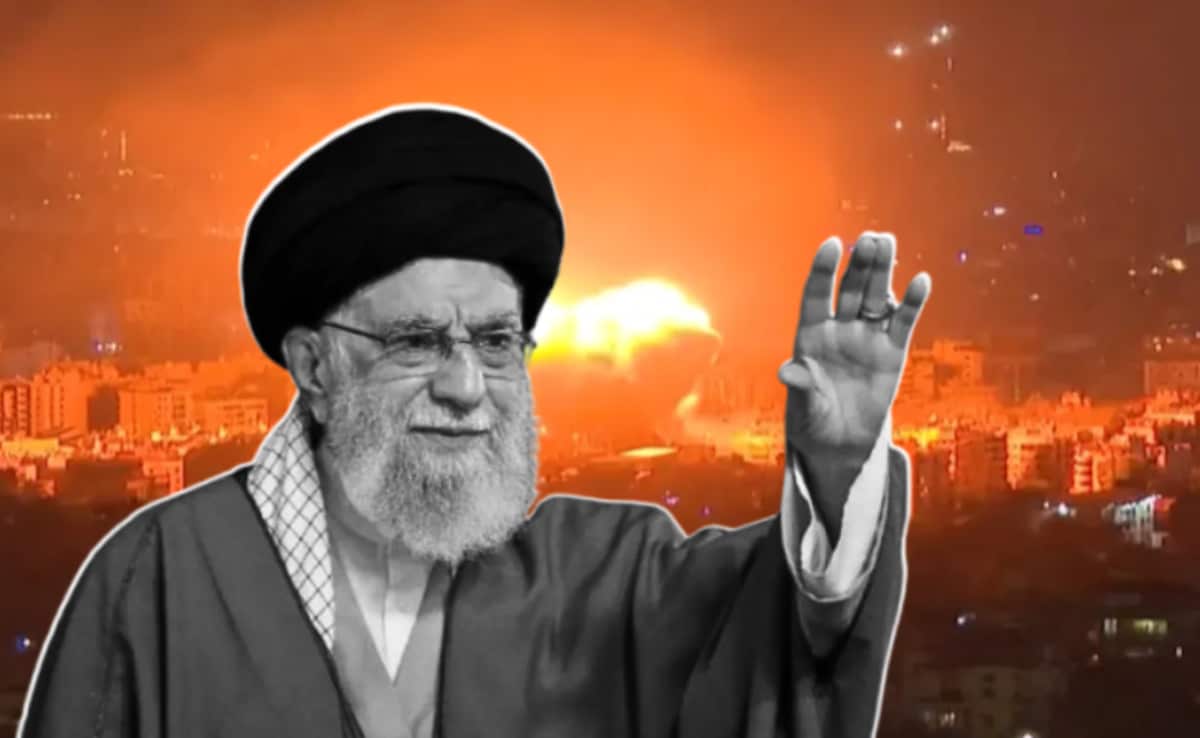
The air in Tehran during the small hours of the morning has a specific, heavy stillness. It is the kind of quiet that feels fragile, as if the city itself is holding its breath, waiting for the sky to break. For the residents of the high-rises in the northern districts, the hum of an air conditioner or the distant whine of a stray cat is usually the only soundtrack to their fitful sleep. But recently, that silence was shattered by a sound that didn't just vibrate the windows—it rattled the very foundation of the Islamic Republic’s power structure.
Reports began to filter through the digital ether: Israel had launched strikes. The target wasn't just a military depot or a nuclear enrichment facility hidden beneath a mountain. This time, the whispers carried a name that usually exists only in the stratosphere of Iranian life: Ayatollah Ali Khamenei. For a deeper dive into this area, we recommend: this related article.
To understand the weight of this moment, you have to look past the satellite imagery and the dry tallies of ballistic missile exchanges. You have to look at the man in the bunker.
The Architect of a Hardened Horizon
For over three decades, Ali Khamenei has been the sun around which the Iranian political universe rotates. He is not merely a politician; he is the "Rahbar," the Supreme Leader, a figure whose authority is woven into the religious and legal fabric of the nation. In the West, we often see him as a static image—a bearded man in robes delivering a sermon with a steady, uncompromising finger pointed toward the horizon. To get more background on this issue, in-depth coverage can also be found at BBC News.
In reality, he is the curator of a vast, complex survival mechanism.
Imagine a master chess player who has spent forty years fortifying his side of the board, not with pieces, but with layers of concrete, intelligence networks, and a sprawling web of proxy militias. This is the "Axis of Resistance." From the streets of Beirut to the highlands of Yemen, Khamenei’s influence has been a shadow cast across the Middle East. It was designed to ensure that if war ever came, it would happen on someone else’s soil.
But the calculus changed. The shadow moved.
When Israeli jets or long-range munitions find their way into the airspace above Tehran, they are doing more than dropping explosives. They are puncturing an illusion. They are telling the 85-year-old leader that the walls he built are porous.
The Physics of the Strike
Modern warfare is a cold, mathematical pursuit. When a military decides to target a high-value individual—especially one as insulated as the Supreme Leader—they aren't just aiming for a person. They are aiming for a node.
In the jargon of defense analysts, this is "decapitation." It is a brutal, clinical term for a move intended to paralyze the entire body of a state. If the brain cannot communicate with the limbs, the limbs cease to function.
Consider the hypothetical logistics of such an operation. A bunker buried deep beneath the granite of the Alborz Mountains is designed to withstand a direct hit from conventional bunker-busters. It has its own oxygen supply, its own encrypted communication lines, and its own ecosystem of loyalists. To reach into that darkness requires a level of intelligence that borders on the supernatural. It requires knowing not just where a man is, but what room he will be in ten minutes from now.
It is the ultimate game of hide and seek, played with supersonic technology.
The strikes reported by Israel weren't just about the physical destruction of buildings. They were a demonstration of reach. By targeting the vicinity of the Supreme Leader’s inner circle, Israel sent a kinetic message: We can see you. Even when you are underground. Even when you are surrounded by your most trusted guards.
The Human Toll of High-Stakes Geopolitics
While the headlines focus on the "Great Satan" and the "Zionist Entity," there is a different story unfolding in the grocery stores and living rooms of Shiraz and Isfahan.
Meet "Farid," a fictional but representative thirty-year-old engineer in Tehran. He doesn't care about the ideological purity of the revolution or the tactical advantages of a fending off an F-35. He cares about the price of eggs, which has tripled. He cares about the fact that every time his phone pings with a news alert, his heart skips a beat because he wonders if this is the night the "big one" finally lands.
For people like Farid, the targeting of Khamenei is a terrifying paradox. On one hand, there is a deep-seated exhaustion with the regime’s aging leadership. On the other, there is the primal fear of what happens when a vacuum is suddenly created in a country with no clear succession plan.
If the Supreme Leader is the glue holding the various factions of the Revolutionary Guard and the civilian government together, his removal—especially by a foreign power—could be the solvent that dissolves the state into chaos. It isn't just about a change in leadership; it’s about the potential for a civil war or a total societal collapse.
The stakes aren't abstract. They are as real as the smoke rising from a charred suburb.
The Silence of the Successors
Inside the corridors of power in Tehran, the silence is even louder.
Khamenei is 85. In any other profession, he would have been retired for two decades. But in the theology of the Islamic Republic, there is no easy exit. The question of "Who comes next?" is the most dangerous topic in the country.
The death of Ebrahim Raisi, the former president and a presumed successor, in a helicopter crash earlier this year, left a gaping hole in the line of inheritance. This left Khamenei’s son, Mojtaba, as one of the few remaining figures with the pedigree and the connections to take the mantle. But the Iranian people have a long memory of the Pahlavi monarchy; the idea of a hereditary religious leadership sits uncomfortably with many.
When Israel targets the leadership, they are poking at this wound. They are forcing the regime to confront its own mortality.
The tension is visible in the way the state media responds. There is a frantic effort to project strength—parades of missiles, fiery speeches, vows of "harsh revenge." But look at the eyes of the officials in the background. They know that the old rules of engagement have been shredded. The "Red Lines" have been painted over in black.
The Invisible War
Beyond the explosions, there is a war of the mind.
Psychological operations are the invisible hand of modern conflict. By making the Supreme Leader feel unsafe, Israel is attempting to trigger paranoia. When a leader stops trusting his surroundings, he stops trusting his advisors. He begins to purge his inner circle. He makes mistakes.
We have seen this pattern throughout history. From the bunkers of Berlin to the palaces of Baghdad, the moment a leader realizes the enemy is inside the gates—or even inside his own communication network—the structure begins to crumble from the inside out.
Is Khamenei truly in danger? The official line from Tel Aviv and Washington is often a mix of strategic ambiguity and calculated leaks. But the reality is that the mere possibility of his targeting is a weapon in itself. It forces the Iranian military to divert resources from the front lines to the defense of a single man. It creates a friction that slows down every decision, every movement.
The Weight of a Single Choice
We often talk about nations as if they are monolithic blocks moving across a map. We say "Iran did this" or "Israel responded with that." But at the end of the day, these are decisions made by individuals in quiet rooms.
For Ali Khamenei, the choice is now one of legacy versus survival. Does he double down on the regional fire he has spent a lifetime stoking, or does he look for a way to preserve the system he helped build before it is incinerated?
The tragedy of the situation is that in the world of high-stakes power, there are rarely any good options left once the missiles start flying. There are only less-bad options.
As the sun begins to rise over the Alborz Mountains, the city of Tehran wakes up. The traffic begins to crawl. The tea shops open their doors. But the air still feels different. The residents look at the sky with a new kind of scrutiny. They know that the distance between a normal Tuesday and a historic catastrophe is now measured in the milliseconds it takes for a radar to lock onto a target.
The shadows in Tehran used to be predictable. They moved with the sun. Now, they move with the whims of a conflict that has finally come home to the man who spent thirty years trying to keep it at bay.
The walls are still there. The concrete is still thick. But for the first time in a generation, the man inside the bunker can hear the sound of the wind whistling through the cracks. It is a cold wind, and it is growing louder.
History doesn't just happen; it is carved out of the silence of nights like these.


