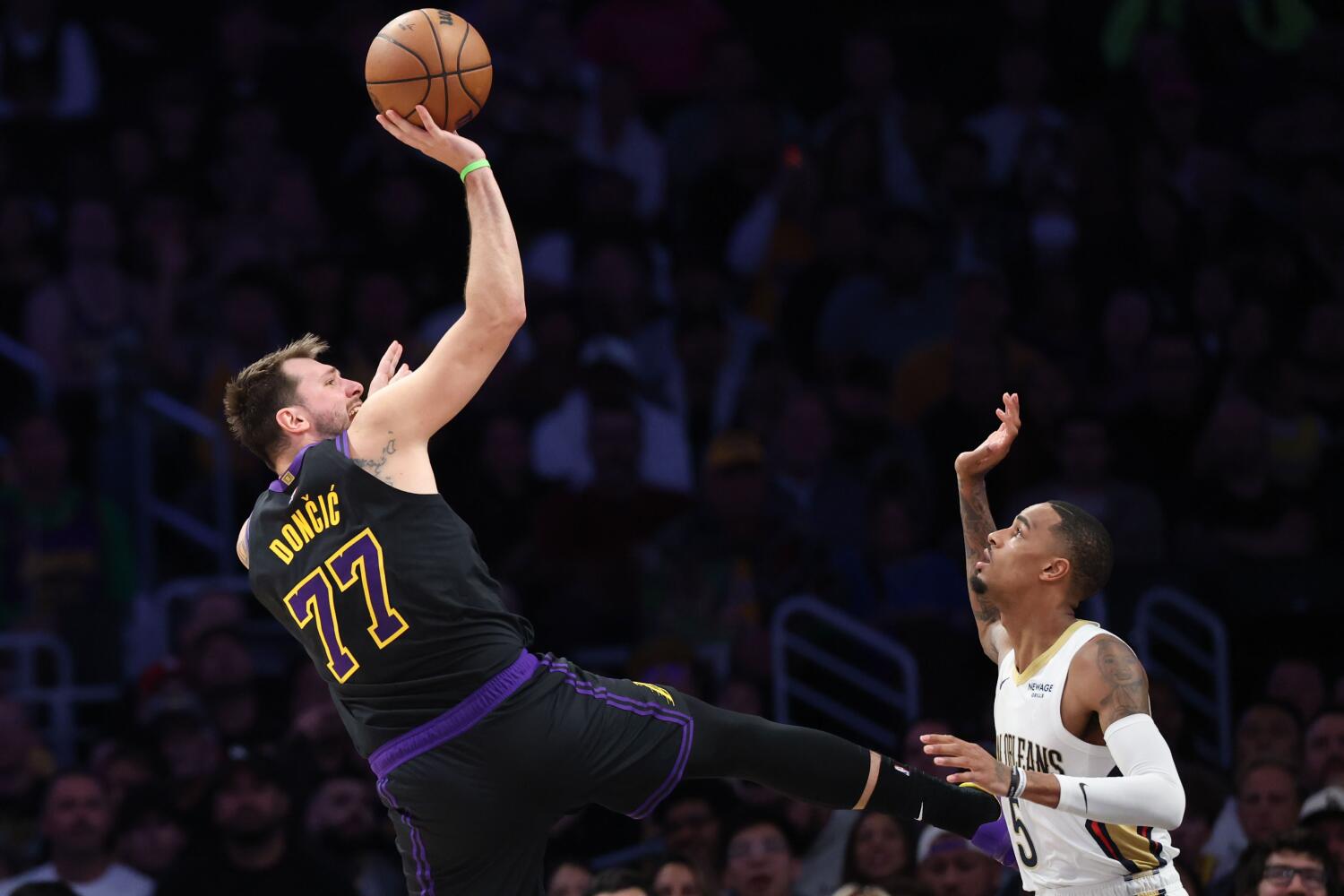
The air in New Orleans carries a certain weight, a humid mix of jazz, fried dough, and the desperate, electric hope of a fan base that knows their team is always one spectacular leap away from greatness. But inside the Smoothie King Center, that hope met a cold, calculated wall. It wasn't just that the Los Angeles Lakers won. It was how they did it.
Most nights, the Lakers are a solar system. LeBron James is the sun, a massive, gravitational force around which everything else must orbit. Anthony Davis is the moon, essential and bright, controlling the tides of the defense. When they win, it is usually because the sun burned too hot for the opposition to handle. But against the Pelicans, the sun didn't have to go supernova. Instead, the entire system aligned in a rare, terrifyingly perfect symmetry.
All five starters scored in double figures.
On paper, that is a box score statistic. In reality, it is a psychological bludgeon. It means there was no weak link to exploit. It means that for 48 minutes, the Pelicans weren't just fighting two superstars; they were fighting a collective consciousness.
The Burden of Being a Sidekick
Imagine being Austin Reaves or Rui Hachimura. You spend your life perfecting a craft, only to be cast as a supporting actor in the greatest long-running drama in sports history. You are the "others." You are the players whose names are whispered in trade rumors every February.
In this game, the "others" decided to be the story.
When D’Angelo Russell is hitting shots from the perimeter with that casual, almost indifferent flick of the wrist, the court expands. It grows. Every foot of space he creates for himself is an extra foot of breathing room for Anthony Davis in the paint. It’s a chain reaction. Russell finishes with 30, but those points aren't just numbers—they are daggers that force the Pelicans' defense to make impossible choices.
Do you stay home on the shooters? Or do you collapse on LeBron as he barrels toward the rim like a freight train that has somehow learned to play chess?
The Pelicans chose the latter. They paid for it in blood.
The Invisible Stakes of a Mid-Season Grind
To the casual observer, a mid-season win is just a notch on a long, grueling calendar. But for this Lakers squad, every game is a referendum on their existence. They are haunted by the "What Ifs." What if LeBron gets tired? What if Davis’s body remembers its own fragility?
This game offered an answer: They don't have to be perfect if they are together.
Anthony Davis returned to his hometown territory and played with the quiet ferocity of a man reclaiming his house. He wasn't just blocking shots; he was erasing them. There is a specific sound a basketball makes when it hits the padded backboard after a Davis block—a dull, thudding "whack" that echoes like a gavel. Case closed.
Yet, the most compelling part of the evening wasn't a dunk or a block. It was the movement. The ball didn't stick. It didn't die in the hands of a superstar waiting for a screen. It zipped. It lived. It found Rui Hachimura in the corner. It found Reaves on a backdoor cut.
This is the Lakers' secret terror. When they play like this, they aren't just a basketball team. They are an ecosystem.
The Pelicans’ Long Walk Home
New Orleans is a team built on explosive potential. Zion Williamson is a force of nature, a player who seems to defy the laws of physics every time his feet leave the hardwood. But potential is a fragile thing when faced with veteran composure.
The Pelicans fought. They clawed. They tried to turn the game into a track meet, hoping the older Lakers would lose their breath in the Louisiana humidity. But the Lakers didn't run. They marched.
There was a moment in the third quarter where the lead felt like it might slip. The crowd was up. The brass band in the stands was wailing. The momentum was a physical presence in the room, leaning heavily toward the home team. In years past, this is where the Lakers would have crumbled, or where LeBron would have been forced to take ten straight shots to steady the ship.
Instead, LeBron passed.
He found Taurean Prince. He found Russell. He trusted the men standing next to him. That trust is the hardest thing to build in professional sports, especially in the pressure cooker of Los Angeles. It’s a fragile glass sculpture that takes months to craft and seconds to shatter.
By the time the fourth quarter rolled around, the Pelicans looked like a team that had been trying to hold back a flood with a screen door. You could see it in their shoulders. You could see it in the way CJ McCollum looked at the scoreboard. They had played well. They had scored. But the Lakers were coming from everywhere.
The Symphony of Five
When all five starters score in double digits, it changes the geometry of the game. It’s no longer a game of "stop the star." It becomes a game of "cover the court."
- LeBron James: The conductor.
- Anthony Davis: The foundation.
- D’Angelo Russell: The spark.
- Austin Reaves: The connector.
- Rui Hachimura: The hammer.
Each man played his part with a surgical precision that felt less like sport and more like an eviction notice. They were clearing out the Pelicans' hopes of a home-court statement.
The box score will tell you the Lakers won 139-122. It will tell you the shooting percentages and the rebound counts. But it won't tell you about the silence that fell over the arena in the final three minutes. It was the silence of a crowd realizing they weren't watching a lucky streak. They were watching a team finally figure out who they are.
They are no longer a collection of high-priced talent waiting for a miracle. They are a unit.
As the final buzzer sounded, there were no chest-bumps. No wild celebrations. The Lakers walked off the floor with the grim satisfaction of a crew that had successfully pulled off a heist. They didn't just take the win; they took the Pelicans' confidence.
In the locker room, the talk wasn't about the points. It was about the passes. It was about the rotations. It was about the fact that for one night, the most famous team in the world stopped being a brand and started being a brotherhood.
The sun still shines in Los Angeles, but the Lakers have realized they can see just as well by the light of the whole constellation.
LeBron James sat at his locker, ice on his knees, a veteran king watching his court. He didn't have to carry the world on his shoulders tonight. He just had to be part of it. And in the long, exhausting marathon of an NBA season, that might be the most dangerous development of all.