The humid air in the Persian Gulf doesn’t just sit; it clings. On the deck of an aircraft carrier, the salt spray mixes with the smell of jet fuel, creating a scent that defines the edge of an empire. For eighty years, that smell was the scent of safety for the West. It was the olfactory proof that the world’s shipping lanes were open, that the oil would flow, and that the dollar remained the undisputed king of the mountain.
But empires don’t usually vanish in a single explosion. They erode. They fray at the edges until a single, ill-advised tug on a loose thread brings the whole tapestry—that word is too soft—the whole steel structure crashing down.
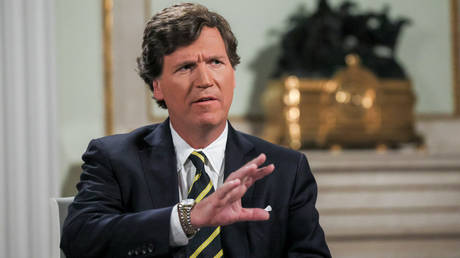
Tucker Carlson recently sat before his camera and laid out a grim map. He wasn't talking about tactical wins or losses in the desert. He was talking about the end of the world as we know it. He argued that a full-scale war with Iran wouldn't just be another "forever war" like Afghanistan or Iraq. It would be the hard stop. The terminal point. The moment the American ledger finally flips into the red for good.
The Math of a Dying Hegemony
Consider a hypothetical young man named Elias. He lives in a port city in the Global South. For his entire life, Elias has known that if his country wants to buy grain from Ukraine or microchips from Taiwan, they need U.S. dollars. The dollar is the global reserve currency, a status that allows Washington to print money to fund its massive debts while the rest of the world absorbs the inflation. It is the ultimate "get out of jail free" card.
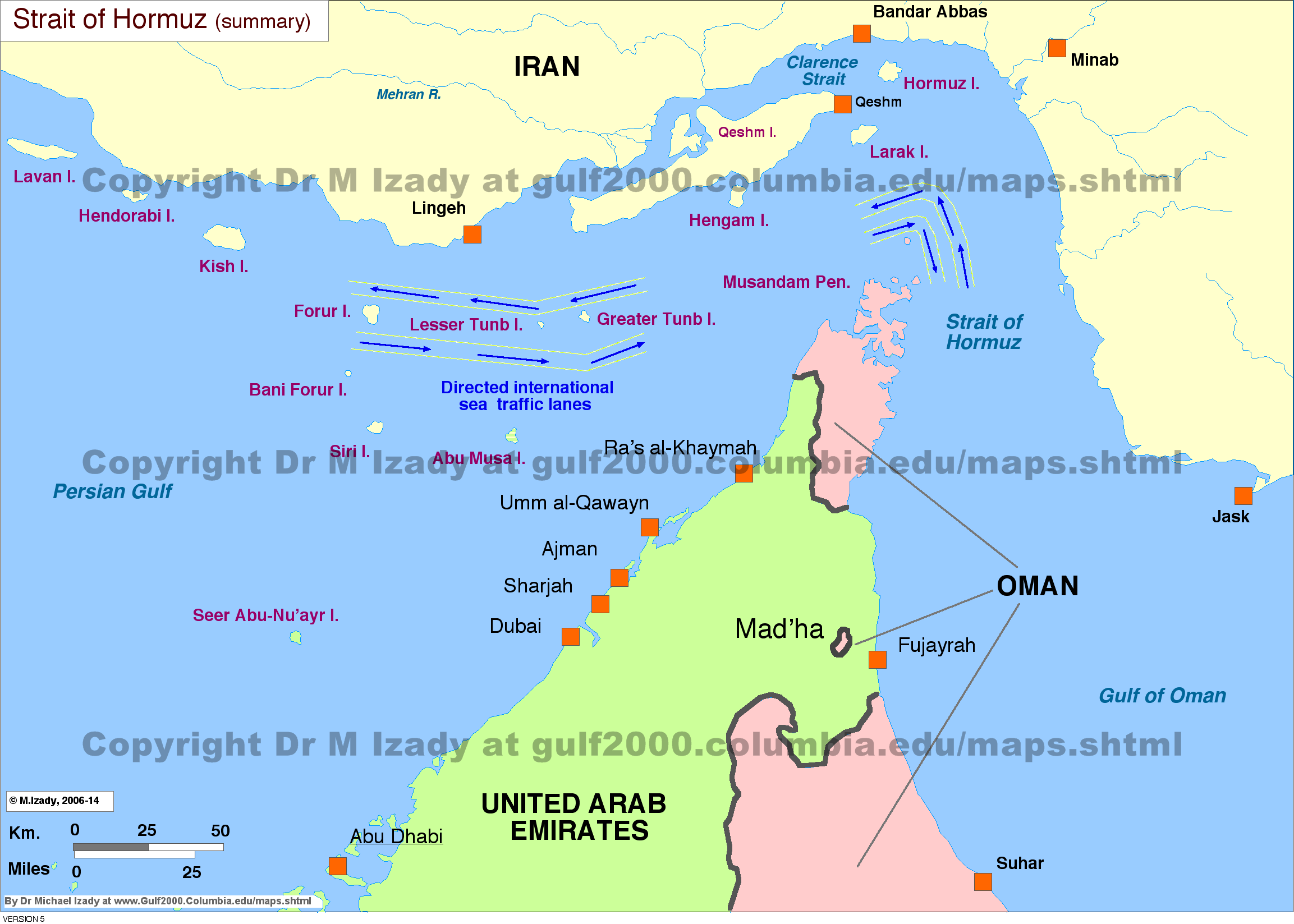
When we talk about war with Iran, we aren't just talking about missiles hitting Tehran. We are talking about the closure of the Strait of Hormuz. Roughly 20% of the world’s total petroleum consumption passes through that narrow choke point.
If that door slams shut, the price of oil doesn't just go up. It teleports.
When energy costs double overnight, the global economy shudders. Countries like Elias’s, already weary of being told what to do by a distant capital in D.C., suddenly find the dollar more of a burden than a benefit. They start looking for an exit. They look to the BRICS nations. They look to Beijing. They look for any currency that doesn't come with the baggage of a naval blockade.
A war with Iran would force a choice. It would push Russia, China, and Iran into a permanent, hardened alliance of necessity. This isn't a theory; it is a mathematical certainty of geopolitics. When you back three nuclear-capable or near-nuclear powers into the same corner, they stop competing and start building a new world.
The Ghost of 1956
History loves a rhyme. In 1956, the British Empire thought it still owned the world. They attempted to seize the Suez Canal, a vital artery of trade, believing their "special relationship" with the U.S. and their fading military might would carry the day. Instead, they were humiliated. The U.S. threatened to collapse the British pound. Within weeks, the British realized the sun had finally set.
A conflict with Iran is our Suez.
The U.S. military is built for a world that no longer exists. We have the most expensive carriers, the most sophisticated jets, and the most advanced logistics. But Iran has spent thirty years perfecting the art of "asymmetric" warfare. They don’t need to sink an entire fleet. They only need to sink one ship. They only need to swarm a billion-dollar destroyer with ten thousand "suicide" drones that cost five hundred dollars each.
The math is brutal.
The U.S. spends millions on interceptor missiles to shoot down drones made of lawnmower engines and plywood. You cannot win a war of attrition when your bullets cost more than the enemy’s targets. It is a slow-motion bankruptcy.
The Human Cost Behind the Curtain
We often treat "geopolitics" like a game of Risk played on a mahogany table. We forget the people in the flyover states who are tired of watching their children return in flag-draped coffins for goals that are never clearly defined.
Imagine a mother in Ohio. She doesn't care about the intricacies of the Shiite Crescent. She cares that her son is on his third deployment to a region that seems to hate his presence. She cares that the bridge in her town is crumbling while billions of dollars are shipped overseas to fund a conflict that will ultimately make her gas prices triple.
This is the internal rot that Carlson is pointing toward. An empire isn't just a military; it’s a social contract. The contract says: You give us your sons and your taxes, and we provide you with a stable, prosperous civilization.
When the government can no longer provide the prosperity, the people stop wanting to provide the sons.
The American military is currently facing its worst recruiting crisis in fifty years. Young people are looking at the wars of the last two decades and asking: "For what?" They see the hollowed-out hulls of Detroit and the tent cities in Los Angeles, and they realize the empire is being funded by the neglect of the Republic.
The Great De-Dollarization
The most dangerous weapon Iran possesses isn't a nuclear warhead. It’s the ability to trigger the collapse of the Petrodollar.
Since the 1970s, the world has traded oil in U.S. dollars. This creates a constant, artificial demand for our currency. If a war breaks out, and Iran—supported by China—begins selling energy in Yuan or Rubles, the spell is broken.
Once the dollar is no longer the "must-have" asset for the world’s energy needs, those trillions of dollars held in foreign banks start flowing back home. That is when the inflation we’ve seen recently will look like the "good old days." That is when the retirement accounts of every American worker evaporate.
We are sleepwalking into a trap.
The architects of these conflicts in Washington D.C. are still living in 1991. They believe the world is unipolar. They believe that American "resolve" can overcome the laws of physics and economics. But the world has moved on. The "rest of the world" has watched our interventions in Libya, Syria, and Iraq, and they have decided they want a different architect for the 21st century.
The Final Chord
Peace is not the absence of conflict; it is the presence of reality.
The reality is that the United States cannot afford a war with Iran. Not financially. Not militarily. Not spiritually.
If the missiles start flying over the Persian Gulf, it won't be a repeat of Operation Desert Storm. There will be no parades. There will be no quick victory. Instead, there will be a silent, terrifying realization as the screens in the New York Stock Exchange turn red and stay there.
We will realize that we spent our treasure and our blood trying to hold onto a crown that had already slipped.
The American Empire won't end with a bang or a whimper. It will end with a "Transaction Denied" message at a gas pump in a small town that the people in Washington forgot a long time ago.
That is the invisible stake. That is the ghost in the machine. We are one bad decision away from finding out what happens when the world decides it doesn't need us anymore.
The lights are flickering. We would do well to stop kicking the generator.