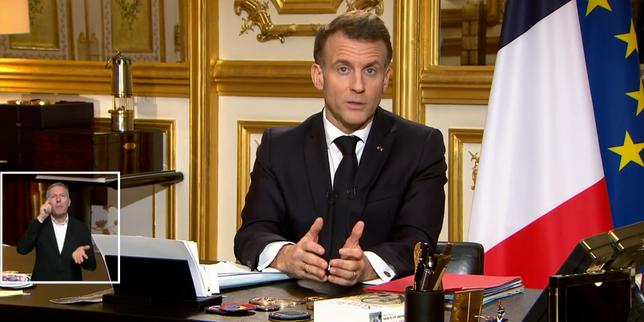
The gold-leafed clocks of the Élysée Palace do not tick; they glide. But at 8:00 PM, as the camera lenses focused on Emmanuel Macron, every second felt heavy, like a physical weight pressing against the chest of a nation. Behind the velvet curtains and the practiced posture of the President lay a reality that few wanted to voice. We weren't just watching a speech about a map or a distant desert. We were watching the recalculation of our lives.
War with Iran is no longer a ghost story told by academics in dusty journals. It is a ledger. It is a calculation of how much a liter of petrol will cost by Tuesday, whether the lights in a small apartment in Lyon will flick on during a cold snap, and if the sons and daughters of France will find themselves on a flight toward a horizon they never planned to see.
Macron’s voice was steady, but the subtext was a frantic SOS hidden in the language of diplomacy.
The Invisible Tripwire
To understand the weight of that evening, you have to look past the suit. You have to look at the Strait of Hormuz. Imagine a needle-thin passage in the sea where the world’s pulse is measured in barrels of oil.
When the President spoke of "regional de-escalation," he wasn't just being polite. He was thinking about the 20% of the world’s liquefied natural gas that threads through that narrow gap. If that door slams shut, the global economy doesn't just stumble. It collapses.
Consider a baker in Bordeaux named Jean-Pierre. He doesn't follow Middle Eastern geopolitics. He cares about the price of flour and the electricity for his ovens. But the moment a missile leaves a silo in Isfahan, the price of the natural gas powering Jean-Pierre’s oven spikes. His bread becomes a luxury. His business becomes a memory. This is the "invisible stake" Macron was trying to manage—the terrifying reality that a conflict thousands of miles away can bankrupt a family in the suburbs of Paris within a month.
The Ghost of 2015
The President’s rhetoric was haunted. He spoke of the JCPOA—the nuclear deal—as if it were a dying patient on life support. There was a time, not long ago, when we believed words on paper could chain the atom. We thought we had a deal.
But trust is a fragile thing. Once it shatters, you aren't just cleaning up glass; you’re walking on it. Macron’s insistence on a "vibrant diplomatic path" is his way of saying that the alternative is a darkness we aren't prepared for. Iran is closer to a nuclear breakout than at any point in history. This isn't a "game-changer" in the way tech CEOs use the word. This is a fundamental shift in the gravity of the planet.
If Iran crosses that threshold, the Middle East enters a nuclear arms race that makes the Cold War look like a schoolyard spat. Saudi Arabia will want the sun in a bottle. Turkey will follow. Suddenly, the Mediterranean—our backyard—is rimmed by states with their fingers on the ultimate trigger.
The Strategy of the Middle Path
France occupies a strange, lonely space in this conflict. We are the bridge that no one seems to want to cross.
On one side, there is the raw, unfiltered pressure of Washington, often swinging between isolationism and intervention. On the other, there is Tehran, a regime that views every olive branch as a potential noose. Macron is trying to play the role of the "honest broker," a title that carries more prestige than power these days.
He outlined a three-pronged approach that sounds clinical but is actually a desperate attempt to keep the peace:
- Strategic Autonomy: The idea that Europe must be able to protect its interests without waiting for a green light from the White House.
- Humanitarian Corridors: Ensuring that if the worst happens, the civilian populations—the families in Tehran who just want to buy milk and the students who want to study—aren't the first to starve.
- Collective Security: A fancy term for "everyone stay in your lane."
But can a bridge hold when both shores are on fire?
The Human Cost of the Abstract
We often talk about "strikes" and "assets" and "capabilities." These words are designed to sanitize the horror. They turn blood into ink.
Macron mentioned the French citizens currently held in Iranian prisons. These aren't "negotiating chips." They are human beings. They have mothers who wake up at 3:00 AM wondering if their children are cold. They have friends who keep their chairs empty at dinner parties, hoping for a return that feels further away with every headline.
When the President speaks of "sovereignty," he is speaking for them. He is trying to remind the world that behind the grand maps of generals, there are individual lives being ground into the dirt.
The tension in his address came from the realization that France’s influence is waning. We are a nuclear power, a permanent member of the Security Council, and the cultural heart of Europe. Yet, we are increasingly at the mercy of decisions made in boardrooms in Riyadh and bunkers in Tehran.
The Cold Morning After
The speech ended, the screen went black, and the news cycle moved on. But the questions remained, vibrating in the air like the hum of a downed power line.
What happens if diplomacy fails? Macron didn't say. He couldn't. To admit the possibility of failure is to invite it.
We are living in an era of "perma-crisis." We have become numb to the word "unprecedented." But a war in Iran would be a different beast entirely. It wouldn't be a localized conflict like we’ve seen in the past decades. It would be a systemic shock that redefines what it means to live in a modern, connected society.
The President’s address was a plea for time. Time to talk. Time to think. Time to find a way out of a room that is rapidly filling with smoke.
As the lights stayed on across France that night, there was a collective, unspoken prayer that they would stay on tomorrow, and the day after that. We are all tethered to the same wire. If it snaps in the Persian Gulf, we all fall into the dark.
The true power of the Élysée that night wasn't in the declarations of strength, but in the quiet, desperate admission that in the modern world, no nation is an island, and no war is ever truly "far away."
The map has folded. The distance has vanished. Tehran is just a heartbeat away from Paris, and the President knows it.
He walked away from the podium, his shadow long against the ornate walls, leaving a nation to wonder if the words of a single man can ever be enough to stop the momentum of history. The silence that followed wasn't peaceful. It was expectant.
Somewhere in the Atlantic, a French submarine moved silently through the deep, a reminder that while we talk of peace, we prepare for the end of it. The lights remained on, for now.
But the clock is still gliding. It never stops. It just waits for the moment when the talking ends and the screaming starts.
We are all waiting with it.
Every single one of us.


