The Invisible Pulse
Everything you touch, eat, or wear is essentially a fossilized drop of oil or a captured puff of gas. When you flip a light switch in a London flat or start a car in a Chicago suburb, you aren't just engaging a mechanical process. You are tapping into a global circulatory system that is currently under cardiac arrest.
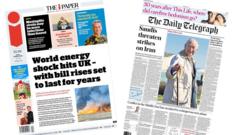
The headlines call it an energy shock. That sounds clinical. It sounds like a static number on a spreadsheet or a minor fluctuation in a stock ticker. The reality is much louder. It is the sound of a supertanker idling in the Strait of Hormuz, its crew watching the horizon for the dark shape of a drone. It is the silence of a factory in Germany that had to cut its night shift because the cost of powering the assembly line now exceeds the value of the parts being made.
Iran didn’t just send a message. They pulled the lever on the world's most sensitive machine.
The Chokepoint at the Edge of the World
To understand the stakes, we have to look at a narrow stretch of water that most people will never see. The Strait of Hormuz is a geographic fluke that dictates the quality of your life. Imagine a doorway so narrow that if someone stands in it, the entire house begins to starve.
Nearly a fifth of the world’s daily oil consumption passes through this single, precarious lane. It is the jugular vein of the global economy. When Iran moves its pieces on this chessboard, the vibration travels instantly. It moves through the crude oil pipelines, into the refineries, and finally into the price of a gallon of milk or a plastic toy.
We often think of "energy" as something abstract, but consider a hypothetical truck driver named Elias. Elias operates a small logistics firm. For him, the "world energy shock" isn't a geopolitical theory. It is the moment he realizes his fuel surcharge will eat his entire profit margin for the month. It is the phone call to his wife explaining why they might have to delay the repairs on their home. This is where the shock lands. Not in the halls of parliament, but at the kitchen table.
The King of the Coast
While the world watches the tankers, another power is cementing its rule. The "King of the Coast" isn't a person. It is a strategic dominance that defies traditional military logic. It is the ability to render a trillion dollars' worth of naval hardware obsolete with a few thousand dollars' worth of suicide drones and asymmetric tactics.
In the old days, power was measured by the tonnage of your hull and the caliber of your guns. Today, power is measured by the ability to create uncertainty. Iran has mastered the art of the shadow. By maintaining a presence that can flicker from "neighbor" to "aggressor" in the span of a heartbeat, they have seized control of the narrative.
The markets hate uncertainty. They loathe it. When a missile is fired, the price of oil spikes because the market is trying to price in a future it cannot see. This is the ultimate leverage. You don't actually have to close the Strait to win. You only have to make the world believe that you could close it tomorrow.
The Fragility of the Modern Miracle
We live in a period of unprecedented luxury, supported by a supply chain that is terrifyingly thin. We have optimized for efficiency at the expense of resilience. We wanted our goods cheap and we wanted them now. To achieve that, we built a system that assumes the oceans will always be peaceful and the valves will always stay open.
That assumption has evaporated.
The recent escalations aren't just a regional spat between ancient rivals. They represent a fundamental shift in how the world's resources are controlled. We are moving away from an era of global cooperation and into an era of energy balkanization.
Consider the "energy shock" as a fever. A fever is the body’s way of saying something is deeply wrong internally. Our global "body" is reacting to a virus of instability. When gas prices at the pump rise, it’s not just because oil is more expensive to pull out of the ground. It is because the "risk premium"—the cost of the fear that the oil might never arrive—has become the dominant factor in the price.
The Human Cost of High Voltage
Behind every geopolitical maneuver is a person trying to keep the cold out. In parts of Europe and Asia, the shock is forcing impossible choices.
Think of a small bakery. The ovens require a constant, intense flow of energy. For decades, that energy was a background noise, a fixed cost that barely changed. Now, it is a predator. The baker looks at the rising cost of natural gas and realizes that to stay in business, the price of a loaf of bread must double. But if it doubles, his neighbors can’t afford it.
This is the "shock" in its rawest form. It is the erosion of the middle class, the tightening of the belt, the quiet anxiety that begins when the sun goes down.
We are told that we are transitioning to "green" energy, and perhaps we are. But that transition is a bridge. Right now, we are standing in the middle of that bridge, and the old supports are being kicked out from under us before the new ones are fully bolted down. Iran knows this. They know that despite all the talk of wind and solar, the world still runs on the black liquid moving through the King’s coast.
The Ghost in the Machine
The irony of our digital age is how beholden we remain to the physical. We spend our lives in the cloud, in apps, and in virtual meetings. Yet, all of that—the servers, the fiber optics, the silicon chips—requires a massive, unending thirst for power.
If the energy shock continues, the digital world will feel the friction. Data centers are the new factories. They are the most energy-intensive buildings on the planet. When the cost of power surges, the cost of "free" services eventually follows. Nothing is truly weightless.
We are watching a collision between 21st-century technology and 19th-century geography. The Strait of Hormuz is a prehistoric crack in the earth's crust. It shouldn't have the power to crash a digital economy, yet it does. It is a humbling reminder that for all our progress, we are still bound by the earth and the people who control its narrowest gates.
The Strategy of the Shadow
Why now? Why unleash this shock at this specific moment?
The timing is never accidental. By creating a crisis in the energy markets, Iran forces every other nation to the table. It is the ultimate insurance policy. When you control the thermostat for the rest of the world, people listen when you speak, even if they hate what you have to say.
The "King of the Coast" strategy is about more than just ships. It is about psychological dominance. It is about making the West feel vulnerable in its own homes. Every time a consumer looks at a utility bill and winces, the strategy has succeeded. It is a slow-motion siege.
This isn't a war fought with invasions. It is a war fought with invoices.
The Long Road Home
There is no quick fix for a world energy shock. You cannot simply drill your way out of a geopolitical crisis, nor can you wish a new energy infrastructure into existence overnight. We are trapped in the consequences of our own dependencies.
The reality we face is one of adaptation. We are learning, painfully, that the era of cheap, certain energy was an anomaly in human history, not a birthright. We are being forced to rediscover the value of what we take for granted.
As the sun sets over the Persian Gulf, the lights begin to flicker on in cities thousands of miles away. Each those lights is a tiny miracle of engineering, logistics, and fragile peace. But the King is watching the coast. The shadow is lengthening. And the world is finally starting to realize that the most expensive thing on earth isn't oil—it's the cost of losing the certainty that it will always be there when we flip the switch.
The silence in the German factory, the wince of the baker, the empty wallet of the truck driver—these are the real maps of the conflict. The shock isn't coming. It's already here, vibrating in the very air of our homes, waiting for the next move in a game where the board is the ocean and the pieces are our lives.