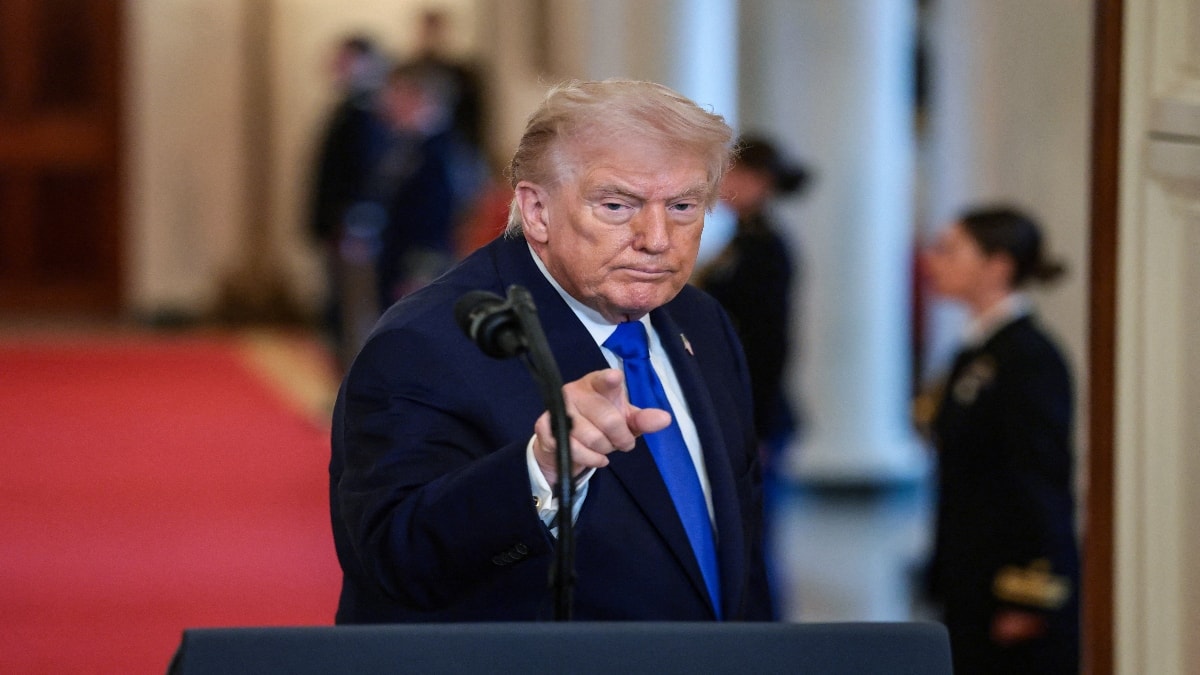
The velvet curtains of the House Chamber have seen it all. They have absorbed the echoes of declarations of war, the whispers of scandal, and the thunderous applause of a nation in its prime. But as the technicians check the camera angles for tonight’s State of the Union, the air feels different. Thinner. Brittle. Donald Trump is preparing to walk down that center aisle, but he isn’t just facing his political rivals. He is facing a ghost: the fading glow of his own spectacle.
For three years, the brand was the backbone. It was built on the idea of an unstoppable momentum—a roaring stock market, a "television president" who knew exactly how to keep the world glued to the screen, and a swagger that suggested America had finally outrun its problems. Tonight, that swagger meets the cold, hard math of a shifting reality.
The Empty Chairs in the Global Living Room
Consider a man named Elias. He lives in a suburb of Columbus, Ohio. In 2017, Elias watched the State of the Union with a sense of electrified curiosity. He felt like he was part of a movement. Fast forward to today. Elias hasn't turned on the news in three weeks. He isn't angry anymore; he’s just tired.
The ratings tell a story that the White House press releases try to bury. Viewership for these grand spectacles has begun to slide, drifting downward like a slow-moving fever. It’s a phenomenon known as "outrage fatigue." When everything is a crisis, eventually, nothing is. When every tweet is a revolution, the revolution starts to feel like background noise. The President, a man who has always measured his worth in Nielson points and trending topics, is walking into a room where the audience is slowly reaching for the remote.
This isn't just about entertainment. In a media-driven presidency, attention is the only real currency. If the public stops looking, the power to persuade vanishes. The "bully pulpit" only works if there is someone in the pews.
The Invisible Tax on the Kitchen Table
While the pundits talk about GDP and macroeconomic trends, the reality in places like Elias’s neighborhood is more nuanced and much more stubborn. The "economic strain" mentioned in the headlines isn't a single crash; it’s a thousand tiny paper cuts. It’s the cost of a gallon of milk creeping up while the "historic" tax cuts feel like a distant memory for the average household.
The administration points to a soaring Dow Jones, but the Dow doesn't pay for childcare. The disconnect between the ticker tape on Wall Street and the balance sheet on Main Street has created a psychological rift. The President will likely spend a large portion of his speech tonight painting a picture of a golden age. He will use words like "unprecedented" and "miraculous."
But for the worker whose wages have remained largely stagnant while the cost of living climbs, those words sound like a foreign language. There is a specific kind of vertigo that comes from being told you are living in the greatest economy in history when you are one car breakdown away from a financial crisis. It is this vertigo—not the official unemployment rate—that will define the mood of the voters listening tonight.
The Long Shadow of the Levant
Then, there is the smell of cordite in the air.
Thousands of miles away, in the dust and heat of the Middle East, the tension with Iran has moved from a slow burn to a flashpoint. This isn't a hypothetical war-game anymore. It’s a series of moves and counter-moves, drone strikes and retaliatory threats that have left the world holding its breath.
To the strategist in the Situation Room, this is a game of leverage. To the mother of a twenty-year-old Marine in North Carolina, it is a nightmare that keeps her awake at 3:00 AM.
The President’s challenge tonight is to reconcile his "America First" promise—the idea that we are bringing our boys home and staying out of "stupid" foreign entanglements—with the reality of a escalating conflict that seems to have no clear exit strategy. He has to project strength without sounding like a warmonger, and he has to project peace while the warships are moving into position.
It is a tightrope walk over an abyss. If he leans too far into the rhetoric of confrontation, he loses the isolationist base that put him in office. If he leans too far into diplomacy, he looks weak to the hawks who demand a show of force.
The Theater of Disunity
Watch the room tonight. Don't just watch the podium; watch the seats.
The State of the Union has always been a piece of political theater, but the choreography has become increasingly jagged. You will see one half of the room leaping to their feet in rhythmic, rehearsed adulation. You will see the other half sitting in stony, practiced silence, or perhaps even hissing.
This isn't just partisan bickering. It is the physical manifestation of a nation that has lost its common vocabulary. We no longer agree on the facts, let alone the solutions. When the President speaks of "greatness," half the country sees a promise kept, while the other half sees a threat to the very fabric of democracy.
There is a cost to this friction. It shows up in the legislative gridlock that ensures nothing—from infrastructure to healthcare—actually gets fixed. It shows up in the way we talk to our neighbors. It shows up in the exhaustion that Elias feels when he decides it’s easier to just turn off the TV and stare at the wall.
The Man in the Mirror
Behind the orange hue and the signature tie, there is a human being who knows the stakes. Donald Trump is a performer who lives for the roar of the crowd. He is a man who senses when he is losing the room.
Tonight, he isn't just fighting the Democrats. He isn't just fighting the "fake news" media. He is fighting the gravity of his own presidency. The novelty has worn off. The shocks no longer shock. The promises are being measured against three years of results.
As he stands before the joint session of Congress, he will try to conjure the old magic. He will tell stories of heroes in the gallery. He will point to the flag. He will use the majesty of the setting to shield himself from the mounting pressures of an impeachment aftermath and an uncertain reelection bid.
But the lights in the chamber are bright, and they reveal every line, every flicker of doubt. The economy is a house of cards built on debt and optimism. The foreign policy is a high-stakes gamble with lives as the chips. And the audience—the real audience, the ones in the living rooms of Ohio and Pennsylvania—is starting to wonder if they’ve seen this episode before.
The speech will end. The cameras will cut away to the analysts. The motorcade will whisk the President back to the safety of the White House.
But in the quiet that follows, the questions will remain. They are the same questions that have haunted every empire at its peak: How much longer can the show go on? And what happens when the audience finally decides they’ve had enough?
The ghost of the spectacle is lingering in the hallways of the Capitol tonight, and no amount of applause can quite drown out the sound of its footsteps.