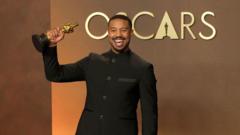
The Dolby Theatre smells of expensive lilies and the kind of high-octane anxiety that could power a small city. By the time the 98th Academy Awards rolled around this March, that scent had become suffocating. For decades, we watched this ceremony like we were peering through the glass of a high-end aquarium—observing exotic, beautiful creatures who didn't seem to breathe the same oxygen as the rest of us.
Then came the 2026 Oscars. Learn more on a connected topic: this related article.
Something shifted. It wasn't just the wins; it was the realization that the "prestige" bubble had finally burst, letting the messy, vibrant, and undeniably human world outside leak into the vacuum of Hollywood.
The Silence Before the Storm
Picture a young cinematographer named Elias. He isn't a household name. He spent the last decade hauling heavy gear through the mud of indie sets, surviving on cold coffee and the hope that one day, he’d see his name in a font larger than a footnote. Elias represents the thousands of people sitting in the nosebleed seats of the Dolby, or watching from cramped apartments in Echo Park. For them, the Oscars aren't about the gift bags. They are about validation. More analysis by IGN explores similar views on the subject.
For years, the Academy felt like a closed circuit. But as the lights dimmed for the 2026 ceremony, the atmosphere was different. The records that fell that night weren't just numbers in a ledger. They were sledgehammers.
When the first major upset occurred, the room didn't just clap. It exhaled. It was the sound of a long-overdue transition. We weren't just watching a prize giving; we were witnessing a changing of the guard that felt less like a corporate handover and more like a revolution.
The Weight of Gold
Winning an Oscar is often described as a "dream come true," but that’s a sanitized version of the truth. It is a relief. It is the end of a marathon where the runners are wearing tuxedos and high heels while carrying the expectations of entire cultures on their backs.
Take the Best Actress category. The win that night was historic not because of the person's age or her previous snubs, but because of what the role represented. For the first time in the ceremony's history, a performance rooted entirely in a non-English, indigenous dialect took the top honor.
The actress didn't give a polished, PR-vetted speech. She stood at the microphone and cried. Not the dainty, cinematic "single tear" we’ve been conditioned to expect, but a ragged, heaving sob of someone who had been told "no" for twenty years and finally heard "yes." In that moment, the statue ceased to be a piece of plated metal. It became a megaphone.
The facts tell us that 2026 saw the highest number of first-time winners in thirty years. Logic suggests this is a result of a diversifying voting body. But the feeling? The feeling was that the doors had been kicked off their hinges.
The Ghosts in the Machine
We often talk about the "magic of movies" as if it’s a spell cast by a wand. It’s actually more like a clock—thousands of tiny, invisible gears grinding together to produce a single tick.
One of the most poignant moments of the night happened during the technical awards. Usually, this is when the television audience goes to the kitchen to refill their drinks. But when the award for Best Sound was announced, the winner didn't talk about decibels or mixing boards. He talked about his father, a man who had lost his hearing working in a factory and had never actually "heard" his son's work.
He dedicated the award to the silence his father lived in.
Suddenly, the "Best Sound" category wasn't a dry technicality. It was a bridge between a son’s success and a father’s sacrifice. This is the human element that the checklists and "big winner" lists always miss. They tell you who won. They rarely tell you why it broke our hearts.
Breaking the 100-Year Curse
History is a heavy thing to carry. Since the first Oscars in 1929, certain patterns became so ingrained they felt like laws of physics. Big budgets won. Period pieces won. Safe, comfortable stories about the triumph of the human spirit (usually a very specific kind of spirit) won.
The 2026 Best Picture winner defied every one of those laws.
It was a film that cost less than the catering budget of a superhero sequel. It was gritty. It was uncomfortable. It didn't provide a happy ending; it provided an honest one. When the producers took the stage, they looked like they had wandered in from a different building. They looked like us.
This wasn't just a win for a movie. It was a funeral for the idea that "prestige" requires a hundred-million-dollar price tag. The data shows that streaming-native films and independent productions dominated the nominations, but the victory was a psychological shift. It proved that the Academy’s taste had finally caught up to the audience’s hunger for reality.
The Invisible Stakes
Why do we still care? Why do millions of people tune in to watch millionaires give each other trophies?
It’s because stories are the only currency that actually matters. We use them to understand our grief, to justify our hopes, and to navigate the terrifyingly complex world we live in. When the Oscars get it right, they aren't just rewarding a movie; they are validating a specific way of seeing the world.
In 2026, the Academy validated the outsiders.
It validated the animators who spent three years in dark rooms drawing the nuances of a child’s frown. It validated the documentary filmmakers who risked their lives to capture twenty minutes of footage in a war zone. It validated the writers who tapped out scripts on their lunch breaks at retail jobs.
The "historic moments" the news outlets keep citing—the record-breaking wins for international features, the first non-binary acting winner, the sweep by a debut director—are markers on a map. But the map itself has changed.
The Long Walk Back
As the house lights came up and the celebrities began their trek to the after-parties, the Dolby Theatre returned to its natural state: an empty room filled with discarded programs and the ghost of a standing ovation.
But for Elias, the cinematographer in the back row, the world looked different. He hadn't won anything. He hadn't even been nominated. Yet, as he walked out into the cool March air of Los Angeles, he wasn't thinking about the mud or the cold coffee anymore.
He saw the gold. Not the gold of the statues, but the gold of the possibility.
The 2026 Oscars will be remembered for the records and the fashion, surely. But its true legacy is the quiet permission it gave to every storyteller who previously felt invisible. It told them that the glass of the aquarium isn't just transparent; it’s breakable.
The statues were handed out. The speeches were made. The history books were updated. But the real story is what happens tomorrow, when a thousand people who saw themselves reflected on that stage for the first time pick up a camera and start to work.
The silence is over. Hollywood has finally started to listen.