The air inside the Rue du Faubourg Saint-Honoré usually smells of heritage. It is a scent composed of beeswax, expensive lilies, and the kind of quiet that only several centuries of extreme wealth can buy. At Le Bristol Paris, luxury isn't a gold-plated faucet; it is the absence of friction. It is the way a glass of Sancerre appears before you've realized you were thirsty. It is the impenetrable safety of being behind the limestone walls of one of the world’s few true "Palace" hotels.
Then came the smoke.
It began as a mechanical whisper in the guts of the building. On a Tuesday night that should have been defined by the soft clink of silver against porcelain at Epicure, the narrative of the perfect stay fractured. Fire does not care about five-star ratings. It does not pause to admire the Louis XV furniture or the hand-woven tapestries. It is a raw, primal intruder. When the alarm cut through the muffled elegance of the hallways, it wasn't just a technical malfunction. It was a breach of a sacred, high-society contract.
The Anatomy of a Panic in Silk
To understand the weight of an "important" fire at Le Bristol, you have to understand the geography of prestige. This isn't a high-rise glass box where you follow glowing green exit signs down a concrete stairwell. This is a labyrinth of history.
Imagine you are a guest on the fourth floor. You have paid several thousand euros for the privilege of forgetting the outside world exists. You are wrapped in a bathrobe that weighs more than a small child. Suddenly, the smell of burning insulation—acrid, synthetic, and terrifyingly out of place—seeps under your door.
The fire broke out in a technical room, a hidden vein of the hotel where the electricity and infrastructure live. It was described by the Brigade des Sapeurs-Pompiers de Paris (BSPP) as "assez important"—sizeable. In the language of Parisian first responders, that is not a casual descriptor. It means the heat was sufficient to warp metal and the smoke was dense enough to turn the opulent corridors into a sightless maze.
For the guests, the journey from luxury to survival is a short, jarring trip. There is a specific kind of vulnerability in being evacuated from a palace. You see captains of industry in mismatched slippers. You see world-class diplomats clutching nothing but a leather briefcase and a look of sheer bewilderment. The invisible stakes here aren't just about the masonry; they are about the shattering of an illusion. The illusion that enough money can insulate a human being from the chaotic whims of a short circuit.
The Front Lines of the Faubourg
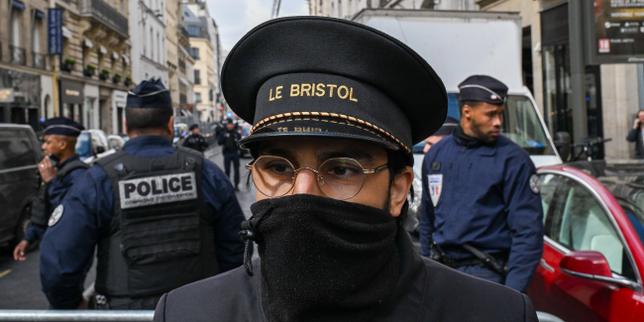
Outside, the scene was a violent contrast to the hotel’s usual serenity. The 110 firefighters who arrived didn't look like the staff the guests were used to. They didn't bow. They moved with a synchronized, heavy-booted urgency that signaled the gravity of the moment. Fifteen fire engines lined the street, their blue lights pulsing against the windows of neighboring boutiques like Hermès and Lanvin.
Two people were injured.
In the grand tally of a city’s daily emergencies, two might seem like a small number. But in the context of a controlled environment like Le Bristol, those two injuries represent a failure of the fortress. One was a firefighter, a person whose job is to run toward the heat that everyone else is fleeing. The other was a member of the hotel staff.
Consider that staff member. In a palace hotel, the staff are the ghosts in the machine. They are trained to be invisible, to anticipate needs before they are spoken, and to maintain the "Bristol Spirit" at all costs. When the fire broke out, they weren't just employees; they were the first line of defense for hundreds of sleeping guests. That injury likely happened in those frantic first minutes of trying to contain a beast that had escaped its cage in the basement. It is a reminder that the "seamless" experience of luxury is built on the very real, very physical labor of people who occupy the spaces the guests never see.
The Ghost in the Infrastructure
Why does a fire happen in a place this meticulously maintained?
We often think of old buildings as fragile, but the irony is that modern luxury often introduces more risk. A hotel like Le Bristol is a 1920s shell stuffed with 21st-century demands. High-speed data cables, complex climate control systems, and industrial-grade kitchen equipment all draw massive amounts of power through the "technical rooms" where this fire started.
Think of it as a vintage Ferrari with a modern jet engine squeezed under the hood. The strain is constant. A single frayed wire or a cooling fan that gives up after ten thousand hours of service is all it takes. The "technical room" is the heart of the beast, and when it suffers an arrhythmia, the whole body feels it.
The fire was "mastered" by midnight, but the term is deceptive. You don't just "put out" a fire in a building like this and go back to business. You fight the water damage from the hoses. You fight the soot that settles into the fibers of the silk wall coverings. You fight the lingering scent of carbon that refuses to be masked by even the most expensive room spray.
The Morning After the Magic Broke
By the time the sun rose over the 8th Arrondissement, the fire trucks were gone. The street was swept. To a casual passerby, Le Bristol looked as it always had—stately, silent, and immensely expensive.
But for the guests who stood on the sidewalk in the middle of the night, something had changed. The relationship between a guest and a palace hotel is built on trust. You trust them with your privacy, your comfort, and your safety. When you are woken by the smell of smoke, that trust is tested in its most raw form.
There is a hollow feeling that follows a "near miss." It’s the realization that even in a place where the staff-to-guest ratio is nearly two-to-one, the elements are still in charge. The fire was contained, the injuries were non-life-threatening, and the structure remains. Yet, the story isn't about the fire itself. It’s about the moment the lights went out in the most expensive neighborhood in France, and the people inside realized they were just as human, and just as breathless, as anyone else.
The smoke eventually clears, and the beeswax scent returns. The silver is polished, and the Sancerre flows again. But for those who were there, the silence of the hotel will never sound quite as absolute as it did before. They will remember the blue lights against the limestone. They will remember the way the air felt when the palace was no longer a fortress, but just a building, breathing in the dark.
The true cost of a fire in a place of perfection isn't measured in euros or smoke damage. It is measured in the loss of the quietest thing the hotel sells: the belief that inside these walls, nothing bad can ever happen.
Would you like me to look into the historical fire safety protocols that have shaped the architecture of Paris's "Palace" hotels?