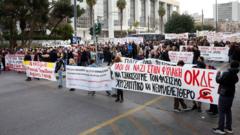
The air in Athens usually tastes of salt and exhaust, but on that particular morning, it tasted of held breath. Thousands of people had poured into the streets surrounding the Appeals Court. They weren’t there for a festival. They were there to see if a decade of darkness could finally be dismantled by a few pieces of paper and a woman’s steady voice.
Magda Fyssas stood among them. To the world, she was a symbol. To herself, she was a mother who had spent years clutching a photograph of her son, Pavlos, whose life was extinguished on a sidewalk in Keratsini by a man acting on orders. When the court finally spoke, upholding the landmark ruling that the political party Golden Dawn was not a mere fringe group of nationalists but a structured, lethal criminal organization, the roar that went up from the crowd wasn't just noise. It was the sound of a lung finally expanding after being crushed for years.
The verdict didn’t just send men to prison. It validated a terrifying truth that many had tried to ignore: hate can wear a suit, sit in parliament, and still hold a knife.
The Architecture of a Shadow
To understand why this court case felt like a battle for the soul of Greece, you have to look past the legal jargon of "articles" and "penal codes." You have to look at the anatomy of the organization itself. Golden Dawn didn't just happen. It was built.
Imagine a house that looks perfectly normal from the curb. It has a mailbox, a garden, and a sturdy front door. But once you step inside, you realize the floorboards are missing, and the basement is a command center for violence. This was the dual nature of the group. On the surface, they were the "voice of the forgotten Greek," preying on the desperation of a country hollowed out by financial crisis. They handed out food—only to those with the "right" blood—and promised to sweep the streets clean.
But the basement was where the real work happened.
The prosecution proved, and the appeals court confirmed, that the leadership operated on a strict "Führerprinzip"—a leader principle. Orders flowed from the top down. This wasn't a collection of hot-headed supporters acting on impulse. These were "hit squads." They targeted migrants, trade unionists, and anyone who dared to look different or think differently. The violence was the point. It was the branding.
The Cost of Silence
We often think of political extremism as a loud, crashing wave. In reality, it’s more like a rising tide. It starts at your ankles. You think, I can handle this. Then it’s at your knees. By the time it’s at your chest, you’re wondering how the water got so high.
For years, the victims of Golden Dawn were the invisible ones. They were the Egyptian fishermen attacked in their sleep. They were the migrants chased through dark alleys. Because these victims lived on the margins, their stories were often treated as isolated incidents or "unfortunate scuffles." The stakes remained invisible to the comfortable middle class until the violence turned inward, toward a Greek citizen, a rapper named Pavlos Fyssas.
His death was the catalyst. It forced a mirror in front of the nation. If a man could be murdered for his lyrics and his stance against fascism in a modern European democracy, then the "house" wasn't just broken—it was a trap.
The legal battle that followed was Herculean. We are talking about millions of pages of evidence, years of testimony, and a defense team that used every trick in the book to delay the inevitable. The defendants tried to claim they were victims of political persecution. They tried to wrap themselves in the flag.
The court didn't blink.
A Verdict Written in Iron
When the appeals court upheld the convictions, it sent a message that traveled far beyond the borders of Greece. It established a legal precedent for how a democracy can defend itself without becoming the monster it fights.
The judges looked at the evidence of the 2013 murder, the attacks on fishermen, and the assaults on activists. They didn't see "politics." They saw a hierarchy of terror. By confirming that the leadership—including former members of parliament—were heads of a criminal group, the court stripped away the shield of legislative immunity. It proved that a ballot box is not a car wash; it cannot scrub the blood off a murderer's hands.
Consider the bravery required to sit in that witness chair. Many who spoke out were people with everything to lose and no guarantee of protection. They were the ones who saw the "hit squads" training in the woods. They were the ones who heard the chants of "blood and honor" echoing through the streets. Their testimony was the friction that finally slowed the gears of the machine.
The Myth of the Final Chapter
It is tempting to look at a prison sentence and think the story is over. We love a clean ending. We want to believe that once the cell door clicks shut, the ideology evaporates.
That is a dangerous delusion.
Ideologies don't live in prison cells. They live in the grievances of the disillusioned. They live in the comments sections of social media and in the quiet conversations of people who feel the world has passed them by. The court can dismantle the organization, but it cannot legislate away the impulse toward hate. That part of the job belongs to the rest of us.
The Greek legal system did something extraordinary. It provided a roadmap. It showed that the law is not just a set of dry rules, but a living, breathing shield. But a shield only works if someone is willing to hold it.
As the sunset hit the Parthenon on the evening of the verdict, the streets were still full. People weren't just celebrating a legal victory; they were mourning the time it took to get there. They were remembering the names of those who didn't live to see the gavel fall.
The real triumph wasn't found in the sentencing of a few dozen men to years behind bars. It was found in the eyes of Magda Fyssas as she walked out of that courtroom. She didn't look like a woman who had won a fight. She looked like a woman who had finally been heard.
The shadows in Athens are still there, hiding in the corners of ancient stone and modern concrete. But for one long, loud moment, the light was turned all the way up.
The gavel didn't just hit the bench. It hit the ground, and the tremors are still moving.
Everything was different, yet the work had only just begun.
A mother’s black dress moved through the crowd, a solitary anchor in a sea of people, reminding everyone that while the law provides the ending, the people provide the soul.