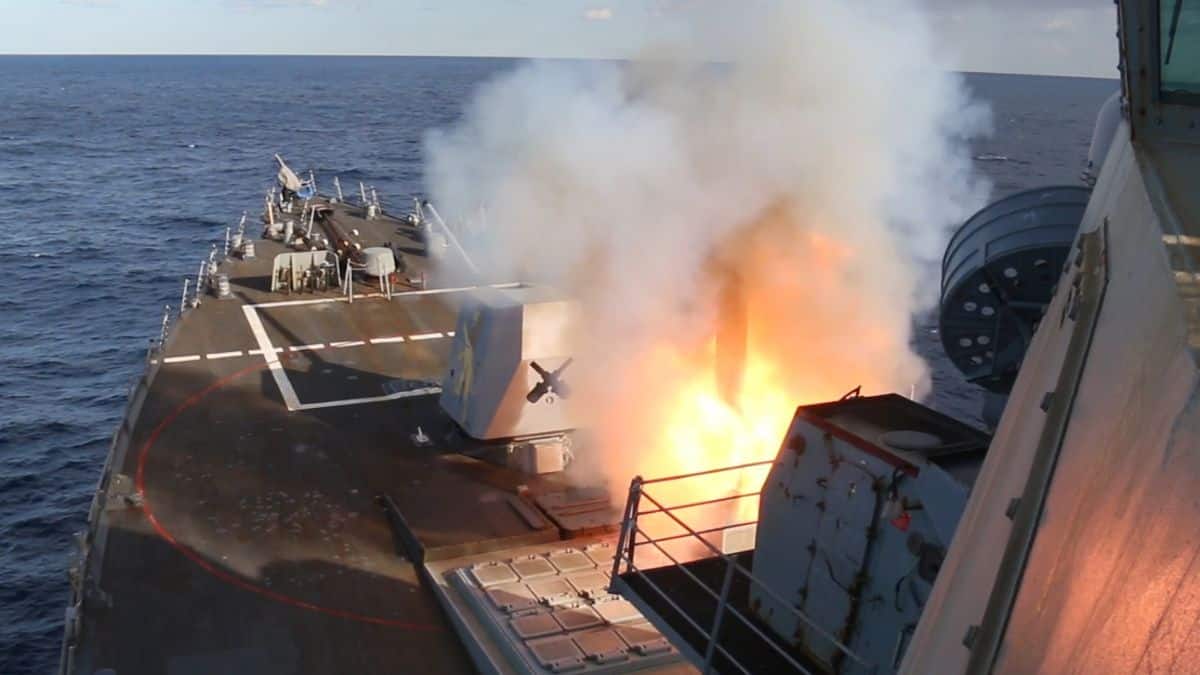
The air in the eastern Mediterranean has a specific weight when the world is about to change. It is thick with the scent of salt water and the static of high-frequency radio waves. Somewhere in the dark, thousands of feet above the whitecaps, a pilot feels the slight thud of a release mechanism. It is a sterile sound for such a violent consequence.
For weeks, the headlines spoke of escalations and red lines. They used words like "strategic assets" and "deterrence posture." But strategic assets do not bleed, and deterrence posture does not have a family waiting for it to come home. When the United States launched its sustained offensive against Iranian command centers and missile sites, it wasn't just a series of dots disappearing from a radar screen. It was the physical dismantling of a decades-long standoff.
The Architecture of the Strike
Modern warfare is sold to us as a surgical miracle. We are told of "smart" munitions that can find a specific window in a specific concrete block. But even the smartest steel is a blunt instrument when it meets the earth.
To understand the scale of what happened tonight, you have to look past the grainy infrared footage. Imagine a command center buried deep beneath the jagged peaks of the Zagros Mountains. This is not a room from a movie; it is a claustrophobic maze of server racks, cooling fans, and young men drinking tea while staring at glowing monitors. They are technicians of destruction. Their job is to ensure that if a button is pressed, a liquid-fueled rocket clears its gantry and finds a city hundreds of miles away.
When the American strikes hit, they didn't just target the missiles. They targeted the nervous system.
By severing the fiber-optic cables and vaporizing the satellite uplinks, the offensive effectively blinded the giant. A missile site without a command center is nothing more than a very expensive, very dangerous firework. The U.S. military calls this "effects-based layers." In plain English: if you can’t talk to your hand, you can’t make a fist.
The Invisible Stakes of the Middle East
We often talk about these conflicts as if they are a chess match. But in chess, the pawns don't have nervous systems.
Consider the merchant sailor on a tanker in the Strait of Hormuz. For him, the "Live Updates" on his phone aren't political fodder. They are a heart rate monitor for his own survival. If the command centers in Iran are crippled, the immediate threat of a coordinated swarm attack on global shipping drops. The price of oil in a gas station in Ohio fluctuates based on how well a specialized fuse performed in the Iranian desert at 3:00 AM.
This is the hidden tether that connects us all. We are bound by a fragile web of supply chains and energy routes that depend entirely on the absence of fire.
The strikes were not a sudden whim. They were the culmination of a slow-motion collision that has been decades in the making. Since the revolution in 1979, the shadow war between Tehran and the West has been fought in back alleys, via proxies, and through computer code. Tonight, the shadow became the light of a thousand explosions. The U.S. moved from the "gray zone" of cyberattacks and sanctions into the blinding white light of kinetic force.
The Logistics of a Sustained Offensive
A "sustained offensive" is a polite way of saying the bombs didn't stop. It means that as soon as the smoke cleared from the first wave, the satellites were already mapping the damage to see what was left. If a concrete bunker was cracked but not collapsed, the second wave was already en route to finish the job.
The sheer volume of hardware involved is staggering. We are talking about B-1B Lancers flying halfway across the world, supported by a literal bridge of aerial tankers that kept them fueled in the thin air over the Atlantic and the Mediterranean. It is a feat of engineering that is as terrifying as it is impressive.
The technical reality of these strikes involves a complex dance of physics and timing.
- Electronic Warfare: Before the first bomb drops, the air is flooded with noise. Jammers scream across every frequency, making it impossible for local radar to see anything but static.
- Suppression of Enemy Air Defenses (SEAD): High-speed anti-radiation missiles seek out the "pings" of defensive batteries. To turn on your radar is to invite a missile into your lap.
- Precision Impact: Only after the "eyes" and "ears" are gone do the heavy hitters arrive to dismantle the launch sites.
But even with all this precision, the human element remains the most unpredictable variable.
The People in the Path
Hypothetically, let’s look at a man named Karim. He isn't a general. He is a maintenance worker at a facility near Isfahan. He knows the facility produces "research," but he also knows the soldiers at the gate don't look like scientists. When the sirens go off, Karim doesn't think about geopolitics. He doesn't think about the "crippling of Iranian command centers." He thinks about the damp smell of the basement and whether his daughter’s school will be open tomorrow.
On the other side, there is a drone operator in a climate-controlled trailer in Nevada or a pilot in a cockpit over the Persian Gulf. They are separated from the impact by thousands of miles or inches of reinforced glass. They see the world in black and white—literally. On their screens, heat shows up as a ghostly white glow. A human being is just a heat signature. A truck is just a hot engine block.
This distance is the defining characteristic of modern war. It makes the violence feel like a video game until the moment the pilot lands and feels the heat coming off the jet’s engines. The smell of burnt JP-8 fuel is a reminder that the "sustained offensive" is very, very real.
Why the World Stays Awake
The reason we refresh our feeds every five minutes isn't just a morbid curiosity. It is a recognition that the rules of the world are being rewritten in real-time.
For years, the "status quo" was a series of small, manageable skirmishes. Iran would use a proxy to harass a ship; the U.S. would freeze an account. Iran would enrich a little more uranium; the U.S. would move a carrier group. It was a choreographed dance of "almost."
Tonight, the music stopped.
By striking the command centers directly, the U.S. has signaled that the era of the proxy war is, for now, over. They are holding the center responsible for the actions of the edges. This is a massive gamble. If it works, it restores a sense of order. If it fails, it triggers a regional wildfire that no amount of diplomatic water can extinguish.
The stakes aren't just about who controls a piece of desert. They are about the precedent of power. Can a superpower still dictate the terms of engagement in a world that is increasingly fragmented? Or is the "sustained offensive" a desperate attempt to hold onto a hegemony that is slipping through their fingers?
The Echoes of the Blast
As the sun begins to rise over Tehran and Washington, the physical damage will be tallied. Analysts will look at "before and after" photos. They will count the number of destroyed TELs (Transporter Erector Launchers) and the square footage of collapsed bunkers.
But you cannot photograph the shift in the collective psyche of a region. You cannot put a sensor on the fear of a parent or the cold calculations of a humiliated leader.
The missiles have landed. The command centers are silent. The launch sites are twisted scrap metal and scorched earth. But in the silence that follows a bomb, the most important things are said. They are whispered in the halls of power and shouted in the streets.
The world feels smaller tonight. Not because we are more connected, but because we realize how easily the things we take for granted—the lights in our homes, the food on our shelves, the safety of our borders—can be shaken by a few hours of coordinated violence.
The dust is still settling. In the desert, the heat from the impacts will take days to dissipate. In the capitals of the world, the heat will remain for much, much longer. We are no longer waiting for the escalation. We are living in it.
The sky is finally clear of drones, but the horizon has never looked more crowded.