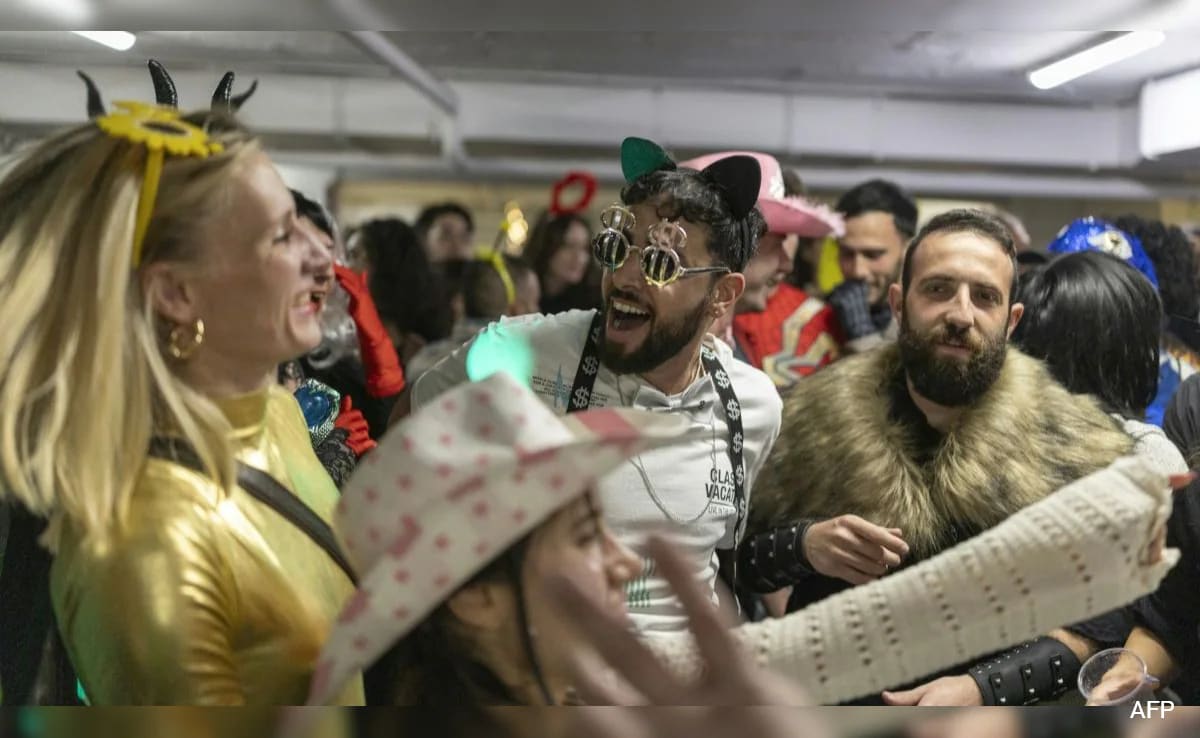
The smell of a bomb shelter is something you never forget. It is a specific, heavy cocktail of filtered air, old dust, and the faint, metallic tang of heavy steel doors. Usually, it is a place of hushed whispers and the frantic scrolling of news feeds. But this week, in the subterranean gut of an apartment building in Tel Aviv, that smell is losing the battle to something far more aggressive: cheap hairspray and industrial-strength bubblegum.
Adina is six years old. She is dressed as a glitter-covered unicorn, her horn slightly askew as she navigates a narrow hallway lined with reinforced concrete. Her mother, Miriam, follows behind with a tray of hamantaschen—those triangular pastries meant to represent the hat of a defeated tyrant from two thousand years ago. They are heading down, not out. In a year where the sky feels perpetually bruised by the threat of incoming iron, the tradition of Purim has found a new, cramped, and defiant home.
The Architecture of Defiance
Purim is, by its very nature, a loud holiday. It celebrates a narrow escape from genocide in ancient Persia with a command to be joyous until you can’t tell the difference between the hero and the villain. Usually, this manifests as massive street parades called Adloyada, where giant papier-mâché floats clog the boulevards of Holon and Jerusalem.
Not this time.
The municipalities called it off. The gatherings are smaller now, restricted by the Home Front Command’s safety tiers. When the gathering limit drops, the creativity rises. If you cannot have a carnival in the sun, you build a kingdom under fifteen feet of earth. This is the reality of the 2024-2026 conflict cycle: the celebration hasn't been canceled; it has merely been compressed.
Consider the physics of a modern Israeli "Mamad" or a communal shelter. These rooms are designed to withstand the blast pressure of a Grad rocket or the debris of an intercepted projectile. They are utilitarian. They are gray. They are the physical manifestation of anxiety. To walk into one and see it draped in purple tinsel is a jarring cognitive dissonance. It is a middle finger rendered in crepe paper.
The Cost of the Mask
For the adults in the room, the costumes serve a dual purpose. On the surface, it’s about the kids. You put on the oversized sunglasses and the neon wig because a six-year-old shouldn't have to spend a holiday wondering if the "boom" they just heard was a firecracker or an interceptor.
But beneath the polyester capes, there is a grittier exhaustion.
Miriam explains it while she adjusts Adina’s mane. "The mask isn't for the party," she says. "The mask is for the rest of the day. You wear the mask of a person who isn't terrified so your daughter can eat her cookies in peace."
This is the "Invisible Stake." If the population stops celebrating, the psychological victory is handed over to the adversary without a single shot being fired. In the logic of the Middle East, joy is a strategic asset. To abandon the feast is to admit that the threat has successfully dictated the terms of your internal life.
The Geography of the Underground
The shift to the shelters isn't just happening in the high-rises of the center. In the north, where the silence is often broken by the low hum of drones, the parties are even more sequestered. In places like Kiryat Shmona, the "party" might just be two families sharing a bottle of wine in a reinforced basement while the wind howls through empty streets.
Statistics tell one story: a 60% reduction in large-scale public events. But the data fails to capture the density of these micro-celebrations. In a standard year, you might wave at a neighbor during a parade. This year, you are locked in a 12-by-12 room with them, sharing a bottle of wine and debating the finer points of Persian history while the muffled thud of the Iron Dome echoes through the ventilation shafts.
There is a strange intimacy in the bunker. You see your neighbors without the veneer of professional life. You see the CEO of a tech startup dressed as a clumsy pirate, helping an elderly widow open a jar of pickles. The concrete walls act as a pressure cooker for community.
The Theology of the Absurd
There is a concept in Jewish tradition called V’nahafoch hu—"and it was overturned." It’s the idea that in a moment, everything can flip. The gallows built for the victim becomes the end for the executioner.
Inside the shelter, this concept feels less like an ancient story and more like a survival strategy. The world outside is upside down. The "safe" places are underground. The "scary" noises are often the sound of your own defense systems. In such a world, the only sane response is to lean into the absurdity.
We see this in the way the costumes have evolved. This year, there are fewer superheroes and more tributes to the "everyday." Children are dressing up as the delivery drivers who kept the country running, or as the search-and-rescue dogs that have become national icons. They are processing their reality through the medium of felt and glitter.
The Filtered Air
As the night wears on, the air in the shelter gets warmer. The sound of a portable speaker playing Israeli pop music competes with the hum of the air filtration system. It is cramped. It is inconvenient. It is, by any objective standard, a terrible way to throw a party.
But then you look at Adina.
She isn't looking at the reinforced steel door. She isn't thinking about the range of a ballistic missile or the geopolitics of the Red Sea. She is focused entirely on the fact that she just won a game of musical chairs against a boy dressed as a slice of pizza.
The victory isn't in the absence of war. The victory is in the refusal to let the war be the only thing in the room.
Outside, the streets are dark and the sirens are a hair-trigger away from screaming. But here, under the flickering fluorescent light, there is the sound of crunching pastry and the high-pitched laughter of children who refuse to be afraid.
The heavy steel door remains shut. It stays shut not because they are hiding, but because they have built a world inside that they aren't ready to leave yet. The party continues, ten feet below the surface, a neon heartbeat pulsing in the dark.
The glitter on Adina’s face has smeared, mixing with sweat and sugar, making her look less like a unicorn and more like a warrior who has just returned from a very colorful front line. She falls asleep on a pile of coats in the corner of the bunker, her plastic horn finally snapping off. Her mother covers her with a camouflage-print jacket, the contrast of the soft purple sparkles against the rugged fabric a perfect, silent map of a country that has learned to dance while the ground is shaking.