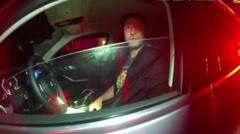
The air in Sag Harbor during the early hours of a Tuesday in June carries a specific, salt-heavy stillness. It is the kind of quiet that feels expensive. In this corner of the Hamptons, the streets are lined with the ghosts of whaling history and the very real, very polished storefronts of the modern elite. On June 18, 2024, that stillness was punctured not by a scream or a crash, but by the slow, rhythmic pulse of red and blue lights reflecting off the chrome of a grey BMW UT.
We have all seen the headlines. We have seen the mugshot—the glassiness of the eyes, the slight, weary tilt of the head. But the newly released bodycam footage from Justin Timberlake’s arrest offers something far more jarring than a static image. It offers a 12-minute window into the precise moment where a global icon becomes a mortal man standing on a dark curb, realizing that his internal compass has spun wildly out of true.
The Illusion of One Martini
The story began at the American Hotel, a local landmark where the wood is dark and the pours are generally generous. Timberlake told the arresting officer he had consumed "one martini" before following his friends home. It is a phrase whispered a thousand times a night across the country. One martini. It is the universal shorthand for "I am fine," a linguistic shield we use to protect ourselves from the reality of our own impairment.
But the physics of the road do not care about intentions.
When the 2025 BMW UT swerved, failing to maintain its lane and blowing through a stop sign, it wasn't just a traffic violation. It was a breakdown of the silent contract we all sign when we get behind the wheel. The bodycam footage shows a young officer, Michael Arkinson, who reportedly did not recognize the face that has been plastered on stadium screens for three decades. To Arkinson, the driver wasn't the Prince of Pop. He was a man who smelled of alcohol, whose speech was slowed by the chemical weight of that "one martini," and who could not complete the tightrope walk of a field sobriety test.
There is a profound, almost cinematic irony in watching a man whose entire career is built on precision—on the exact placement of a foot during a dance routine, on the perfect pitch of a falsetto—struggle to walk a straight line on a flat piece of asphalt. It is the ultimate equalizer. Gravity and biology are unimpressed by Grammys.
The Invisible Stakes of the Hamptons
We often view celebrity arrests as a form of dark entertainment, a "gotcha" moment that brings the high-flyers down to earth. Yet, looking past the tabloid gleam, the footage reveals a terrifyingly common human error. The Hamptons, for all their luxury, are a maze of narrow, unlit roads and unexpected deer crossings. When a vehicle as powerful as a BMW UT becomes a projectile guided by a clouded mind, the margin for error evaporates.
Consider the hypothetical family driving home from a late dinner, or the local worker finishing a double shift at a seaside restaurant. They aren't in the frame of the bodycam video, but they are the invisible stakes. Every time someone decides they are "good to drive" after that one drink too many, they are gambling with lives they will never meet. The footage serves as a visceral reminder that the "Forget Tomorrow" tour—the very name of Timberlake's current run—is a dangerous philosophy when applied to the driver’s seat.
The officer’s persistence is the most grounding element of the video. He remains professional, almost rhythmic, as he moves through the protocol.
"I’m not doing a chemical test," Timberlake says, his voice caught between a plea and a flat refusal.
He knew. At that moment, the realization of the professional fallout must have been crashing down. In the state of New York, refusing a breathalyzer triggers an automatic license suspension, regardless of the court's eventual verdict. It is a tactical move often advised by lawyers, but in the court of public opinion, it feels like a confession whispered in the dark.
The Architecture of a Public Fall
Why does this footage fascinate us? It isn't just the voyeurism. It is the shattering of the brand. For years, Justin Timberlake has occupied a space of curated perfection. He is the "suit and tie" guy. He is the man who brought "sexy back." He is the consummate professional. To see him swaying slightly, his eyes tracking the officer’s flashlight with a delayed, sluggish focus, is to see the scaffolding of a persona collapse.
The arrest happened at 12:37 AM. By sunrise, the world knew. The legal system moved with its usual, grinding indifference. He was arraigned, released without bail, and eventually pleaded guilty to a reduced charge of Driving While Ability Impaired—a non-criminal traffic violation. He was sentenced to community service and a fine, a conclusion that many critics argued was a "celebrity pass," while others saw it as a standard outcome for a first-time offender in that jurisdiction.
But the legal resolution is the least interesting part of the story. The real narrative is found in the silence between the officer's questions. It’s in the way the light hits the pavement. It’s in the sobering truth that even at the height of fame, a single choice—a single glass—can turn a night of celebration into a lifetime of "what ifs."
The Lesson in the Lens
We live in an age of total documentation. Nothing is hidden. The bodycam isn't just a tool for law enforcement; it is a mirror for society. It captures the moments we would rather forget and plays them back in high definition for the world to dissect.
There is a specific kind of vulnerability in the footage when Timberlake realizes his friends aren't going to be able to talk the officers out of it. The "man of the world" suddenly looks very small against the backdrop of the Sag Harbor Police Department’s duty. It serves as a stark rebuttal to the idea that some people are too big to fail or too famous to follow the lines on the road.
The BMW UT sat idling, its headlights cutting through the New York mist, a silent witness to a lapse in judgment. It wasn't about the car, or the hotel, or the tour. It was about the chemical reality of impairment and the fragile nature of public trust.
As the video ends, the handcuffs click. It is a sharp, metallic sound that cuts through the salt air. It’s the sound of a night ending, and a long, difficult morning beginning.
The road back to grace is always longer than the drive home, and it’s a journey that cannot be navigated by following a GPS or a set of tour dates. It requires a different kind of sobriety—a clear-eyed look at the person in the mirror when the stage lights finally go down and the only thing left is the cold, honest glow of a police cruiser in the rearview mirror.