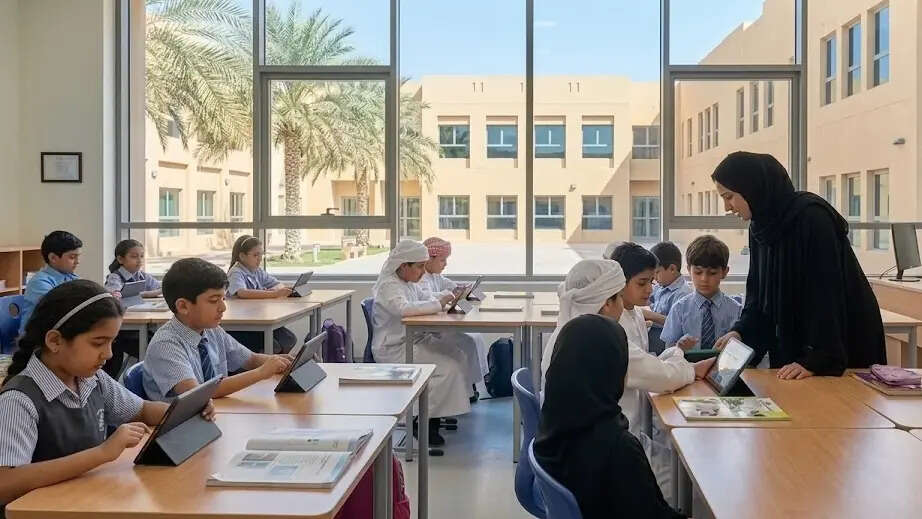
The UAE Ministry of Education has officially extended the distance learning mandate until April 17, 2026, for all schools and universities across the federation. This decision ensures that millions of students will continue their spring semester through digital interfaces rather than physical classrooms. While the immediate trigger involves the ongoing management of national infrastructure and safety protocols, the move signals a deeper, more permanent shift in how the Gulf state views the necessity of brick-and-mortar education during periods of transition.
By extending the remote period, authorities are not just reacting to a temporary hurdle. They are stress-testing a digital infrastructure that has been years in the making. For parents and educators, the announcement removes the ambiguity of a week-to-week existence, providing a concrete timeline that allows for structured lesson planning and childcare arrangements. However, the move also brings to the surface simmering questions about the long-term efficacy of a screen-based education and the mounting pressure on the domestic internet grid.
The Infrastructure Behind the Screen
Moving an entire nation’s youth onto the internet at 8:00 AM every morning is not a simple feat of clicking a link. It requires a massive coordination of data centers and local bandwidth. The Ministry’s decision to stay online until mid-April suggests that the "hybrid" model of the past is being phased out in favor of a total digital immersion when circumstances demand it. This isn't just about avoiding a commute. It is about the central government’s ability to maintain a functioning society regardless of external conditions.
We have seen this play out before, but never with this level of administrative certainty. In previous years, such extensions were often announced at the eleventh hour, leaving families in a state of perpetual chaos. This time, the two-week window provides a rare luxury in the world of crisis management: predictability.
Data from telecommunications providers indicates a massive spike in residential data consumption during these periods. This puts a strain on the "last mile" of connectivity—the physical wires leading into individual homes. While the UAE boasts some of the fastest fiber-optic speeds globally, the simultaneous demand of high-definition video conferencing for education, combined with a workforce that is also largely remote, creates a unique bottleneck. The government is betting that the current network can handle this sustained load without a significant drop in service quality.
The Hidden Cost of the Digital Extension
While the administrative logic is sound, the human element remains messy. Educators are reporting a phenomenon known as "interaction fatigue," where the psychological barrier of the screen begins to degrade the quality of student engagement after the first ten days. By extending the period to April 17, schools are entering a zone where the novelty of being home wears off and the reality of isolation sets in.
The Socialization Deficit
Students lose more than just a desk when they stay home. They lose the informal negotiations of the playground and the immediate feedback of a teacher’s body language. These are not "soft skills" that can be ignored; they are the bedrock of developmental psychology.
- Peer-to-peer collaboration: Group projects conducted over chat apps lack the nuance of in-person debate.
- Teacher intervention: It is much harder for an instructor to notice a struggling student in a grid of thirty small video squares than it is in a physical room.
- Laboratory and Practical Work: Science and engineering students are particularly hit hard, as simulations cannot fully replace the tactile experience of a lab.
The Ministry’s confirmation applies to universities as well, which is where the stakes are arguably higher. Medical students, engineers, and pilots-in-training cannot learn their crafts through a browser alone. There is a growing concern among faculty that a prolonged absence from specialized facilities will require a massive "catch-up" period later in the year, potentially delaying graduation dates for the class of 2026.
Economic Ripples for Families
The financial burden of distance learning is often overlooked in official statements. When children are home, one parent often has to withdraw from the workforce or significantly reduce their hours to act as a proctor. This is especially true for families with younger children in the Foundation Stage or Primary levels who cannot navigate a learning management system independently.
This creates a secondary economic impact. Productivity in the private sector tends to dip when a significant portion of the workforce is distracted by home-schooling duties. Furthermore, the private school sector, which operates on a high-overhead model involving massive physical campuses, faces a disconnect. Parents are increasingly questioning the tuition rates they pay when the primary service—the facility and face-to-face instruction—is not being utilized.
Accountability and Academic Integrity
One of the most significant challenges of the distance learning extension is the issue of assessment. How do you conduct a fair exam when every student is in an unproctored environment?
Schools have turned to various "proctoring software" solutions that track eye movements and browser activity. These tools are controversial. They raise privacy concerns and are often prone to technical glitches that can penalize a student for simply looking away from the screen to think. Moreover, the digital divide, while narrow in the UAE, still exists. A student with a dedicated home office and high-speed internet has a distinct advantage over a student sharing a room with three siblings and a spotty Wi-Fi connection.
The Ministry has been clear that standards will not be lowered. This means the pressure is on schools to innovate their testing methods. We are seeing a move toward "open-book" assessments that prioritize critical thinking over rote memorization. This might be the one silver lining of the extension: it is forcing a decades-old assessment model to finally evolve into the modern era.
The Role of Private Institutions
Private school operators find themselves in a precarious position. They must adhere to the Ministry’s mandate while keeping a demanding parent body satisfied. Some elite institutions have invested heavily in proprietary platforms that offer a more "metaverse" style of learning, attempting to replicate the campus environment in three dimensions.
However, for the mid-tier schools that make up the bulk of the educational landscape, the extension means two more weeks of relying on standard video conferencing tools. These schools are under immense pressure to prove their value. If a student is merely watching pre-recorded videos or filling out digital worksheets, the justification for high fees begins to evaporate. The "premium" on education in the UAE has always been tied to the facilities—the Olympic-sized pools, the high-tech labs, and the sprawling campuses. Without access to those, the industry is undergoing a forced rebranding.
Technical Resilience and Cyber Security
With a massive influx of users onto educational platforms, the risk of cyber threats increases exponentially. Educational institutions are prime targets for data breaches. The extension to April 17 gives IT departments more time to manage these risks, but it also broadens the window of vulnerability.
The Ministry has mandated specific security protocols for all platforms used by schools. This includes end-to-end encryption and multi-factor authentication for students and staff. But the weakest link in any security chain is the human element. Phishing attacks targeting parents—disguised as school tuition invoices or "urgent" updates from the principal—have seen a marked increase since the remote period began.
A Permanent Tool in the Arsenal
This extension proves that distance learning is no longer a "break glass in case of emergency" option. It is now a standard operational procedure. The government has demonstrated that it can flip a switch and move millions of people into a virtual environment with forty-eight hours' notice.
This capability is a strategic asset. It allows the nation to maintain continuity in the face of environmental, logistical, or health-related disruptions. The traditional school year, once defined by a rigid calendar of physical attendance, has been replaced by a fluid model where the location of the student is secondary to the delivery of the content.
The real test will come on April 18. If the return to physical classrooms is further delayed, it will signal that the "emergency" has transitioned into a new baseline. For now, the focus remains on the quality of those digital interactions. The Ministry has made its move, and the burden of execution now falls on the teachers who must keep their students engaged through a piece of glass for another fourteen days.
The infrastructure is ready. The teachers are trained. The students are logged in. But the long-term psychological and educational consequences of this digital-first policy are still being written in real-time. Parents must now balance their professional obligations with their new roles as teaching assistants, navigating a landscape where the dining table has become the new front row of the classroom.
The transition to April 17 is a definitive statement that the physical building is no longer the defining characteristic of an education. The UAE is betting that its digital backbone can carry the weight of its future. Whether the students emerge from this period with the same level of proficiency as their predecessors is a question that only the end-of-year assessments will answer.
Schools must now prioritize the mental health of their cohorts as much as their curriculum. Isolation is a quiet predator in the world of remote learning. Identifying the students who are fading into the background of the digital grid is the most urgent task for every administrator in the country. The technology works, but the social fabric requires constant maintenance.