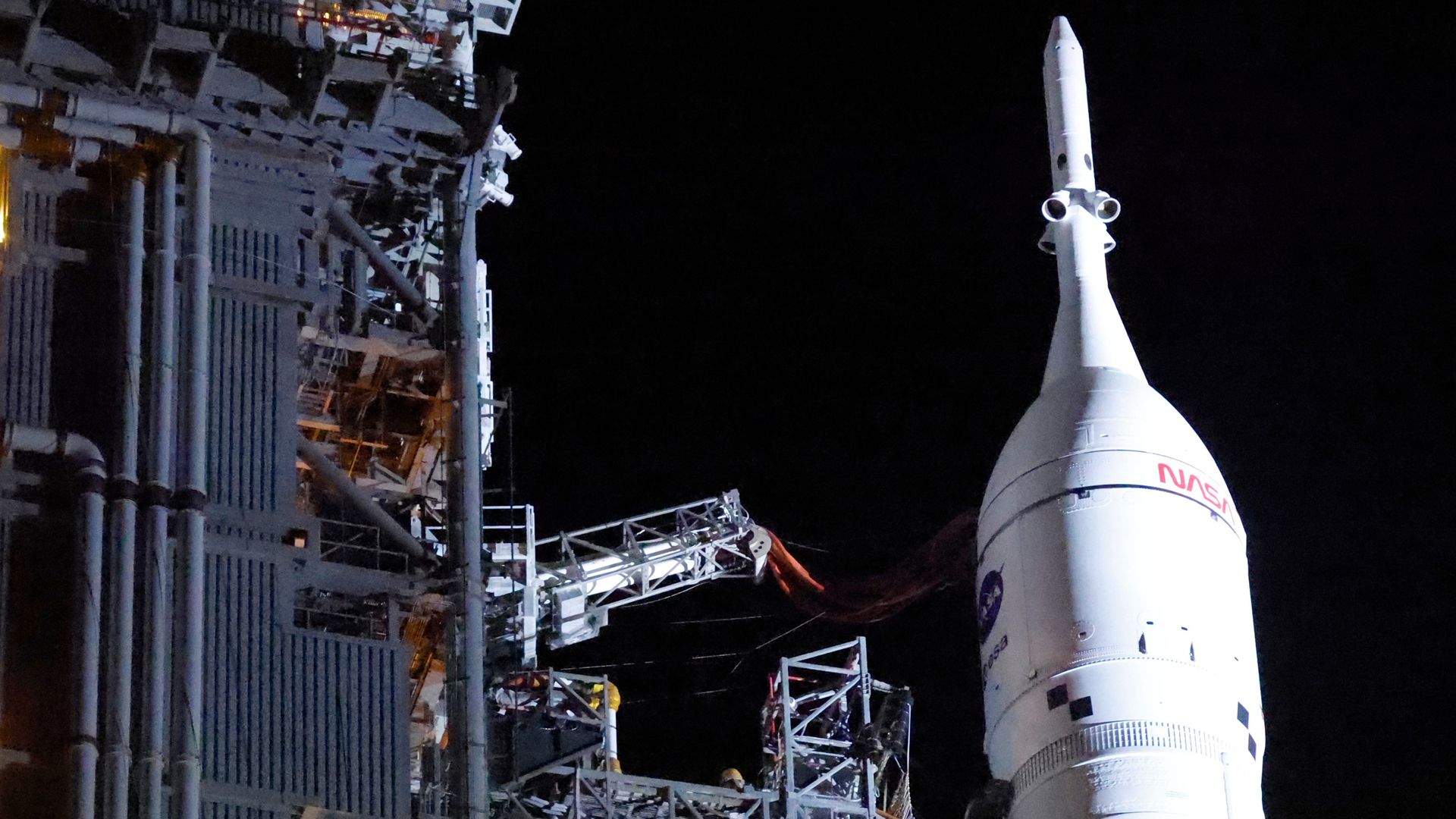
The SLS is back on the pad, and the press is swooning over "the next giant leap." They are lying to you.
Artemis II isn't a mission of discovery; it’s a high-stakes museum tour funded by a sunk-cost fallacy. We are watching NASA attempt to recreate the Apollo era using a supply chain designed in the 1970s, at a price point that would make a Roman Emperor blush. While the headlines scream about returning to the moon for the first time in fifty years, they conveniently ignore that we are doing it with hardware that belongs in a Smithsonian exhibit.
The Space Launch System (SLS) is a Frankenstein’s monster of Space Shuttle components. Those "new" RS-25 engines at the base? They are literally refurbished Shuttle engines. The solid rocket boosters? Modified Shuttle tech. NASA took the most expensive, least efficient parts of a retired program, slapped a new paint job on them, and called it the future. It isn't progress. It’s a jobs program disguised as an exploration initiative.
The Myth of "Sustainable" Exploration
The competitor headlines focus on the spectacle of the launchpad. They want you to feel the rumble in your chest and ignore the vacuum in the taxpayer's wallet. Each SLS launch costs roughly $2 billion. That isn't the development cost—that is the "per-shot" price tag. If you include the Orion capsule and ground systems, we are looking at closer to $4 billion every time the clock hits zero.
For that price, we get a single-use rocket. We throw the most expensive engines ever built into the Atlantic Ocean. In an era where private entities are landing boosters on drone ships and reflying them within weeks, NASA’s "flagship" is a disposable straw in a world of reusable thermoses.
If the goal is truly a "sustained presence" on the lunar surface, you don't build a vehicle that costs a significant percentage of your annual budget to fire once. Imagine trying to build a transcontinental railroad if you had to burn the locomotive after every trip to the coast. You wouldn't have a railroad; you’d have a very expensive pile of scrap metal and a lot of frustrated travelers.
The Orion Capsule: A Tight Squeeze for Four Billion Dollars
The media loves the Orion capsule because it looks like Apollo. That’s exactly the problem. Orion is a heavy, over-engineered life support system that is currently a decade behind schedule and billions over budget.
The heat shield issues discovered after Artemis I should have been a wake-up call. Instead, they were treated as a minor "technical hurdle." During the uncrewed reentry of Artemis I, the Avcoat ablator didn't just wear down; it charred and chipped away in ways the models didn't predict. NASA is now gambling that "more data" makes it safe for the four humans scheduled for Artemis II.
We are sending a crew—Reid Wiseman, Victor Glover, Christina Koch, and Jeremy Hansen—on a figure-eight loop around the moon. They won't land. They won't dock with a station. They will simply fly past, take some high-resolution photos that a CubeSat could take for a fraction of the cost, and come home. It is a $4 billion selfie.
The Wrong Question: "When Will We Land?"
People keep asking when we will finally step foot on the lunar south pole. That is the wrong question. The real question is: "Why are we using a 20th-century architecture to solve a 21st-century problem?"
The "lazy consensus" suggests that we need a massive, government-owned rocket to get to deep space. I’ve seen this play out in aerospace for twenty years. Big Prime contractors like Boeing and Lockheed Martin have lobbied for the SLS because it guarantees "cost-plus" contracts. There is zero incentive for efficiency when you get paid more the longer you take and the more you spend.
By the time Artemis III actually attempts a landing—if the SLS doesn't bankrupt the agency first—the lunar orbit will likely be crowded with commercial tankers and private habitats. NASA is building a cathedral in an era of modular prefab housing.
The Physics of the Failure
Let’s look at the math. The SLS Block 1 can lift about 95 metric tons to Low Earth Orbit (LEO). That sounds impressive until you realize the sheer mass required for a lunar landing, a return vehicle, and the fuel to move between them.
$$\Delta v = v_e \ln \frac{m_0}{m_f}$$
The Tsiolkovsky rocket equation is a cruel mistress. Because the SLS is non-reusable, every gram of dry mass ($m_f$) we throw away is a massive waste of energy and capital. A truly modern architecture would focus on orbital refueling—launching multiple smaller, cheaper, reusable rockets to fill a "gas station" in orbit. NASA is instead betting everything on a single, massive, fragile "all-in-one" shot. It is a brittle strategy. One failure on the pad and the entire program dies for a decade.
The Apollo Nostalgia Trap
The push for Artemis II is fueled by a desperate need to relive the 1960s. We are chasing a ghost. Apollo was a Cold War flex, a demonstration of raw industrial might to prove a political point. It was never meant to be a sustainable business model for space.
By trying to copy the Apollo silhouette, NASA has inherited its limitations without the unlimited budget of the 1960s. During the height of the Space Race, NASA received nearly 4% of the federal budget. Today, it gets less than 0.5%. You cannot run an Apollo-style program on a 21st-century shoestring.
The result is a "zombie program." It moves forward because it’s too big to fail, not because it’s the best way to get to the moon. Thousands of jobs in nearly every state are tied to the SLS supply chain. It is a political shield, not a scientific spear.
What No One Tells You About the Lunar Gateway
The competitor article likely mentions the Gateway—the planned small space station in lunar orbit. They describe it as a "staging ground." In reality, it is a toll booth.
The Gateway exists primarily to give the SLS somewhere to go. Because the SLS/Orion combo doesn't have enough $\Delta v$ to easily get into a low lunar orbit and back to Earth, NASA invented the Near-Rectilinear Halo Orbit (NRHO). It’s a compromise. It makes landing on the moon harder because you have to drop down from a much higher, more elliptical orbit, but it makes the Orion capsule look like it’s doing its job.
We are adding layers of complexity—docking, life support maintenance in deep space, long-term radiation shielding—just to justify the limitations of the rocket. If we used a high-cadence, reusable architecture, we wouldn't need a Gateway. We would just go to the moon.
The High Cost of Risk Aversion
NASA is terrified of a "Rapid Unscheduled Disassembly." They have been since Challenger and Columbia. This fear has led to a culture of "analysis paralysis." They spend years and billions on simulations, yet the Artemis I heat shield still behaved in ways they didn't expect.
Contrast this with the "test, fail, fix" mentality of the private sector. If a prototype blows up, you look at the telemetry, fix the weld, and launch again in three weeks. NASA’s current structure doesn't allow for that. A single SLS explosion would be a national scandal. This creates a feedback loop where they spend more money to reduce risk, which makes the rocket more expensive, which makes them even more risk-averse.
The SLS is too expensive to fly, but it’s too expensive to fail. It is the ultimate technological paradox.
Stop Cheering for the Wrong Victory
When Artemis II finally clears the tower, the world will cheer. They will see the fire and the smoke and think we are back in the business of exploration.
But look closer. Look at the timeline. Look at the costs. Look at the lack of innovation in the propulsion systems. We are watching the last gasp of a dying era of aerospace. We are watching a government agency try to compete with the future by doubling down on the past.
If we want to be a multi-planetary species, we have to stop building one-off Ferraris that we crash into the ocean. We need a fleet of trucks. We need orbital depots. We need a radical departure from the "single big rocket" philosophy.
Artemis II isn't the beginning of a new chapter. It’s a very expensive epilogue to the last one. We aren't going back to the moon to stay; we are going back to prove we still can, and we’re going broke doing it.
The SLS is a monument to how things used to be. If you want to see the future of space, stop looking at the launchpad in Florida and start looking at the scrap metal in Texas where people are actually allowed to fail, learn, and iterate. NASA is playing it safe, and in space, playing it safe is the fastest way to get left behind.
Stop treating the SLS like a triumph. It’s a warning.
Next time you see that orange rocket on the pad, don't think about the moon. Think about the opportunity cost. Think about the ten better, cheaper, faster ways we could have done this if we weren't so obsessed with the 1960s. We aren't reaching for the stars; we are reaching for a scrapbook.