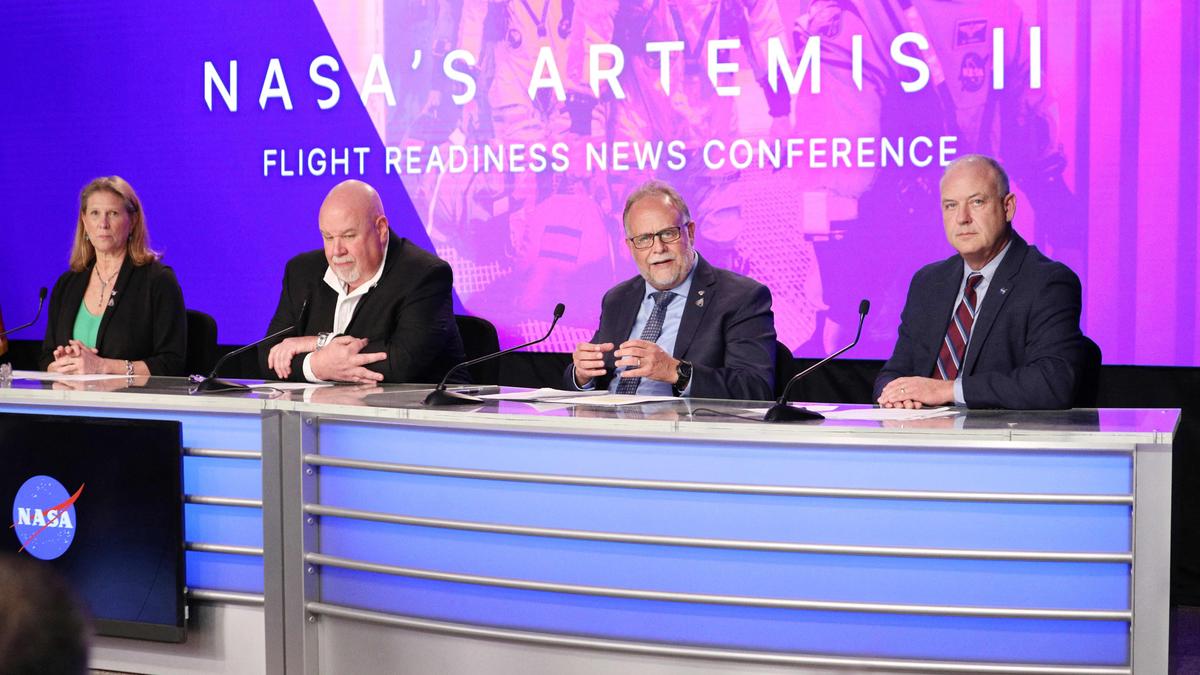
The headlines are currently screaming about a "go" for the April launch of Artemis II. They treat this like a triumph of bureaucratic will over physics. They point to the heat shield issues and the electrical gremlins as "problems to be managed" rather than symptoms of a terminal illness in modern space exploration.
NASA is about to put four humans on top of a rocket because they are terrified of being irrelevant. That is the wrong reason to ignite millions of pounds of propellant.
Everyone is asking if Artemis II is safe. That is the wrong question. The real question is: Why are we still trying to build a 1960s dream with a 2026 budget and a 1990s supply chain? We are obsessed with putting boots on the regolith when we should be obsessed with building the infrastructure that makes those boots unnecessary.
The Heat Shield Fallacy
The "consensus" view is that the charring on the Orion heat shield during the Artemis I uncrewed mission was an anomaly. NASA engineers call it "unexpected erosion." In the private sector, we call that a design failure.
When the Orion capsule returned from its lunar skip-entry, it shed material in a way that wasn't predicted by the thermal models. The fix? Testing. More modeling. A "calculated risk."
But let’s talk about the math of risk in a monolithic government program. If Orion fails with a crew on board, it doesn’t just end the mission; it ends the American presence in deep space for a generation. We are risking a thirty-year setback for a photo op. The heat shield isn't a "hurdle." It is a warning.
If the $SiO_2$ (silica) based blocks aren't behaving as predicted at velocities of $11,000$ meters per second, you don't "OK" a launch. You redesign the architecture. But NASA can’t redesign. They are locked into contracts signed a decade ago. They are flying a museum piece because the paperwork is too heavy to change.
The SLS is a Jobs Program, Not a Rocket
The Space Launch System (SLS) is a technical marvel only if you ignore the balance sheet. It is an expendable rocket built from Space Shuttle leftovers.
Imagine buying a brand new Ferrari, driving it once, and then pushing it off a cliff. That is the SLS flight profile. Every time those RS-25 engines—engines that were designed to be reused—hit the ocean, we are flushing hundreds of millions of dollars into the Atlantic.
The industry insider secret is that nobody at NASA actually wants to keep building the SLS. They have to. It is politically bulletproof because its components are manufactured in nearly every state. It isn't a vehicle for exploration; it is a vehicle for wealth redistribution.
The contrarian truth? Artemis II doesn't need to happen for us to get to the Moon. We could wait three years, let the private sector perfect on-orbit refueling, and go to the Moon for a tenth of the cost with hardware that doesn't end up as reef fodder.
The Deep Space Gateway is a Toll Booth
The current plan involves the Gateway—a small space station orbiting the Moon. The mainstream media calls it a "staging point." In reality, it is a bottleneck.
Why would you stop at a station in high lunar orbit when you could go directly to the surface? The answer is simple: The SLS isn't powerful enough to send a lander and a crew capsule together. The Gateway exists to justify the rocket's limitations. It is a rest stop in the middle of a desert where nobody needs to rest.
By forcing the mission through the Gateway, we increase the points of failure. We add docking maneuvers, life support handoffs, and radiation exposure. We are adding complexity to hide a lack of capability.
The Myth of the New Space Race
The media loves the "US vs. China" narrative. They claim we have to launch Artemis II in April to "beat" them.
China is not racing us. China is building. They are methodical. They are not beholden to four-year election cycles. While we rush a compromised heat shield to meet a PR deadline, they are establishing a long-term presence.
If we "win" by landing a human on the Moon in 2026 and then realize we can't afford to go back until 2030, we haven't won anything. We’ve repeated the Apollo mistake. We’ve built a "flags and footprints" program instead of a "mines and fuel depots" program.
The Real Cost of "Go"
The "People Also Ask" section of your favorite search engine is filled with questions about how much Artemis costs. The official number is around $93 billion through 2025.
That number is a lie.
It doesn't account for the opportunity cost. What could we have done with $93 billion if we weren't trying to rebuild the Saturn V with a committee?
- We could have built a fleet of robotic miners.
- We could have perfected nuclear thermal propulsion.
- We could have mapped the entire lunar sub-surface for water ice.
Instead, we are focused on the "manned" aspect. We are obsessed with the biological cargo. Space is hard for humans. It is easy for silicon. By insisting on sending people now, we are slowing down the actual expansion of the human species.
The Brutal Reality of Lunar Dust
No one is talking about the regolith. The Apollo astronauts found that lunar dust is like crushed glass. It gets into everything. It eats seals. It destroys lungs.
Artemis II is a flyby. It won't land. But the rush to Artemis III (the landing) means we are ignoring the fact that we still haven't solved the dust problem. Our current spacesuit designs are essentially just better versions of the ones from 1969. We are bringing 20th-century solutions to a 21st-century environment.
Stop Trying to Fix Artemis
The consensus is that we just need to "iron out the kinks" in the Orion capsule and get the SLS cadence up.
No. We need to scrap the SLS.
We need to admit that the "Old Space" model of government-owned, contractor-operated heavy lift is dead. The future is "Commercial-Owned, Government-Leased."
NASA should be the customer, not the architect. They should be saying, "We want to get 20 tons to the lunar south pole. Whoever gets it there cheapest gets the contract."
Instead, NASA is trying to be the airline, the plane manufacturer, and the airport authority all at once. It’s a recipe for the exact delays and "loomng problems" the competitor article mentioned.
The Danger of Success
The worst thing that could happen is that Artemis II is a flawless success.
If it succeeds, it validates a broken system. It ensures that we will waste another hundred billion dollars on a dead-end architecture. It keeps the "jobs program" alive for another decade.
Failure, while tragic, often forces a reckoning. Success in a flawed paradigm just postpones the inevitable collapse.
We are cheering for a mission that is designed to fail the future. We are celebrating a rocket that is obsolete before it leaves the pad. We are prioritizing the ego of a nation over the survival of a species.
Cancel the April launch. Not because the heat shield might fail, but because the mission is already failing its true objective.
Build the robots. Build the fuel depots. Build the nuclear engines. Leave the boots at home until the road is actually paved.