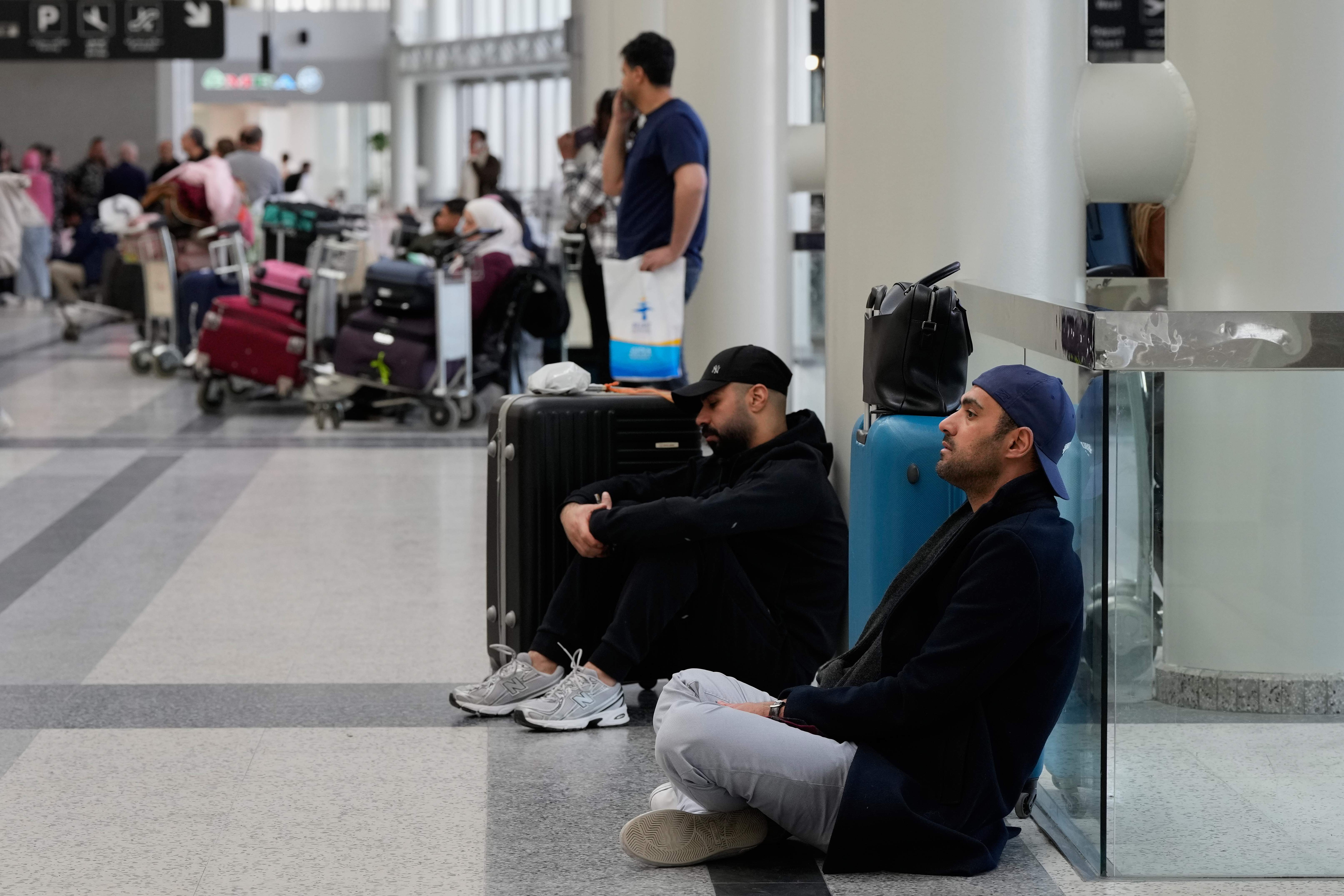
The headlines are bleeding with the same exhausted narrative: tens of thousands of "stranded" souls trapped in the Middle East because of regional volatility. The mainstream media wants you to picture helpless victims caught in a gears-of-war machine they couldn't possibly have predicted. They paint a picture of a travel industry in collapse.
They are lying to you. Or, at the very least, they are coddling you.
Nobody is truly stranded in 2026 unless they ignored every red flag, every insurance rider, and the basic physics of global fuel hedging. What we are seeing isn't a "travel crisis." It is a massive, collective failure of risk assessment by consumers who treat international borders like a local bus route.
If you fly into a region with a decades-long history of airspace closures and then act shocked when your flight to London is canceled, you aren't a victim of geopolitics. You are a victim of your own optimism bias.
The Airspace Lie
The common complaint right now is that the "war" closed the routes. That’s a fundamental misunderstanding of how the sky works. Airspace doesn't just "close" like a boarded-up shop. It re-routes based on the Notices to Air Missions (NOTAMs) and the risk appetite of individual carriers.
When Iran launches or Israel retaliates, the sky doesn't become a brick wall. It becomes a math problem.
- Fuel Burn vs. Ticket Price: Airlines like Emirates or Qatar Airways aren't canceling because they can't fly; they are canceling because flying the "long way" around Turkey or Egypt eats the margin on an economy ticket.
- Insurance Premiums: The moment a missile crosses a GPS coordinate, the hull war risk insurance for that aircraft triples.
The "stranded" passenger is actually just a passenger whose ticket price no longer covers the cost of the kerosene required to get them home safely. We shouldn't be talking about a humanitarian crisis; we should be talking about the end of the "cheap long-haul" era in an unstable world. If you paid $600 for a round-trip from Dubai to NYC, you didn't buy a guaranteed seat. You bought a speculative asset that devalued the moment the first siren went off.
Stop Asking the Embassy for a Ride
One of the most frequent "People Also Ask" queries during these flare-ups is: When will the government evacuate its citizens?
This is the wrong question. The brutal reality is that your government is not your travel agent. I’ve watched travelers sit in airport lounges for 72 hours waiting for a state-sponsored charter while commercial flights were available three gates over for an extra $1,200.
They stay "stranded" because they refuse to pay the "volatility tax."
If you have the means to travel to a sensitive region, you must have the "escape liquidity" to leave it. Relying on an embassy evacuation is a strategy for the desperate or the unprepared. In the industry, we call this the Liability Hand-off. The traveler tries to hand their personal risk off to the taxpayer the moment things get inconvenient.
If you want to avoid being part of the "tens of thousands" in the next headline, follow the 30% Liquidity Rule: Never travel to a high-risk corridor without 30% of your total trip cost sitting in a liquid account specifically for a "GTFO" flight.
The Logistics of the "New Normal"
The competitor articles love to cite the number of canceled flights as proof of a broken system. In reality, the system is working exactly as designed. The rerouting of traffic away from Iranian or Lebanese airspace is a triumph of modern data.
We use $S = \frac{D}{V}$ for basic transit, but in a conflict zone, the variables for $D$ (distance) and $V$ (velocity) are hijacked by $R$ (risk).
$$Cost = (Fuel \times Reroute_Factor) + Insurance_Surcharge + Crew_Duty_Overages$$
When the $Cost$ exceeds the $Revenue$, the flight is scrubbed. This isn't a failure of the airline; it’s a rational economic response to a physical threat. The "stranded" population is a byproduct of a logistical system that prioritizes the airframe over the itinerary. You are a line item, not a guest.
The Insurance Industrial Complex
Most people being interviewed in these "stranded" segments are complaining about their travel insurance. They should be. Travel insurance is, for the most part, a scam designed for peace-time delays.
Most policies contain a "War and Terrorism" exclusion clause. If you bought a standard policy thinking it would cover a hotel in Amman while missiles are in the air, you didn't read the fine print. You need CFAR (Cancel For Any Reason) coverage. It’s expensive. It’s "inefficient" for the casual traveler. But it’s the only thing that actually works when the Middle East catches fire.
I’ve seen families lose $10,000 on a wedding trip because they relied on a credit card's "built-in" protection. Those protections are built for lost luggage, not regional escalations. If you aren't paying for specialized coverage, you are self-insuring whether you realize it or not.
How to Actually Navigate a Conflict-Zone Exit
Stop checking the airline app. It’s updated by a server that lags behind the reality of the ground.
- Monitor FlightRadar24, not the News: Look at where the planes are actually going. If you see a cluster of diversions over the Mediterranean, don't wait for the "Canceled" notification. Book the alternative route through a neutral hub (like Tashkent or Addis Ababa) immediately.
- Avoid Hub Dependency: The "stranded" are almost always at the hub (Doha, Dubai, Istanbul). If the hub is clogged, go "backwards" to a secondary domestic city and find a charter or a ferry.
- The "Lobbyist" Method: Don't call the 1-800 number. Go to the airport and find the supervisor for a premium airline you aren't even flying with. Pay for a day pass to their lounge. The concierges in those lounges have more power to override ticketing blocks than any phone agent.
The Hard Truth About Regional Travel
The world is not a playground. The "Middle East complication" isn't a glitch; it’s a feature of the geography.
We have lived through a decade of unnaturally stable air travel where we assumed the shortest path between two points would always be open. That era is dead. The tens of thousands of people sitting on suitcases in terminal 3 are the first casualties of a return to a fragmented world.
If you are "stranded," it’s because you treated a volatile region with the casual indifference of a weekend trip to the suburbs. The routes home didn't get "complicated"—they got honest.
Stop waiting for a rescue that isn't coming and start paying the price for the risk you took. The sky doesn't owe you a schedule.