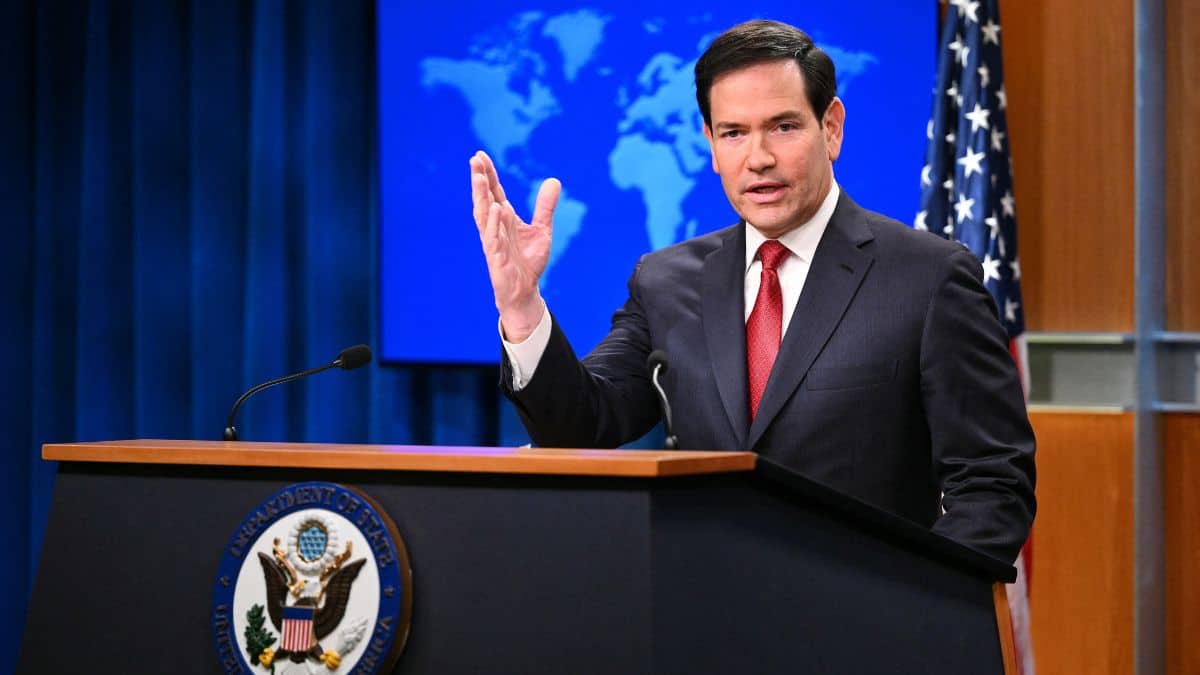
The beltway is currently vibrating with a singular, comforting lie: that the United States is a passive passenger strapped into a sidecar while Israel drives the Middle East off a cliff. Marco Rubio’s latest grandstanding about an "imminent attack" forcing the American hand is a masterpiece of political theater, but it’s factually bankrupt. It paints a picture of a superpower with its hands tied, ignoring the reality that the Pentagon doesn’t "get forced" into theater-wide wars; it calculates them years in advance.
The "lazy consensus" suggests that Washington is desperately trying to hold back the dogs of war. In reality, the strategic architecture of the region has been built specifically to ensure that if one pillar moves, the entire weight of the American military industrial complex drops. We aren't being dragged into a conflict with Iran. We’ve been parked on the doorstep with the engine running since 2019.
The Intelligence Trap of Imminence
When politicians use the word "imminent," they aren't describing a timeline. They are describing a marketing budget. In the world of high-level intelligence, imminence is a flexible metric used to bypass Congressional oversight and prime the public for "inevitable" kinetic action.
I have watched dozens of these "imminent" windows open and close. In 2020, after the Soleimani strike, the consensus was that a regional conflagration was minutes away. It didn’t happen because the logistical reality didn't match the rhetoric. To suggest that a single Israeli tactical decision "forces" a total shift in US posture ignores the sheer scale of American force projection. You don't move a Carrier Strike Group because you’re surprised; you move it because you’ve already decided where the ceiling of the conflict sits.
The current friction isn't about Israel’s lack of restraint. It is about the synchronization of two different clocks:
- The Israeli Security Clock: Driven by the existential math of a nuclear-capable neighbor.
- The American Hegemony Clock: Driven by the need to maintain global trade routes and energy stability without a direct boots-on-the-ground commitment.
Rubio’s narrative collapses when you look at the Integrated Air and Missile Defense (IAMD) systems currently blanketing the region. This isn't a reactive shield; it’s a proactive net. By integrating Israeli sensors with US interceptors and regional radar hubs, the US has created a scenario where it is physically impossible to stay out of the fight. That wasn't an accident. It was a deliberate engineering choice to ensure that any Iranian response to Israel would necessitate an American counter-response. We didn't get "forced." We built the trap ourselves.
Stop Asking If We’ll Join the War
The premise of the question is flawed. People keep asking, "Will the US join the war?" while ignoring the fact that the US is already the primary logistics, intelligence, and electronic warfare provider for the current conflict.
If you are providing the target coordinates, the mid-air refueling, and the satellite imagery, you aren't "joining" a war. You are managing it. The idea that there is a binary "on/off" switch for American involvement is a relic of 20th-century thinking. In modern warfare, the "kinetic" part—the actual bombs dropping—is only about 15% of the total operation. The other 85% is the digital and logistical backbone, which the US has been providing for months.
The Brutal Reality of Iranian Deterrence
The status quo says Iran is a "rational actor" that wants to avoid a direct hit. The contrarian truth is that Iran’s internal stability currently requires an external threat to justify its domestic crackdowns and economic failures.
When Rubio says we are being "forced" to join, he’s ignoring the agency of the Iranian IRGC. They know exactly how to play the American political cycle. They use the threat of a "regional war" to extract concessions, while the US uses the "imminent Israeli strike" to justify increased military spending and a permanent presence in the Eastern Mediterranean. It is a symbiotic relationship of escalation.
The Technology of Non-Escalation is a Lie
We’ve been told that precision-guided munitions and "surgical strikes" prevent wider wars. This is the great lie of 21st-century defense tech.
Imagine a scenario where a "precision" strike on a nuclear facility in Natanz leads to a "precision" cyber-attack on the SWIFT banking system or the colonial pipeline. The idea of "contained" escalation is a fantasy sold by defense contractors.
- Cyber-Attribution Delay: By the time we know who hit us, the physical war is already three phases ahead.
- The Drone Saturation Problem: Iran’s "Shahed" style drones cost less than a used Toyota. Our interceptors cost $2 million each.
The math of this war doesn't favor the "imminent attack" narrative. It favors a slow, grinding attrition that exhausts the US treasury while keeping the region in a state of permanent, low-level combustion. This serves the interests of every player except the taxpayer.
The Strategic Incompetence of "Holding Back"
The most dangerous thing the US can do is what it's doing now: signaling that it will only act if "forced." This creates a vacuum.
If you're an industry insider, you know that ambiguity is the mother of miscalculation. By pretending we are a reluctant participant, we give Iran the impression they can push further, and we give Israel the impression they must act alone to ensure their own survival. This "strategic ambiguity" isn't a clever diplomatic tool; it's a failure of leadership that makes the very war we claim to fear a statistical certainty.
The US should stop the charade of being "dragged" into things. We are the world’s only superpower. If we are in a war, it’s because we chose to be there. Whether that choice was made in a boardroom in Northern Virginia or a bunker in Tel Aviv is irrelevant. The bill is the same.
The Hard Logic of the Next Phase
Forget the "imminent" headlines. Look at the data points that actually matter:
- Refueling Contracts: The US recently increased the frequency of KC-46 sorties in the region. You don't do that for "defense." You do that to keep strike packages in the air for 12 hours at a time.
- Forward Deployment of THAAD: Putting American boots on the ground to operate missile defense systems in Israel isn't a "support" move. It’s a "tripwire" move. It ensures that any Iranian strike that kills a THAAD operator is a direct declaration of war against the United States.
We have moved past the point of "influence." We are now in the era of "automated involvement." The systems are linked, the sensors are shared, and the political rhetoric is just a way to make sure the public doesn't realize the decision was made months ago.
The next time a senator tells you we are being "forced" into a conflict, ask yourself: who built the bridge we’re walking across? We aren't being pushed. We’re marching. And we’re doing it with our eyes wide open, pretending they’re shut.
Check the flight manifests out of Al-Udeid if you want the truth. The politicians provide the cover; the logistics provide the reality. We aren't waiting for a war to start. We are waiting for the permission to admit it’s already happening.
Stop looking at the podium. Look at the map. If you think this is about one "imminent" strike, you’ve already lost the game. This is about the total restructuring of regional power, and the US isn't a reluctant witness—it's the architect.