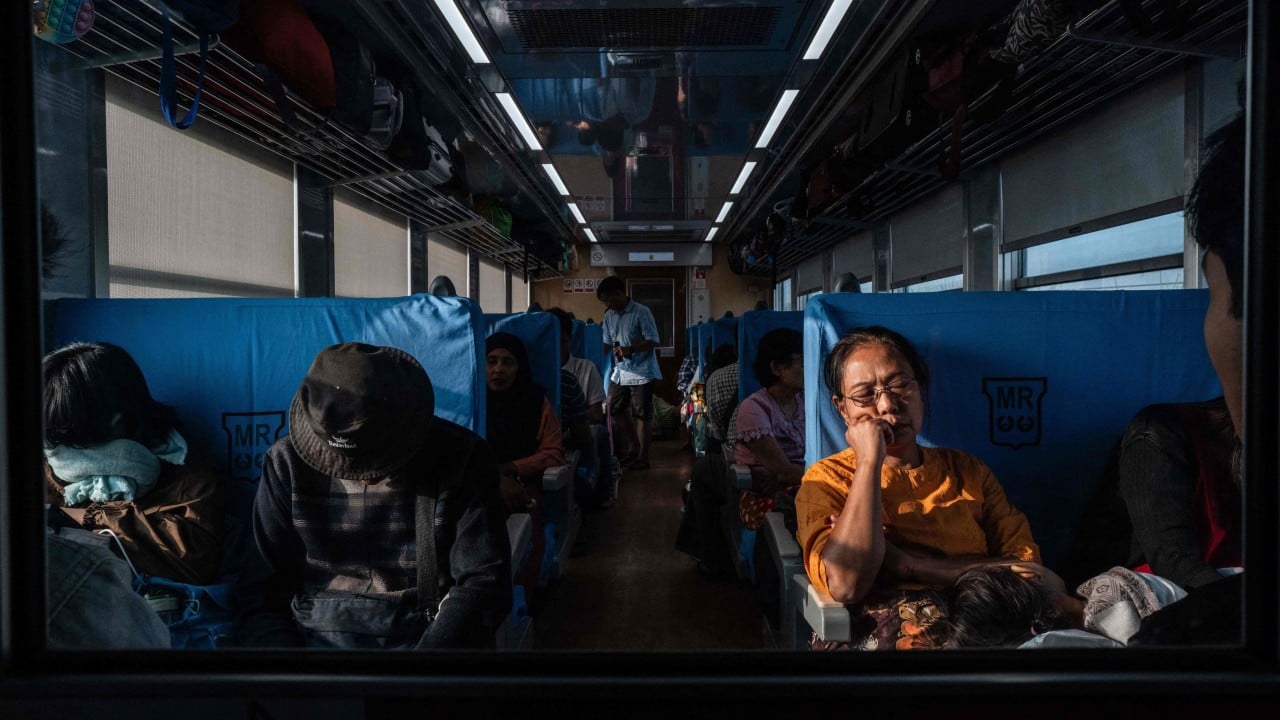
The narrative is simple, clean, and entirely wrong. As fuel prices in Myanmar skyrocket and the kyat tumbles, the global press has fallen in love with a heartwarming tale of "resilient" commuters returning to the romantic, clicking-clacking tracks of the state-run railway. They frame it as a logical shift—a victory for public transport and a middle finger to the volatility of the global oil market.
That is a fantasy.
What we are actually witnessing is not a strategic pivot to rail. It is a desperate, forced migration into a collapsing infrastructure that was never designed to handle this load. The "surge" in train travel in Myanmar isn't a success story; it is a flashing red light on the dashboard of a regional economy about to seize up. If you think a crowded train platform in Yangon is a sign of a "transportation shift," you aren't looking at the data. You’re looking at a hostage situation.
The Myth of Rail Efficiency in a Broken Grid
The lazy consensus suggests that because a train can carry more people than a bus for less fuel, the move is "efficient." In a vacuum, sure. But Myanmar’s rail system isn't a modern high-speed network. It is a colonial-era relic maintained by duct tape and sheer willpower.
When fuel prices hit 3,000 MMK per liter, the bus lines—which actually reach the villages where the labor force lives—become insolvent. The train is the only thing left. But here is the nuance the "resilience" stories miss: Reliability is a form of currency. If a worker spends six hours on a train for a journey that used to take two hours by express bus, that is four hours of lost productivity. Multiply that by hundreds of thousands of commuters. You aren't saving money; you are burning human capital to save a few liters of diesel. I have seen logistics firms in Southeast Asia try to "cost-save" their way through fuel spikes by switching to inferior modes of transport. It never ends in a profit. It ends in a death spiral of late deliveries, exhausted workers, and systemic friction.
The Diesel Paradox
Here is the dirty secret the headlines ignore: Myanma Railways (MR) runs on diesel.
The idea that shifting from cars to trains solves the fuel crisis is a fundamental misunderstanding of industrial scale. While the individual traveler might pay less for a ticket, the state—already strapped for foreign currency—has to subsidize the massive amounts of fuel required to keep those aging locomotives running.
In a scenario where the state-backed rail operator is hemorrhaging cash to keep ticket prices artificially low, one of two things must happen:
- The service quality drops until the trains are literally falling off the tracks.
- The government prints more money to cover the fuel bill, driving inflation even higher.
The "cheap" train ticket is an illusion. You aren't paying the full price at the window, but you are paying for it through the devaluation of your currency and the degradation of the national infrastructure.
Stop Asking if the Trains are Full
The question "Are people taking the train?" is the wrong question. Of course they are. If you double the price of bread, people will eat sawdust if it’s cheaper. That doesn't mean sawdust is a "disruptive alternative" to the bakery industry.
The real question is: Can the rail network sustain the weight of a collapsed road economy?
The answer is a resounding no. Most of the trackage in Myanmar is narrow-gauge and single-track. You cannot simply "add more cars" to a system that is already bottlenecked by ancient signaling and weight restrictions. When the crowd on the platform grows, the safety margin shrinks. We aren't seeing a "transportation revolution"; we are seeing the cannibalization of the last working part of the country’s skeleton.
The Hidden Cost of "Romantic" Travel
Travel influencers and surface-level journalists love the aesthetic of the Yangon Circular Train. They see the vibrant markets and the slow pace as "authentic."
Ask a mother trying to get her sick child to a clinic in Mandalay if she finds the twelve-hour delay "authentic."
The shift to rail isn't a lifestyle choice for the people of Myanmar. It is a symptom of a mobility crisis. When people lose the ability to move quickly, they lose the ability to react to the market. Labor becomes static. Goods rot in warehouses because the "efficient" rail system doesn't have the cold-chain capacity of the private trucking fleets that are currently parked because they can't afford a tank of gas.
The Logistics Reality Check
If you want to understand the health of a nation, don't look at how many people are on the train. Look at what is in the freight cars.
In a functional economy, rail is the backbone of heavy freight—grain, timber, minerals. In Myanmar right now, the freight capacity is being sidelined to make room for desperate commuters. This is the equivalent of a shipping company throwing its cargo overboard to make room for more rowers. It keeps the boat moving for a mile, but you arrive at the destination with nothing to sell.
Why the "Fuel Price" Argument is a Distraction
People blame the global oil market. They blame the war in Ukraine or OPEC+ quotas. But fuel prices are a global constant. Why is the impact so much more catastrophic here?
Because the transport sector was never diversified. It was a fragile monoculture of second-hand Japanese buses and aging trucks. The train was always a "Plan B." Now that Plan B has become the only plan, the sheer lack of maintenance over the last decade is being exposed. You cannot fix twenty years of underinvestment with a sudden influx of passengers. In fact, the extra weight usually breaks the camel's back.
The Uncomfortable Truth About Infrastructure
I have worked with infrastructure development groups where we analyzed the "breaking point" of public utilities. That point occurs when the cost of maintenance exceeds the revenue generated by the users. By keeping rail prices low to "help" the public during the fuel crisis, the railway is effectively committing suicide. They aren't generating the CAPEX (Capital Expenditure) needed to repair the very tracks that are now being pulverized by 24/7 usage.
The contrarian take is this: The train should be more expensive.
If the goal is a sustainable, robust rail network that can actually replace the road system, the tickets need to reflect the reality of the fuel and maintenance costs. Giving away "cheap" rides on a dying system is just a slow-motion liquidation of the national assets.
What Actually Works (The Hard Truth)
If you are looking for a silver lining, you won't find it in a train schedule. You find it in the decentralization of trade. Since people can no longer afford to travel to the big hubs, we are seeing the forced birth of hyper-local economies. This isn't "growth," but it is survival.
The advice for anyone looking at this sector is simple: Stop betting on the "return to rail." The rail system is being used as a shock absorber, and shock absorbers eventually bottom out.
Don't celebrate the crowded stations. Mourn the loss of the mobility that actually built the modern world. Every person standing in a five-hour line for a train ticket is a person who isn't producing, isn't innovating, and isn't contributing to a recovery. They are just trying to get home before the lights go out.
Stop romanticizing the struggle. The train isn't the solution; it’s just the loudest symptom of the problem.