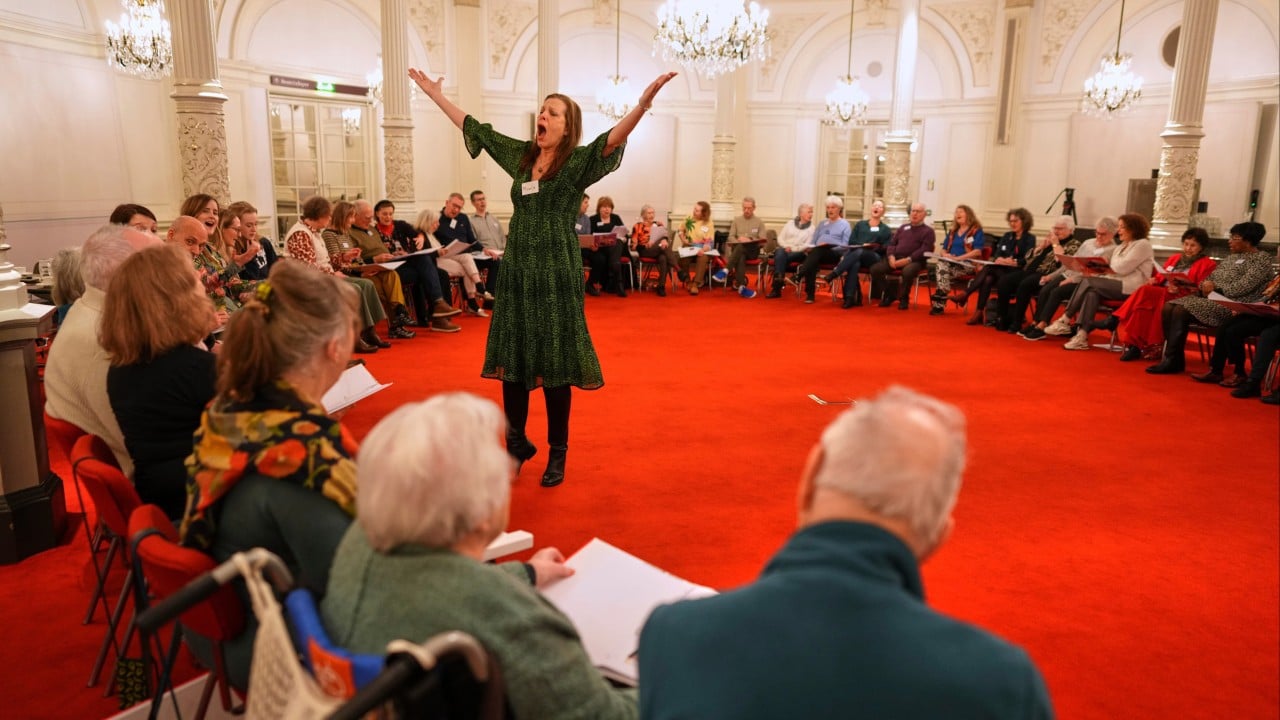
Amsterdam is currently patting itself on the back because a few retirees are humming "Aan de Amsterdamse grachten" in a community hall. The narrative is predictably syrupy: music is a "key" that unlocks the prison of dementia, providing a "connection" that medicine cannot reach. It’s a lovely sentiment. It’s also a massive oversimplification that ignores the brutal mechanics of neurodegeneration in favor of a feel-good photo op.
We need to stop pretending that choral therapy is a functional intervention. It is a recreational activity. Confusing the two isn't just a semantic error; it’s a policy failure that diverts resources from structural support and genuine cognitive research into the equivalent of a neurological spa day. For a different view, consider: this related article.
The Procedural Memory Trap
The reason dementia patients can still sing isn’t because music is "magical" or "divine." It’s because the human brain is compartmentalized.
Music resides in the basal ganglia and the cerebellum. These are the ancient, deep-seated regions of the brain responsible for procedural memory—the same "muscle memory" that helps you ride a bike or brush your teeth without thinking. Alzheimer’s and other forms of dementia typically attack the hippocampus and the prefrontal cortex first. These are the areas responsible for episodic memory (where you left your keys) and executive function (how to plan a meal). Similar insight on the subject has been published by WebMD.
When a patient with late-stage dementia joins a singing circle and hits every note of a song they learned in 1956, they aren't "recovering" their personality. They are executing a pre-programmed motor sequence. To the observer, it looks like the person is "back." To the neurologist, it’s a hardware-level playback of a file that was saved forty years ago.
I’ve seen families break down in tears when a non-verbal relative starts singing. I don’t blame them. But let’s be honest: that person still doesn’t know their daughter’s name. They still can’t navigate their own home. They are simply surfing a neural wave that hasn't eroded yet. By framing this as a "benefit" rather than a "byproduct," we give families a false sense of progress that makes the inevitable crash even more devastating.
The Efficiency Problem: Why Singing Circles Scale Poorly
Singing circles in Amsterdam, London, or New York are touted as "low-cost, high-impact" solutions. They are the favorite child of municipal budgets because they are cheap. You need a room, a volunteer with a guitar, and some sheet music.
This is the Lazy Consensus in action.
If we actually cared about the quality of life for dementia patients, we would be funding one-on-one specialized care, high-protein nutritional programs, and aggressive environmental modifications. Instead, we give them a sing-along. It’s the "pizza party" of the medical world. It’s what you do when you don’t want to pay for a raise or a better healthcare system.
- The Social Fatigue Factor: Many dementia patients suffer from sensory overload. A room full of twenty people singing at different pitches is a recipe for agitation, not peace.
- The "Childish" Trap: We infantilize the elderly. We wouldn't expect a 40-year-old with a traumatic brain injury to find "fulfillment" in a campfire sing-along, yet we act like it’s the pinnacle of care for an 80-year-old.
- The Localization Lie: The Amsterdam model is lauded for its "community" aspect. In reality, it’s often a way for caregivers to get an hour of respite while the patient is parked in a circle. Call it what it is: a daycare service.
Music is a Stimulant, Not a Solution
We treat music like it’s a curative agent. In reality, it’s a stimulant. It’s caffeine for the limbic system.
Neuroscientist Dr. Oliver Sacks famously documented the profound effects of music on the brain in Musicophilia. He noted that music can "reanimate" a person. But Sacks was also careful to note that this effect is fleeting. The music ends, the stimulation fades, and the patient returns to their baseline.
Imagine a scenario where a city invests €500,000 into singing circles across the Randstad. They claim a "15% increase in patient happiness." How is that measured? A questionnaire given to the caregivers who feel less guilty? A temporary spike in dopamine levels that dissipates before the patient even gets back into the transport van?
We are measuring the wrong things because the right things are too expensive to fix. We should be measuring:
- Reduced medication for agitation.
- Increased caloric intake.
- Stability of circadian rhythms.
If singing circles don't move those needles—and the data on long-term outcomes is notoriously thin—then we are just performing theater for the benefit of the healthy.
The Economics of Feel-Good Healthcare
I’ve watched municipal boards greenlight these "soft" programs while cutting funding for geriatric nurses and home-care visits. It’s a classic bait-and-switch.
By promoting the "benefit" of these circles, we shift the burden of care from professional medical infrastructure to "community volunteers." It sounds noble. It’s actually a divestment.
The Dutch healthcare model is often praised for its "human-centric" approach, but "human-centric" shouldn't mean "cheap and cheerful." True dignity for a dementia patient isn't found in a chorus line; it’s found in a quiet, safe environment where they aren't forced to perform for the satisfaction of the people watching them.
Stop Asking "Does it Make Them Happy?"
The most annoying question in geriatric care is "But doesn't it make them happy?"
Happiness is a high bar for someone who doesn't know where they are. We should be aiming for comfort, safety, and agency. Singing circles provide none of those. They provide a brief, noisy distraction.
If you want to actually help someone with dementia, stop trying to drag them back into "our" world through song. Enter their world. If they want to sit in silence, let them. If they want to pace, let them. Don't force them into a circle and expect them to perform the hits of 1960 so you can feel like you’ve "done something."
The Dark Side of Musical Triggers
Music is a double-edged sword. While it can trigger "happy" memories, it can just as easily trigger trauma.
A song that reminds a patient of a deceased spouse or a lost child can lead to catastrophic reactions—episodes of intense distress that the patient cannot explain because they no longer have the verbal tools to do so. A "singing circle" is a blunt instrument. It’s an indiscriminate blast of nostalgia in a population that is emotionally fragile.
We wouldn't prescribe a drug with that many side effects without a rigorous screening process. Yet we treat a room full of music as a universal "good."
The Better Way (That Nobody Wants to Pay For)
If you actually want to use music effectively, it has to be individualized.
One person, one set of headphones, and a playlist curated by someone who actually knows their history. This is clinical. This is targeted. This respects the individual's autonomy.
But individualized care doesn't make for a good newspaper headline. It doesn't look like a "movement." It looks like a nurse sitting quietly in a room, watching a patient breathe. It’s boring. It’s expensive. And it’s the only thing that actually matters.
The Actionable Alternative
If you are a caregiver or a policy maker, stop chasing the "group" high.
- Prioritize environment over activity: Use the budget for "singing circles" to install better lighting and soundproofing in care facilities. Noise is a major trigger for dementia-related aggression.
- Invest in physical therapy: Mobility is a better predictor of longevity and quality of life than "socialization" in a group setting.
- Reject the "Success" Stories: When a viral video shows a dementia patient playing the piano, remember that you are seeing a glitch in the decay, not a reversal of the disease.
Stop funding the theater of care. Start funding the reality of it.
If you want me to break down the actual cost-benefit ratio of individualized music therapy versus group circles, I can pull the data from the 2024 Lancet reports on dementia prevention and intervention.