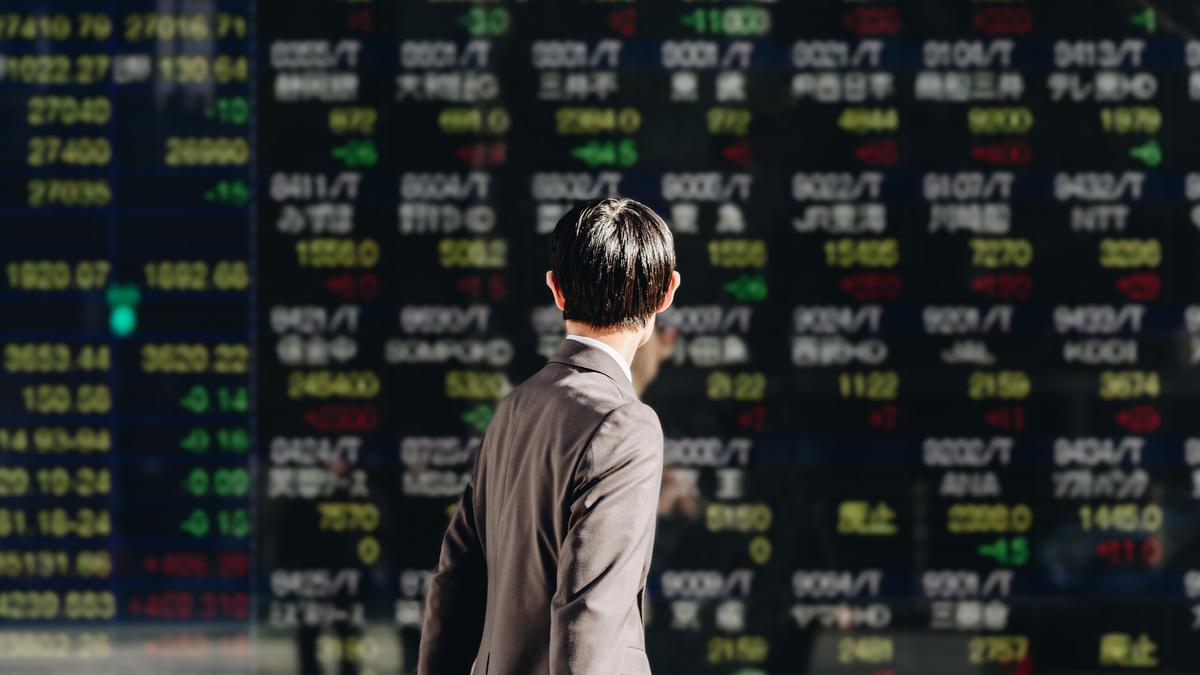
The sun hadn’t even touched the glass towers of Hong Kong when the screens began to bleed red.
It starts with a flicker. A notification on a trader’s phone in a darkened bedroom. A frantic whisper across a trading floor in Tokyo. Then, the math takes over. When oil prices leap 30% in a single session, the world doesn’t just get more expensive. It slows down. It gasps.
The headlines will tell you about "volatility" and "market corrections." They will use sterilized language to describe a West Asia crisis that feels thousands of miles away from an office in Singapore or a factory in Seoul. But for the person behind the desk, the reality isn't a percentage. It is the sudden, chilling realization that the cost of moving everything—from a liter of milk to a microchip—just rewrote the rules of survival.
The Invisible Pipeline
Consider a hypothetical courier named Kenji in Osaka. He doesn’t own stocks. He doesn’t follow geopolitical skirmishes in the desert. But when Brent crude surges toward the stratosphere, Kenji’s motorbike becomes a liability. His thin margins evaporate before he even turns the ignition.
This is how a crisis travels. It isn't just a graph on a Bloomberg terminal; it is a thermal wave moving through the global nervous system.
Asia is the world's factory floor, and that floor runs on energy. Most of it is imported. When the price of that energy spikes by nearly a third overnight, every contract signed yesterday becomes a loss-maker today. The "Asian equities plunge" isn't some abstract tantrum by wealthy investors. It is the sound of thousands of companies like Kenji’s realizing they are breathing thinner air.
The connection is mechanical. Crude oil isn't just fuel; it’s the ghost in the machine of the global economy. It’s in the plastic of your keyboard, the synthetic fibers of your shirt, and the fertilizer that grew your lunch. When the source of that ghost becomes contested—when tankers are diverted and pipelines are threatened—the ghost turns into a poltergeist.
The Red Screen Effect
In the trading pits of Sydney and Seoul, the atmosphere shifted from caffeinated optimism to a heavy, damp dread. The Nikkei dropped. The Hang Seng buckled.
Why? Because markets are nothing more than a collection of human expectations about the future. Right now, those expectations are shrouded in smoke.
Investors hate a vacuum. When they don't know if a regional conflict will last three days or three years, they pull their hands back from the fire. They sell. They seek the "safe havens"—gold, the US dollar, things you can hold in a shaking hand. This flight to safety leaves the Asian markets hollowed out.
The numbers are staggering. A 30% rise in oil is the kind of shock that creates a recessionary feedback loop. High energy prices act as an invisible tax on every human being on the planet. It pulls money out of pockets that would have spent it on clothes, or electronics, or travel.
The Arithmetic of Fear
To understand the scale, we have to look at the mechanics of the barrel.
$$P_{new} = P_{old} \times (1 + \Delta%)$$
If $P_{old}$ is $70 and $\Delta%$ is 30, the new price hits $91. That $21 difference per barrel doesn't just vanish. It is extracted from the global economy. Multiply that by the nearly 100 million barrels the world consumes every day, and you are looking at billions of dollars in "lost" wealth every 24 hours.
That money is being transferred from the pockets of consumers and the balance sheets of tech companies directly into the furnace of geopolitical risk.
Panic is a contagion. It starts in the energy sector, but it quickly infects airlines—who see their fuel hedges incinerated—and then manufacturing, and finally, the banks. The banks are the most sensitive. They hold the debt of the companies now struggling to pay for their power bills. When the foundations tremble, the penthouse feels it first.
The Human Cost of a Decimal Point
We often treat the economy as a weather pattern, something that just happens to us. But the "West Asia crisis" is a story of choices and their echoes.
Imagine a factory manager in Vietnam. She has three hundred employees. Her margins are measured in pennies. She just received a memo that shipping costs for her raw materials have doubled because of the fuel surcharges and the "war risk" insurance premiums now attached to every vessel in the Indian Ocean.
She has two choices: raise prices and risk losing her customers in Europe, or cut costs. Cutting costs usually means people.
This is the "human-centric" reality of a 30% oil spike. It’s not just a red line on a chart. It’s a series of impossible conversations in small offices. It’s a father deciding he can’t afford the commute this week. It’s the quiet, creeping anxiety that the world is becoming more expensive than we can afford to inhabit.
The Fragile Web
The modern world is built on the assumption of "just-in-time" efficiency. We assumed the oil would always flow, the ships would always dock, and the prices would stay within a predictable band.
We were wrong.
We are living through a reminder that our entire civilization is draped over a very fragile skeleton of supply lines. When one joint in that skeleton—the West Asia corridor—is struck, the whole body winces. Asian equities are simply the first part of the body to show the bruise. They are the canary in the coal mine, or perhaps more accurately, the sensor in the oil tank.
There is a specific kind of silence that falls over a city when people realize the price of life has just gone up. You can hear it in the reduced traffic, see it in the shorter queues at luxury shops, and feel it in the way people talk about the future. It’s a shift from "When will I buy?" to "Will I have enough?"
The markets will eventually find a floor. They always do. But the floor is often built on the remains of smaller players who couldn't survive the drop. The 30% jump is a mountain for some, but for others, it is a cliff.
As the sun sets over the Pacific, the red screens continue to glow. The traders have gone home, but the oil is still out there, bobbing on a dark sea, its value dictated by the whims of history and the geography of anger. The world is a much smaller place than we like to admit, and tonight, everyone is paying the price for a distance they thought was safely far away.
The lights in the towers remain on, for now, but the meter is running faster than anyone expected.