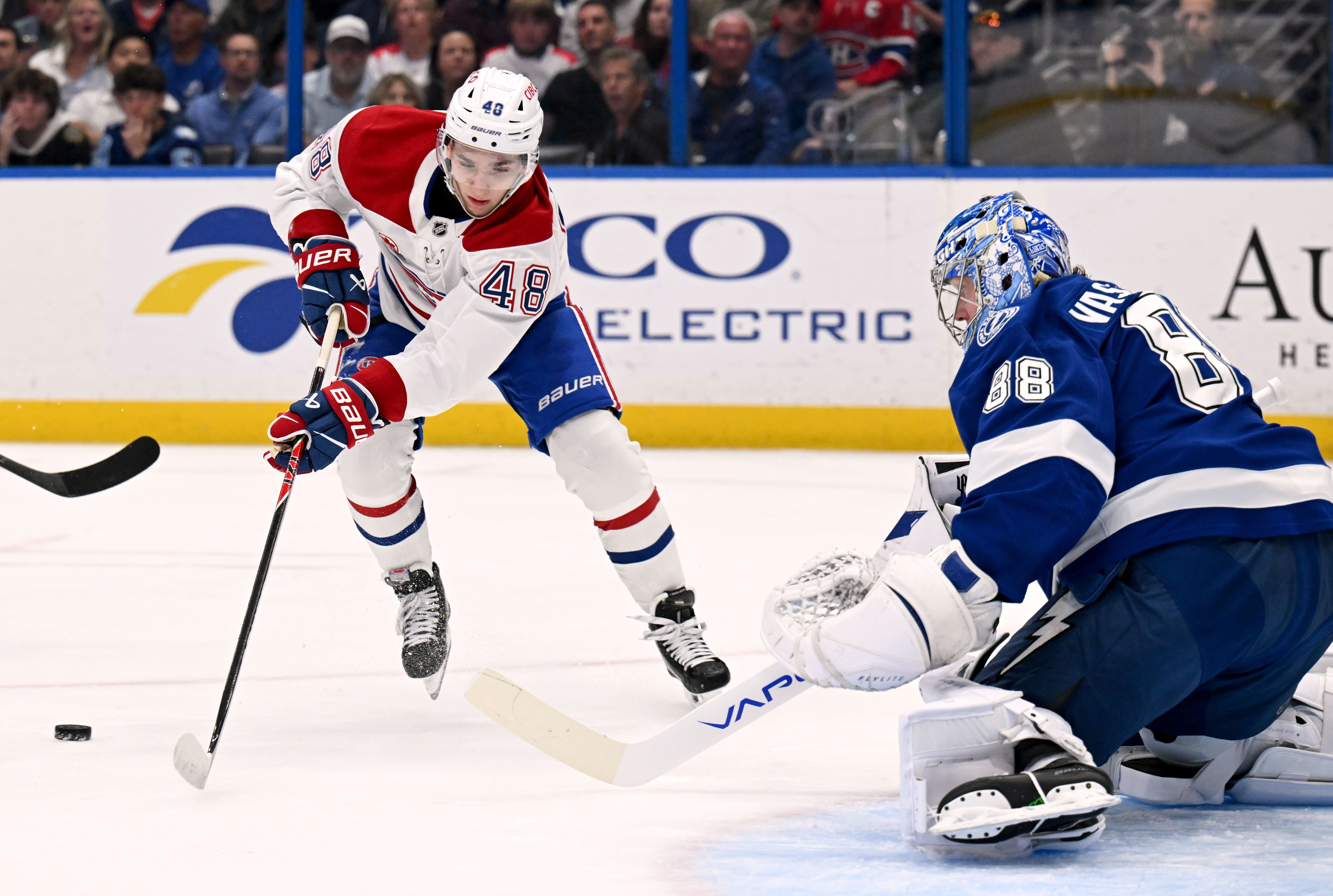
The scoreboard at the Bell Centre read 4-1, but the numbers alone failed to capture the tactical autopsy performed on the Tampa Bay Lightning. While casual observers might label the Montreal Canadiens' victory a "shock" or a "fiery" fluke, a closer look at the ice reveals a deliberate, systematic breakdown of a modern NHL dynasty. Montreal didn't just outwork Tampa; they out-thought them. By neutralizing the Lightning’s transition game and exploiting a specific structural weakness in their defensive rotation, the Canadiens provided a league-wide masterclass on how to topple a giant.
The Myth of the Underdog Surge
Every time a rebuilding team beats a contender, the narrative machine grinds out stories about "heart" and "grit." While Montreal certainly played with an edge, the win was built on a foundation of neutral zone discipline that rendered Tampa’s speed irrelevant. The Lightning thrive on north-south flow. They want to stretch the ice, using their defensemen to trigger quick breakouts that find elite wings in stride.
Montreal’s coaching staff countered this by implementing a staggered 1-2-2 neutral zone trap that specifically targeted the Lightning’s favorite exit lanes. Instead of chasing the puck behind the net, Montreal’s lead forechecker forced the play toward the boards, where the second layer of the trap waited to swallow up cross-ice passes. Tampa Bay spent the first forty minutes hitting a wall at center ice, resulting in a series of frustrated dump-ins that Montreal’s mobile defensive core retrieved with ease.
Neutralizing the Kucherov Factor
Nikita Kucherov operates in the shadows of the offensive zone, finding pockets of space that other players don't even see. Stopping him requires more than just a dedicated shadow; it requires a defensive rotation that denies him the "half-wall" setup. In this matchup, the Canadiens utilized a high-pressure box-plus-one on the penalty kill and during even-strength sustained pressure.
By keeping a defender within a stick-length of Kucherov’s favorite passing lanes, Montreal forced the play into the hands of Tampa’s secondary scoring options. The gamble was clear: let the Lightning’s bottom-six try to beat you from the perimeter rather than allowing the superstars to slice through the middle. It worked. Tampa’s high-danger scoring chances were at a seasonal low, restricted largely to desperate shots from the point that had no chance of beating a focused goaltender.
The Physical Toll of the New Montreal Identity
There is a specific kind of violence in the way this Montreal roster is being constructed. It isn't the old-school brawling of the seventies, but a relentless, heavy-forecheck style that punishes defensemen every time they turn to retrieve a puck. By the middle of the second period, the Tampa Bay blue line looked exhausted. Victor Hedman, usually the pinnacle of poise, began coughing up the puck under the duress of Montreal’s rookie speedsters.
This physical pressure creates a psychological fatigue. When a defenseman knows he is going to get hit every single time he touches the puck, his internal clock speeds up. He begins to make "safe" plays—chipping the puck out of the zone instead of making a controlled pass. Montreal feasted on these panicked clears, instantly re-entering the zone and keeping the Lightning trapped in their own end for agonizingly long shifts.
Exploiting the Fatigue of a Dynasty
The Lightning are a team with a massive amount of "hockey miles" on their tires. Years of deep playoff runs and short off-seasons eventually catch up to even the most professional athletes. Montreal, by contrast, is a team composed of young lungs and fresh legs. The speed differential in the third period was glaring. While Tampa Bay’s veterans were lunging and reaching, Montreal’s youth movement was skating through them.
Tactical Execution Over Emotional Highs
Montreal’s power play, often a point of contention among the fan base, showed a level of sophistication that caught the Lightning's penalty killers off guard. Instead of the static "umbrella" formation that has become predictable, the Canadiens used constant interchanging between the point and the circles. This movement forced the Tampa Bay box to expand and contract, eventually creating a seam for a backdoor play that effectively iced the game.
The beauty of this victory lay in its repeatability. This wasn't a game won on lucky bounces or a hot goalie stealing thirty-five saves. This was a game won by a team that identified a specific weakness—Tampa's inability to handle sustained, high-speed physical pressure on their breakout—and hammered it for sixty minutes straight.
The Reality of the Canadiens Rebuild
Critics will point to the standings and suggest this win is a mere blip in a long season. They are missing the forest for the trees. The significance of this victory isn't the two points in the standings; it is the proof of concept for the front office’s vision. They are building a team that doesn't just survive against elite competition but dictates the terms of the engagement.
To beat the Lightning, you have to take away their time. You have to make the game small, ugly, and physically taxing. Montreal did that with a roster that is still technically "learning how to win." If this is what they look like during the learning phase, the rest of the Atlantic Division should be taking very detailed notes.
The Lightning left the Bell Centre with more than just a loss. They left with a blueprint of their own mortality. For Montreal, the message was even clearer: the gap between the middle of the pack and the top of the mountain is closing much faster than the experts predicted.
Every player in that locker room now has a manual on how to dismantle a champion. The task now is to see if they can execute that manual when the lights are brighter and the stakes are higher. Consistency is the final hurdle for any young team, but for one night in Montreal, the "shock" was actually a very calculated execution.
Stop looking for the fluke and start looking at the tape.