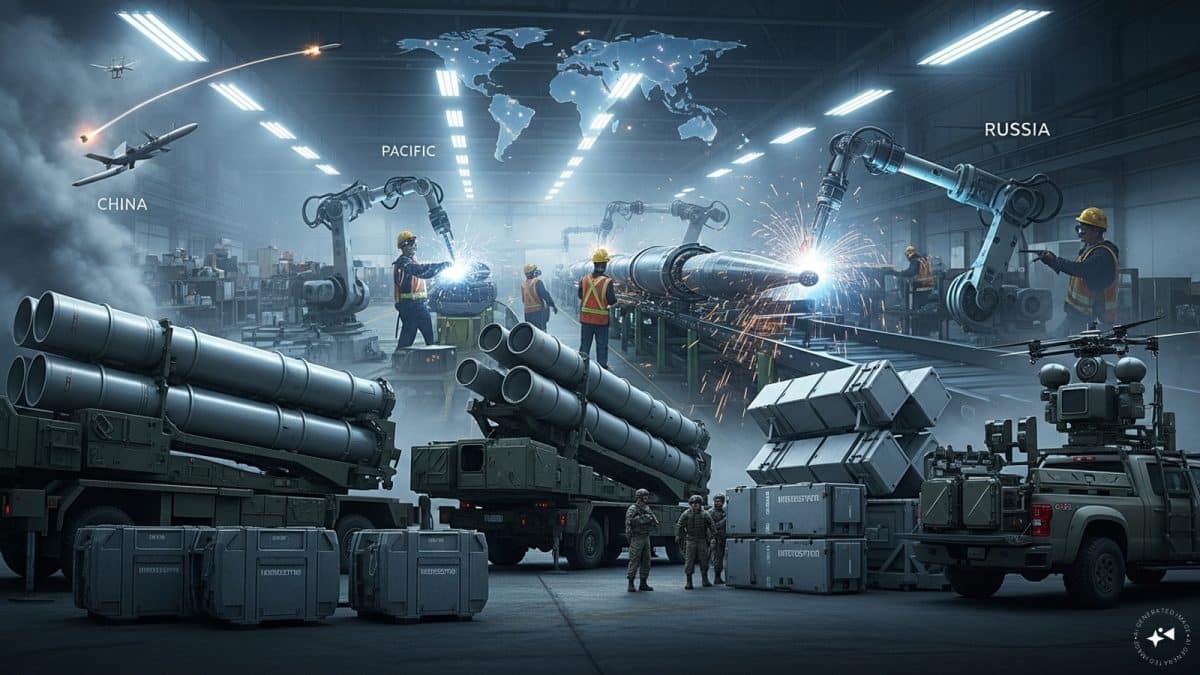
The Stockpile Panic is a Sales Pitch
The headlines are screaming about empty warehouses. Pundits point to the Red Sea and the Levant, claiming the United States is "running out" of interceptors. They want you to believe that every SM-6 or Patriot missile fired at a low-cost drone is a step toward national vulnerability.
They are wrong. For an alternative view, check out: this related article.
The narrative of "depleted stockpiles" is the greatest marketing achievement of the defense industrial base in a decade. It ignores the fundamental reality of modern attrition: we aren't running out of weapons; we are finally clearing out the inventory of the last century to justify the astronomical budgets of the next one.
When analysts moan about the "strain" on missile defense, they are using a spreadsheet-level analysis for a chess-level problem. They look at the unit cost of a $2 million interceptor versus a $20,000 suicide drone and call it a loss. That is a freshman-year accounting error. In the real world, you don't trade the cost of the missile against the cost of the drone; you trade the cost of the missile against the $2 billion destroyer or the $500 million port facility it is protecting. Related coverage regarding this has been published by NPR.
The False Equivalence of Unit Cost
The "cost-imposition" argument is the favorite toy of the contrarian-lite crowd. They love to say that Iran or its proxies are winning because they force the U.S. to "waste" expensive interceptors.
This is a fundamental misunderstanding of American hegemony. The United States does not win wars by being frugal. It wins by being the most expensive entity in the room.
We have seen this play out before. During the Cold War, the "missile gap" was the phantom used to drive procurement. Today, it’s the "attrition gap." But let’s look at the mechanics of what is actually happening in the current theater.
- The Logistics of Obsolescence: Many of the interceptors being fired are older variants nearing the end of their shelf life. Maintaining 20-year-old solid rocket motors is a nightmare of chemical stability and safety inspections. Every time a "legacy" missile is fired, the taxpayer is actually saved the future cost of hazardous waste disposal.
- The Live-Fire Data Harvest: You cannot buy the data we are currently gathering. Simulation is a lie. Testing at White Sands is a controlled environment. Firing an SM-2 at a real-world threat in a congested electromagnetic environment provides telemetry that is worth more than the physical hardware.
- The Production Myth: Critics argue that U.S. production lines are too slow to replace what is spent. This assumes we want to replace exactly what was spent. We don’t. We want to replace it with the next iteration. The "strain" provides the political cover to sign multi-year procurement contracts that the Pentagon has been begging for since the 1990s.
The Irony of "Limited" Capacity
If the U.S. were truly concerned about stockpile exhaustion, it would change its Rules of Engagement (ROE). We are using high-end interceptors because we have the luxury of choice.
I’ve seen how these procurement cycles work. When the military claims it is "strained," it is usually a signal to Congress to bypass the standard, glacial acquisition process. It’s an "Urgent Operational Need" (UON) masquerading as a crisis.
The real bottleneck isn't a lack of missiles. It’s a lack of imagination in how we deploy them. We are currently watching the death throes of "exquisite" defense—the idea that you need a perfect, million-dollar solution for every ten-cent problem. The smart money isn't on building more $2 million missiles; it's on the rapid hybridization of directed energy and electronic warfare that this current "crisis" is accelerating.
The PAC-3 Fallacy
Let’s talk about the Patriot system, specifically the PAC-3 MSE. It is the gold standard of point defense. The media treats its deployment as a desperate measure.
In reality, the PAC-3 is a victim of its own success. It is so effective that it has become the "security blanket" for every regional ally. The "concern" over its stockpile isn't a military failure; it's a diplomatic triumph. We have created a global demand for American defense exports that ensures our production lines will be subsidized by foreign military sales for the next thirty years.
The "stockpile crisis" is actually a massive regional beta test for the Integrated Battle Command System (IBCS). We are learning how to link sensors from Aegis ships, shore batteries, and aircraft into a single "glass floor" of situational awareness. You can't do that in a vacuum. You need the stress of high-volume incoming fire to find the bugs in the code.
The Dangerous Truth: We Want the Strain
Why would the U.S. allow the narrative of "strained" defenses to persist?
Because a comfortable military doesn't get funded.
A military "in crisis" gets a blank check. By emphasizing the strain caused by Iranian-backed threats, the Department of Defense is successfully pivoting from the "War on Terror" footing—which was a drain on specialized hardware—to a "Great Power Competition" footing.
They are using the current conflict to:
- Stress-test the "Arleigh Burke" class destroyers to their absolute limits.
- Force the rapid integration of AI-driven target prioritization.
- Prove to the Pacific that American systems can handle high-saturation attacks.
If you think the U.S. is worried about the Houthis or Iranian drone swarms, you aren't paying attention to the real target: the South China Sea. The current theater is a laboratory. The "expended" missiles are the tuition fees.
The Strategy of Intentional Depletion
Imagine a scenario where the U.S. sat on its stockpiles, refusing to fire for fear of "exhaustion." The result would be a loss of regional influence and the destruction of high-value assets.
Instead, we are choosing "Intentional Depletion." We are purging the middle-tier inventory to force an evolution toward:
- Kinetic Interceptors with Lower Unit Cost: Systems like the Coyote or the Roadrunner.
- Hard-Kill Directed Energy: Moving the cost-per-shot from $2 million to $20.
- Distributed Lethality: Moving away from a few massive "missile magnets" to a thousand smaller, expendable nodes.
The "concerns" you read about in mainstream rags are based on the assumption that the goal is to maintain the status quo. The status quo is a loser’s game. The goal is to break the current model of missile defense so it can be rebuilt for a drone-saturated world.
Stop Asking if We Have Enough
The question "Does the U.S. have enough missiles?" is a distraction. It's the wrong metric for the wrong century.
The question we should be asking is: "How quickly can we make these expensive missiles irrelevant?"
The "strain" on our current systems is the necessary friction required to move the gears of the military-industrial complex toward directed energy and autonomous counter-UAS platforms. If we weren't "running out" of interceptors, we would continue to over-invest in 1980s technology for the next fifty years.
Every missile fired in the Red Sea is a nail in the coffin of the old way of doing business. The "crisis" isn't that we are losing a war of attrition; it’s that the transition to the next era of warfare is happening faster than the bureaucrats can track.
The stockpiles are thin because the old world is ending.
Stop mourning the inventory. Start watching the replacements.