The ground in the Middle East just shifted. If you have family in Israel, Iran, or anywhere in the Gulf, you're likely staring at your phone waiting for a message that says "I'm safe." This isn't just another flare-up. With the recent joint US-Israeli strikes on Iran—dubbed Operation Epic Fury—and Tehran's heavy retaliatory missile barrages reaching as far as Dubai and Abu Dhabi, the safety of nearly 10 million Indians is suddenly up in the air.
Honestly, the situation is messy. India’s Ministry of External Affairs (MEA) isn't just "monitoring" anymore; they're in full crisis mode. Here’s what’s actually happening and what you need to do if you’re caught in the crossfire.
The MEA advisory you cannot ignore
The MEA just dropped an urgent travel advisory that basically tells Indians to stay exactly where they are—provided that place has a roof and a reinforced basement. The core message is simple: stop traveling. If you were planning a trip to Tel Aviv or Tehran this week, cancel it.
The government has activated 24/7 control rooms because the conflict has leaked out of the Iran-Israel border. Missiles have hit residential areas in Beit Shemesh and commercial hubs in the UAE and Qatar. The MEA’s stance is a mix of "stay vigilant" and "keep your bags packed but don't move yet."
Unlike previous skirmishes, the MEA is being very specific. They aren't just worried about the 30,000+ Indians in Israel or the 10,000 in Iran. They're worried about the 9 million Indians across the GCC (Gulf Cooperation Council) countries. When missiles start landing near Dubai International Airport, the game changes for everyone.
Breaking down the numbers and the risk
It's easy to get lost in the headlines, but let's look at who's actually on the ground. You've got two very different groups of Indians facing two very different types of danger.
The Indian workforce in Israel
Since the Gaza war started in late 2023, the number of Indian workers in Israel has actually surged. We're talking about roughly 30,000 to 40,000 people. Many are caregivers who've been there for years, but a huge chunk are construction workers who recently arrived to fill the labor gap.
These folks are often in urban centers like Tel Aviv or Haifa. While Israel’s Iron Dome is legendary, it’s not invincible. The recent strikes on March 1st showed that saturation attacks can and do get through. If you're an Indian worker there, you're likely spending a lot of time in mamads (fortified rooms).
The community in Iran
The situation in Iran is smaller but arguably more isolated. About 10,000 Indians live there. We're talking about students, traders, and small-scale workers. With Israel and the US targeting sites in Tehran and Isfahan, these Indians are right in the bullseye of "Operation Epic Fury."
Communication in Iran is notoriously difficult when things get hot. The MEA has been pushing for Indians to register with the embassy in Tehran immediately because if a mass evacuation—like Operation Sindhu in 2025—happens again, you don't want to be the one the embassy doesn't know exists.
Flights are grounded and airspaces are closed
Don't bother checking your flight status if you're flying through the Middle East. It's a mess. Air India has already extended its suspension of all flights to Israel, Iran, the UAE, Qatar, and Saudi Arabia.
Basically, the "Tehran Flight Information Region" is a no-go zone.
- Air India is rerouting US and Europe-bound flights through alternative airspaces.
- Flights to New York (JFK) are now making "technical stops" in Rome.
- Flying times are increasing by 2 to 4 hours depending on the route.
If you're currently in Israel or the UAE, you aren't getting out on a commercial flight today. The skies are literally filled with drones and missiles, not Boeings.
Practical steps you need to take right now
If you're an Indian national in the region, stop reading the "doom scrolls" on X (formerly Twitter) and do these three things.
- Register with the Mission: This isn't optional anymore. Use the links on the MEA website or the embassy's social media. If the Indian government needs to send a ship or a plane, they use these lists to prioritize who gets a seat.
- Stockpile the basics: We're talking 72 hours of water, non-perishable food, and your medications. Don't wait for the local grocery store to run out.
- Know your shelter: In Israel, know where the nearest public shelter is if you don't have a mamad. In the Gulf or Iran, stay away from military installations and government buildings. Those are the primary targets.
Emergency Contact List (Keep these saved)
- Israel (Tel Aviv): +972-54-7520711, +972-54-2428378
- Iran (Tehran): +98-9128109115, +98-9128109109
- UAE (Abu Dhabi): 800-46342 (Toll-free)
- Saudi Arabia (Riyadh): 800-247-1234
- MEA Delhi Control Room: +91-11-23012113
Why an evacuation is harder this time
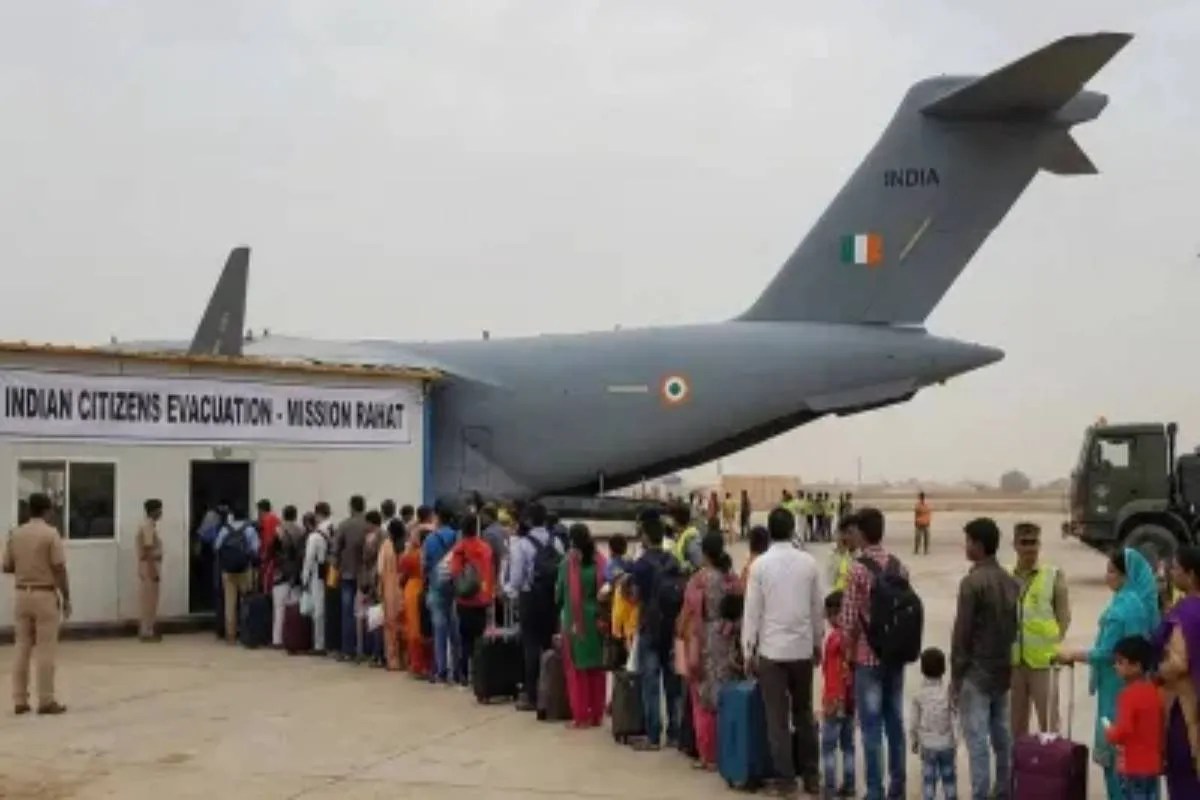
In the past, India has been the king of evacuations. Think back to Kuwait in 1990 or the Vande Bharat mission. But this is different. The sheer scale of the Indian population in the Middle East—9 million people—makes a total evacuation impossible.
The MEA is currently working on "contingency plans," which is diplomatic speak for "we're hoping it doesn't get worse." EAM S. Jaishankar has been on the phone with his counterparts in Qatar, UAE, and Iran to ensure the safety of Indian workers. The reality? India's strategy right now is protection in place rather than extraction. The Strait of Hormuz is under threat of closure. If that happens, shipping lanes die. This would spike oil prices in India and make sea-based evacuations incredibly risky.
Stay off the streets. Keep your phone charged. If the sirens go off, don't try to film it for Instagram—get to cover. The situation is evolving by the hour, and the MEA will likely issue more restrictive advisories if the "Epic Fury" strikes continue into the week. Make sure you're following the verified embassy accounts on Telegram or X to get the real-time updates.
Check your passport validity and keep all your documents in a waterproof bag near your emergency kit. You don't want to be scrambling for a birth certificate when the call to move finally comes.


